But possessing the legal authority to act is not the same thing as possessing the authority to act in any manner the government chooses.
One of the fundamental restraints on government power in the American legal system is due process of law.
The Fifth Amendment provides that the federal government may not deprive a person of “life, liberty, or property, without due process of law.” The Fourteenth Amendment imposes a similar limitation on state governments.
Those few words embody an important principle: when government action threatens certain protected interests, fairness may require more than simply reaching a legally permissible result. The government may also have to use a fair method for reaching that result.
That distinction matters.
A government agency may ultimately have authority to revoke a license. A school may have grounds to impose discipline. A court may have authority to enter a judgment. An agency may be entitled to terminate a benefit.
Yet a legitimate outcome can still be undermined by an unfair process.
Due process asks an essential question:
Before the government acts against a person, what opportunity must that person have to know what is happening and to respond?
Due Process Is a Restraint on Government Power
Due process is sometimes described simply as the right to a hearing. That captures part of the concept, but not all of it.
At its core, due process is a constitutional limitation on governmental power.
The government cannot ordinarily deprive someone of a protected life, liberty, or property interest merely because an official has decided that doing so would be appropriate. Depending on the circumstances, the Constitution may require procedures designed to reduce the possibility of arbitrary or erroneous government action.
Those protections can take different forms.
They may include notice of the proposed action, disclosure of the reasons for it, an opportunity to respond, consideration of evidence, and a decision by someone who is sufficiently neutral.
Exactly what process is required depends heavily on the situation.
A minor administrative decision does not necessarily require the same procedures as a criminal prosecution. An emergency may justify government action before a full hearing can occur. Some disputes require extensive evidentiary proceedings, while others may be resolved through written submissions.
Due process is therefore not a single procedure applied identically to every case.
It is a principle of constitutional fairness whose requirements depend on what the government is doing, what interests are at stake, and the risk that an incorrect decision will be made.
Procedural Due Process: How the Government Makes the Decision
The branch of due process most directly concerned with the fairness of governmental decision-making is known as procedural due process.
Procedural due process focuses primarily on the method used before a person is deprived of a protected interest.
The classic elements are straightforward:
notice and an opportunity to be heard.
Those protections serve different but complementary purposes.
Notice tells the affected person what the government proposes to do and, where appropriate, why.
The opportunity to be heard gives that person a meaningful chance to respond.
Without notice, a hearing may be useless because the person does not know the case that must be answered.
Without an opportunity to respond, notice becomes little more than an announcement that a decision has already been made.
Together, the two principles help transform governmental decision-making from unilateral action into a process in which the affected person can participate.
Notice Must Be Meaningful
Fair procedure generally begins with notice.
Imagine receiving a letter stating that an important government benefit has been terminated, effective immediately, without identifying the reason. Or imagine discovering that a proceeding affecting your property occurred weeks earlier and that you never knew it had been scheduled.
Even if the government possessed legitimate grounds for acting, the absence of meaningful notice creates an obvious fairness problem.
A person cannot effectively defend an interest without knowing that the interest is in jeopardy.
Meaningful notice ordinarily must provide enough information, in an appropriate manner and at an appropriate time, to allow the affected person to respond.
The precise requirements vary according to the proceeding. But the underlying principle is remarkably consistent:
People should ordinarily have a reasonable opportunity to understand the governmental action they face before they are expected to challenge it.
Notice is therefore more than a technical formality.
It is what makes participation possible.
The Opportunity to Be Heard Must Also Be Real
Due process does not necessarily guarantee a courtroom trial every time the government makes a decision affecting someone.
What it generally requires, when applicable, is a meaningful opportunity to be heard.
That opportunity can take many forms.
In one setting, it may involve a formal hearing with testimony and witnesses. In another, written objections may be sufficient. Some proceedings permit attorneys, cross-examination, or presentation of documentary evidence. Others are intentionally less formal.
The constitutional question is not simply whether something called a “hearing” occurred.
The more important question is whether the procedure gave the affected person a meaningful opportunity to address the issues relevant to the government's decision.
A hearing held after the decision has become practically irreversible may provide considerably less protection than one held beforehand. A proceeding in which a person is technically permitted to speak but cannot learn the basis for the proposed action may also provide little meaningful protection.
Due process is concerned with substance as well as labels.
A procedure should provide a genuine opportunity to influence the decision—not merely the appearance of participation.
Timing Can Matter
An important due process question is when the opportunity to be heard must occur.
In many circumstances, the strongest protection comes from allowing a person to respond before the government takes the threatened action.
That is because some injuries are difficult to undo.
Losing an essential benefit, a professional license, possession of property, or personal liberty can have immediate consequences even if the decision is eventually reversed.
But a pre-deprivation hearing is not always possible or constitutionally required.
Emergencies illustrate why.
Government sometimes must act quickly to protect public safety, preserve evidence, address immediate hazards, or respond to rapidly developing circumstances. In those situations, the law may permit action first and require an opportunity for review afterward.
The timing of due process therefore reflects a balance.
The legal system considers the private interest affected, the danger of an erroneous decision under the procedures being used, the value of additional safeguards, and the government's interests—including the practical burdens of requiring additional procedures.
The result is a flexible doctrine rather than a universal requirement that every government action be preceded by a full hearing.
Neutral Decision-Makers Matter
The right to present an argument means considerably less if the person deciding the matter has already determined the outcome or has an improper personal interest in the decision.
For that reason, impartiality is another important component of fair procedure.
Decision-makers are expected to approach matters without disqualifying bias or improper conflicts of interest.
That does not mean a judge or administrative official must know nothing about a case before making a decision. Nor does every unfavorable statement or prior ruling establish unconstitutional bias.
Government decision-making often requires officials to become familiar with facts, make preliminary determinations, and reconsider issues as proceedings develop.
The deeper concern is whether the structure of the process provides a sufficiently neutral decision-maker rather than one whose personal interests or impermissible prejudgment make meaningful consideration unlikely.
The principle is simple:
The opportunity to be heard should include the opportunity to be heard by someone capable of fairly considering what is said.
Evidence Helps Protect Against Mistakes
Government decisions are made by people, and people can make mistakes.
Records may be incomplete. Names may be confused. Witnesses may be wrong. Computer systems may contain errors. Investigators may misunderstand events. Relevant documents may have been overlooked.
Procedure creates opportunities to identify those mistakes before they become government action.
When an affected person can examine allegations, submit records, challenge incorrect information, explain circumstances, or present competing evidence, the decision-maker receives information that might otherwise never have been considered.
This does not guarantee that the individual will prevail.
It does something different: it improves the process through which the government determines whether the individual should prevail.
That is one reason due process serves the interests of government as well as the individual.
A system that permits meaningful participation is more capable of correcting errors before they become final decisions.
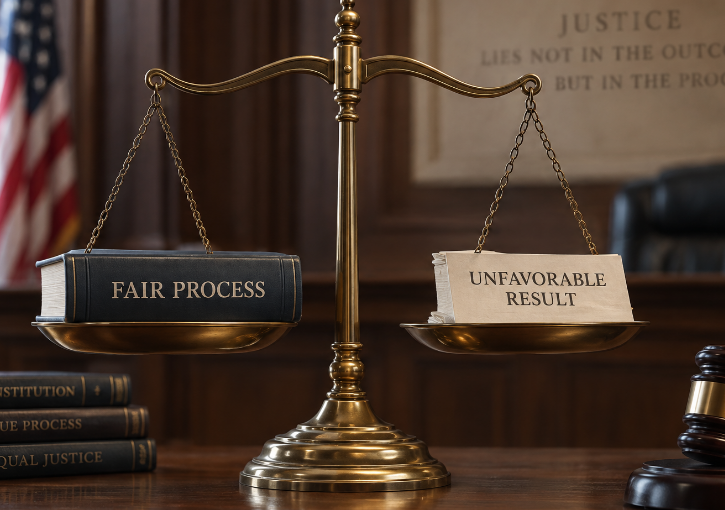
Due Process Does Not Guarantee a Favorable Outcome
This distinction is essential.
Due process generally protects the fairness of the decision-making process; it does not guarantee that the person receiving that process will win.
Someone may receive adequate notice, participate fully in a hearing, present evidence, challenge the opposing position, and still lose.
That does not by itself establish a due process violation.
Courts frequently must distinguish between objections to how a decision was made and objections to the decision itself.
A person understandably may believe an outcome was wrong. But constitutional due process ordinarily requires more than dissatisfaction with the result.
The relevant questions may instead include whether the person had a protected interest, whether adequate procedures were provided, and whether the government followed the process constitutionally required under the circumstances.
Fairness provides an opportunity to be heard.
It does not provide a right to have one's argument accepted.
Substantive Due Process Asks a Different Question
Due process also has another dimension, commonly called substantive due process.
Procedural due process generally asks:
Was the government required to use particular procedures before acting?
Substantive due process addresses a different issue:
Are there some governmental actions that constitutional protections prohibit regardless of how much procedure the government provides?
The distinction can be illustrated simply.
Suppose the government proposes to take an action affecting a protected interest. Procedural due process may determine whether notice and a hearing are required before that action occurs.
But in some circumstances, the constitutional problem is not merely the absence of a hearing. The argument is that the government lacks constitutional authority to impose the particular deprivation at all.
Providing additional hearings would not necessarily cure that problem.
Substantive due process doctrine has developed through a complicated and sometimes controversial history, particularly when courts determine whether certain rights receive constitutional protection even though they are not expressly listed in the Constitution.
Because of that history, substantive due process questions can involve difficult debates about constitutional interpretation, judicial authority, history, tradition, and the proper role of courts.
But the basic distinction remains important:
Procedural due process concerns the fairness of the method. Substantive due process can concern the constitutional permissibility of the governmental action itself.
Procedure Matters Even When the Government Is Right
Perhaps the most important feature of due process is that it matters even when government officials believe they have reached the correct conclusion.
Imagine that an agency is nearly certain that a license should be revoked.
Why provide a hearing?
Because confidence is not the same as infallibility.
The hearing may reveal a mistaken identity, an inaccurate record, an exception in the law, missing evidence, or facts the agency did not previously know.
And even when the hearing changes nothing, the process serves another important function.
It requires government to explain and defend the exercise of its power.
That obligation is itself a restraint.
Government officials who know that their decisions may have to be explained, supported, reviewed, and challenged operate within a different system from officials who may act without providing reasons or listening to objections.
Procedure therefore does more than correct mistakes.
It disciplines power.
Fair Procedures Strengthen the Legitimacy of Decisions
Courts cannot promise that every participant will agree with every decision.
They can, however, strive to provide procedures that allow people to understand how decisions were reached.
That distinction has consequences for public confidence.
A person who loses after receiving notice, presenting evidence, making an argument, and receiving a reasoned decision may still strongly disagree with the outcome. But that person has at least participated in a recognizable legal process.
A person who loses without knowing the accusation, without an opportunity to respond, and without an explanation for the decision experiences something fundamentally different.
Procedural fairness helps demonstrate that government power is exercised through rules rather than merely through authority.
That is important not only to the person directly affected.
It is important to the legitimacy of the institution making the decision.
Due Process Is Not Inefficiency for Its Own Sake
Procedural protections inevitably require time and resources.
Hearings must be scheduled. Notices must be delivered. Evidence must be considered. Decisions may have to be explained. Appeals and administrative reviews can delay finality.
It can therefore be tempting to view procedure as an obstacle standing between government and an obvious result.
But efficiency is not the only value in a legal system.
A system capable of acting instantly but incapable of correcting mistakes would be efficient in one sense and profoundly dangerous in another.
Due process recognizes that when government exercises significant power over individuals, some degree of deliberation is not waste.
It is a safeguard.
The challenge is to provide enough procedure to protect against arbitrary and erroneous action without making ordinary government administration impossible.
That is why due process requirements vary with context.
The Right to Be Heard Is a Principle of Limited Government
The deeper importance of due process becomes apparent when the doctrine is viewed not merely as a collection of hearing requirements but as part of the constitutional structure of limited government.
Government necessarily exercises power.
Due process asks that, in circumstances where protected interests are at stake, that power be exercised through procedures compatible with law and fairness.
Notice forces government to identify what it proposes to do.
A hearing allows the affected person to answer.
Evidence creates a basis for factual decisions.
Neutral decision-makers reduce the danger that the process is merely a predetermined exercise.
Review provides an opportunity to identify legal or procedural error.
And substantive constitutional limits recognize that some questions concern not merely how government acts, but whether it may act in that way at all.
None of these protections means government is powerless.
Government can still enforce laws, regulate conduct, impose lawful penalties, protect public safety, and make difficult decisions.
Due process requires something more fundamental:
When government exercises its power over people, the method matters.
The right to be heard does not guarantee victory.
It guarantees something essential to a system governed by law—the opportunity, when the Constitution requires it, to stand before governmental power and answer before the decision becomes final.