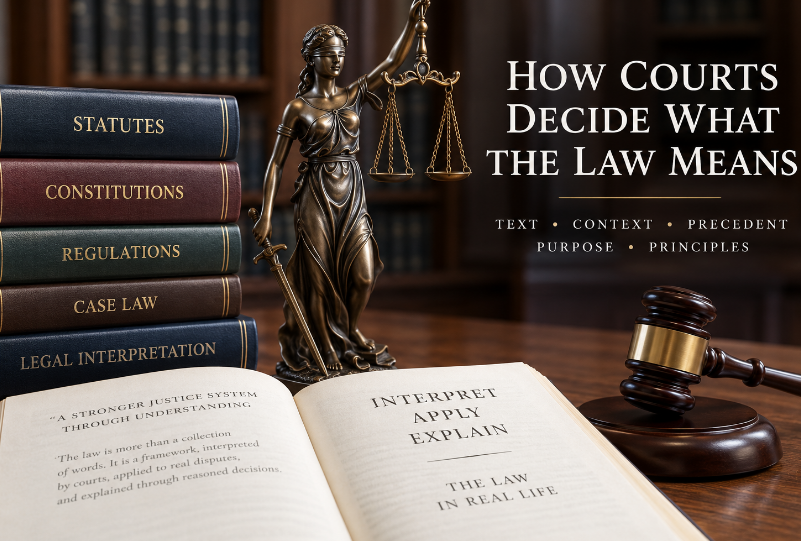
How Courts Decide What the Law Means
Laws are written in words, but words do not always answer every question that reaches a courtroom.
A statute may have been written decades before a new technology existed. Two provisions may appear to point in different directions. A word may have several reasonable meanings. A general rule may collide with a specific exception. And sometimes the parties simply disagree about what the legislature meant when it chose a particular phrase.
When that happens, courts must interpret the law.
This process is often called statutory interpretation when a court is interpreting legislation. Similar interpretive questions arise when courts examine constitutions, regulations, contracts, and prior judicial decisions.
Judges do not ordinarily begin with a blank slate. They use established legal principles to determine what a legal text means and how it applies to the dispute before them.
Courts Usually Begin With the Text
The starting point is generally the language of the law itself.
If a statute says that a particular requirement applies to a "person," for example, a court may need to determine who qualifies as a person under that statute.
The court will examine the words actually enacted rather than simply asking what rule it believes would produce the best outcome.
Sometimes the language provides a straightforward answer.
Other times, the meaning becomes less obvious when the words are applied to a particular situation.
That is where interpretation becomes important.
Words Are Read in Context
Courts generally do not interpret individual words in complete isolation.
Consider the word "vehicle."
Depending on the context, that word could include a car, motorcycle, bicycle, golf cart, aircraft, or even some devices that did not exist when a law was written.
Suppose a statute prohibits "vehicles" in a public park.
Does that include an ambulance responding to an emergency? A child's electric toy car? A motorized wheelchair?
A dictionary definition might provide useful information, but it may not completely resolve the question.
Courts therefore often examine the surrounding language and the broader statutory structure.
The meaning of a word can become clearer when considered alongside the words around it.
The Entire Statute Can Matter
A court interpreting one sentence may examine other sections of the same law.
This is important because legislation is generally interpreted as a whole.
Suppose one provision uses the term "motor vehicle," while another provision in the same statute separately refers to "motor vehicles and bicycles."
That distinction may provide information about whether lawmakers intended the term "motor vehicle" to include bicycles.
Definitions contained elsewhere in the statute can be especially important.
Many laws contain specific definition sections stating exactly what certain words mean for purposes of that particular law.
Those statutory definitions may differ from the way the same words are used in ordinary conversation.
Specific Provisions Can Affect General Ones
Laws sometimes contain both broad rules and narrow provisions addressing particular circumstances.
For example, one section might establish a general requirement applying to all businesses, while another creates a specific rule for hospitals.
If the two appear to conflict, courts may consider whether the more specific provision was intended to govern the narrower situation.
This reflects a broader principle of interpretation: courts generally try to read different provisions so that they work together rather than unnecessarily treating them as contradictory.
Courts Try to Give Meaning to the Words Chosen
Judges generally presume that words included in legislation were placed there for a reason.
If one interpretation would make an entire phrase meaningless or redundant, while another would give that phrase an independent function, that difference may matter.
The same can be true when lawmakers use different words in neighboring provisions.
If one section says "knowingly" and another does not, for example, a court may consider whether the difference was intentional.
This does not mean every variation in wording necessarily carries enormous significance.
But courts frequently pay close attention to what lawmakers included—and what they omitted.
Ordinary Meaning Can Be Important
When legislation does not specially define a word, courts may consider its ordinary meaning.
Judges sometimes consult dictionaries, historical usage, legal dictionaries, technical sources, or other materials to determine how a term was understood.
The relevant meaning may depend on when the law was enacted.
A word used in a statute written in 1890 may have had a somewhat different commonly understood meaning than the same word has today.
Technical legislation can present another issue.
A term used in medicine, finance, engineering, or another specialized field may carry a technical meaning that differs from everyday usage.
The context helps determine which meaning is appropriate.
Courts Consider Existing Precedent
Judges do not ordinarily interpret every legal question as though no court has considered it before.
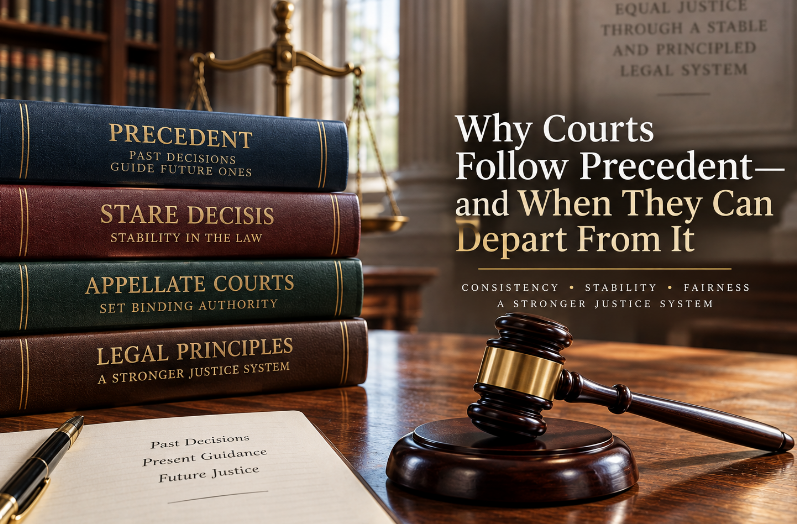
Under the doctrine of stare decisis, prior judicial decisions can have significant importance.
A lower court generally must follow controlling decisions from higher courts within the relevant judicial system.
If a state's highest court has already interpreted a provision of state law, lower state courts ordinarily do not simply choose a different interpretation because another reading seems preferable.
Likewise, federal courts operate within a hierarchy in which decisions from higher courts can bind lower courts on questions within their authority.
Precedent promotes stability and consistency.
People and institutions can make decisions with greater confidence when legal rules do not change unpredictably from one courtroom to another.
Not Every Prior Decision Is Binding
Courts encounter many decisions that may be informative without being controlling.
A decision from another jurisdiction may address nearly identical statutory language. A federal court may have analyzed a question of state law without the state's highest court having decided it. A lower appellate decision may discuss an issue that a higher court has not addressed.
These decisions may be considered persuasive authority rather than binding authority.
A judge can examine the reasoning and decide how persuasive it is.
This distinction between binding and persuasive precedent is an important part of legal research.
Finding a case that supports a position does not necessarily mean the court hearing the current dispute must follow it.
Constitutions Present Their Own Interpretive Questions
Constitutional interpretation can be particularly significant because constitutional provisions often use broad language intended to establish fundamental governmental structures and rights.
Terms such as "due process," "equal protection," "unreasonable searches," and "freedom of speech" have generated extensive bodies of judicial precedent.
Courts interpreting constitutional provisions may consider text, historical context, precedent, governmental structure, and other recognized interpretive sources.
Different judges may also place different weight on particular interpretive methods.
Those disagreements can produce majority opinions, concurring opinions, and dissents even when all of the judges are examining the same constitutional language.
Legislative History May Sometimes Be Considered
When statutory language leaves genuine interpretive questions, courts in some circumstances consider materials associated with the law's enactment.
These materials can include committee reports, legislative analyses, earlier versions of a bill, amendment history, and other records.
The extent to which judges rely on legislative history varies.
Some judges consider it useful evidence of statutory context or purpose. Others are more reluctant to rely on it, particularly when they believe the enacted text provides the answer.
The governing jurisdiction's own interpretive rules can also affect when legislative history is considered.
Purpose Can Help Explain a Law
Courts may also consider the problem a statute was intended to address.
Imagine a law enacted specifically to prevent fraudulent financial transactions.
If two interpretations of an ambiguous provision are possible, the statute's structure and evident purpose may help a court understand which interpretation better fits the law as a whole.
But purpose generally does not give a court unlimited authority to rewrite statutory language.
A judge cannot ordinarily replace the law enacted by the legislature with a different rule merely because the judge believes the alternative would better accomplish the statute's general objective.
The text remains central.
Courts Sometimes Apply Interpretive Canons
Over time, courts have developed recurring principles known as canons of construction.
These are tools for interpreting legal text.
For example, courts may presume that lawmakers do not ordinarily include meaningless language. A specific provision may control over a more general provision addressing the same subject. Words grouped together may help illuminate one another's meaning.
Some canons address more specialized situations.
Their importance and application can vary depending on the jurisdiction and the type of law involved.
Canons are therefore tools of interpretation rather than mathematical formulas that automatically produce an answer.
Ambiguity Does Not Mean a Judge Can Choose Anything
When lawyers say that a law is "ambiguous," it does not mean the court is free to select whatever result it prefers.
It usually means that the text reasonably permits more than one interpretation when applied to the particular dispute.
The court must still justify its interpretation using legitimate legal reasoning.
That reasoning may involve text, statutory structure, definitions, precedent, context, interpretive rules, and other legally recognized sources.
The requirement to explain that reasoning helps constrain judicial discretion.
Sometimes the Legislature Responds to a Court's Interpretation
Judicial interpretation is not always the final chapter.
Suppose a court interprets a statute in a way lawmakers believe does not reflect the policy they want.
If constitutional limits permit it, the legislature may amend the statute.
The revised law might add a definition, create an exception, remove ambiguous language, or expressly reject the interpretation adopted by the court for future cases.
This interaction demonstrates the different roles of courts and legislatures.
Legislatures enact laws.
Courts interpret and apply those laws in actual disputes.
Legislatures can then change statutory law when they conclude that different language is needed.
Hard Cases Can Produce Reasonable Disagreement
Some legal questions are genuinely difficult.
Highly qualified judges can examine the same statutory language, precedent, and history and reach different conclusions.
That is one reason appellate courts sometimes issue divided decisions.
A dissent does not necessarily mean the majority ignored the law, just as a majority decision does not mean the dissent was frivolous.
Often the disagreement concerns which interpretive consideration should receive the greatest weight.
One judge may view the ordinary meaning of the text as decisive. Another may believe the statutory structure makes a different interpretation necessary. Another may disagree about what an earlier precedent actually established.
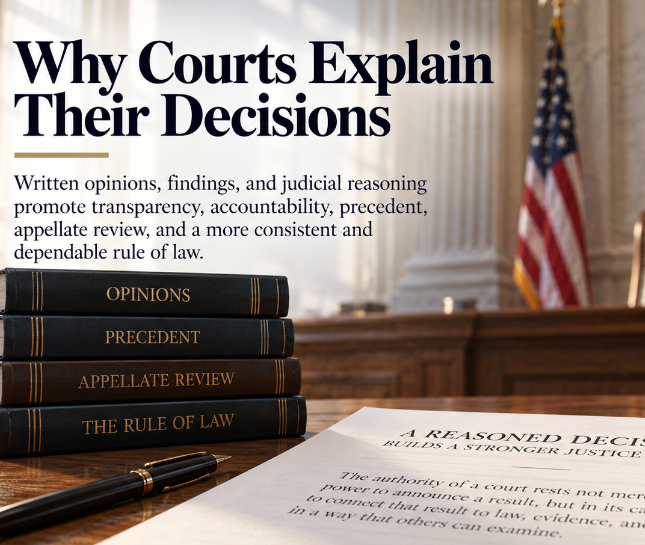
Written opinions expose those disagreements to public examination.
Interpretation Is Different From Making New Law
The distinction between interpreting law and creating law is an enduring subject of legal debate.
Courts inevitably must determine what legal language means when resolving cases. At the same time, judges operate within a constitutional system in which elected legislatures ordinarily have primary responsibility for enacting statutes.
The tension becomes most visible when a legal text does not provide an obvious answer.
Judges therefore frequently explain why their interpretation follows from the enacted language, existing precedent, and accepted interpretive principles rather than simply from a preferred policy result.
That explanation is part of what makes judicial reasoning reviewable.
Why Legal Interpretation Matters
Questions about legal interpretation can sound technical, but their consequences are often very practical.
The meaning of a few words can determine whether a business owes millions of dollars, whether evidence can be used in a criminal prosecution, whether a government agency has authority to act, whether a person qualifies for a benefit, or whether a constitutional protection applies.
The interpretive method can therefore matter almost as much as the words being interpreted.
A legal system committed to the rule of law requires more than judges announcing conclusions.
It requires judges to connect those conclusions to legal authority.
The Law Is More Than a Collection of Words
Written law provides the foundation, but applying those words to real disputes requires interpretation.
Courts examine text, context, statutory structure, definitions, precedent, and other recognized interpretive sources to determine what the law requires in a particular case.
Sometimes the answer is straightforward.
Sometimes reasonable judges disagree.
But the central expectation remains the same: the court should be able to explain how it moved from the words of the law to the rule applied in the case before it.
That connection between legal text and reasoned judgment is one of the foundations of a system governed by law rather than individual preference.