“Equal justice under law” expresses one of the most important aspirations of the American legal system.
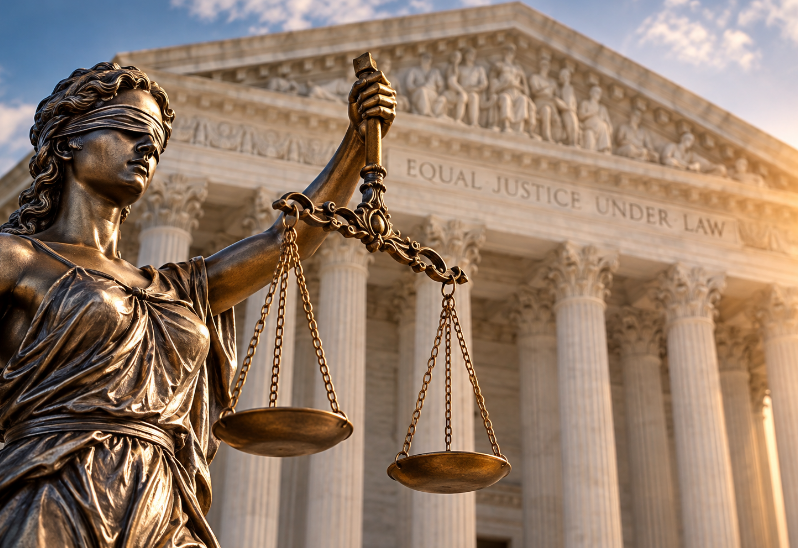 The phrase suggests something both simple and powerful: the law should not become a different law depending on who stands before it.
A wealthy person and a poor person should not be governed by different legal rules merely because of their economic status. A government official should not receive one interpretation of a statute while an ordinary citizen receives another because of political influence. Judges should not decide identical disputes differently because they favor one party over another.
But equality under law is more complicated than requiring government to treat every person identically.
People and circumstances are not always identical. Laws routinely distinguish between adults and children, licensed and unlicensed professionals, property owners and nonowners, first-time offenders and repeat offenders, taxpayers in different income brackets, and people whose conduct creates different levels of risk.
Some distinctions are legitimate. Others may violate constitutional guarantees.
The challenge is determining the difference.
Equal justice therefore involves two related ideas:
Similar cases should generally be treated similarly, while legally meaningful differences may sometimes justify different treatment.
Understanding that distinction is essential to understanding equality before the law.
Equality Before the Law
At its most basic level, equality before the law rejects the idea that legal rules should depend on a person's status or identity when that characteristic has no legitimate legal relevance.
The principle restrains arbitrary government.
Government officials exercise considerable power. Legislatures classify conduct. Agencies administer programs. Police enforce laws. Prosecutors make charging decisions. Courts determine rights and obligations.
If those institutions could apply legal rules differently to different people without justification, law would become unpredictable and potentially personal.
The rule of law depends upon something different.
Legal standards should govern decisions rather than personal favoritism.
That does not mean every legal decision will produce the same result. Facts differ. Evidence differs. statutes differ. Circumstances differ.
Equality before the law instead means that those differences—not favoritism, hostility, or arbitrary preference—should explain different legal outcomes.
The Constitution and Equal Protection
The most prominent constitutional expression of legal equality appears in the Fourteenth Amendment.
Its Equal Protection Clause provides that no state shall “deny to any person within its jurisdiction the equal protection of the laws.”
Those words have generated an enormous body of constitutional law.
At a general level, equal protection addresses governmental classifications: situations in which the law or government treats one group of people differently from another.
But the existence of a classification does not automatically make a law unconstitutional.
Government classifies constantly.
A driver's license may be available only to people meeting specified qualifications. Certain public benefits may depend on income. Voting eligibility may depend on age and citizenship. Professional licenses may require education and testing. Criminal penalties may vary according to the seriousness of an offense.
The constitutional question is therefore not simply:
Does the law treat people differently?
Often it does.
The more difficult question is:
What distinction is the government making, why is it making that distinction, and what constitutional standard applies to it?
Equal Does Not Always Mean Identical
One of the easiest mistakes to make when discussing equality is assuming that fairness always requires identical treatment.
Sometimes identical treatment would itself produce an irrational result.
Consider two motorists.
One drives five miles above the speed limit. The other drives at an extremely dangerous speed through a crowded area.
Treating the two drivers identically simply because both exceeded the speed limit would ignore a legally relevant difference in their conduct.
Or consider professional licensing.
A state may require a person practicing medicine to possess qualifications that are not required of someone working in an unrelated occupation. That is unequal treatment in a literal sense, but the difference in responsibilities provides an obvious reason for different legal requirements.
Equality therefore cannot mean eliminating every distinction.
Instead, legal equality requires attention to whether the distinction matters for the purpose of the law.
The principle can be expressed this way:
People who are similarly situated in legally relevant respects should ordinarily be governed by the same legal standards.
The difficult work lies in deciding which differences are legally relevant.
Not Every Classification Receives the Same Constitutional Review
Equal protection law does not examine every governmental classification with the same degree of scrutiny.
Many ordinary economic and social regulations receive relatively deferential judicial review. Government generally has considerable latitude to draw reasonable distinctions when regulating everyday matters.
Other classifications receive much more demanding constitutional review.
For example, classifications based on race are subject to the Constitution's most rigorous form of judicial scrutiny. Certain other classifications and rights receive heightened forms of review under Supreme Court doctrine.
These differing standards reflect the history and structure of equal protection law.
They also demonstrate why equal protection disputes cannot ordinarily be resolved merely by observing that two groups were treated differently.
The nature of the classification matters.
The governmental objective matters.
The relationship between the classification and that objective matters.
And the applicable constitutional standard matters.
Consistency Is an Important Part of Justice
Equality also has an institutional dimension that extends beyond formal constitutional classifications.
Courts depend heavily on consistency.
When two cases present materially similar facts and the same legal question, people generally expect courts to apply the same legal principles.
That expectation is one reason precedent plays such an important role in American law.
Earlier judicial decisions can establish principles that guide later cases. Although precedent is not absolute and courts sometimes distinguish or overrule earlier decisions, a legal system based on precedent encourages judges to explain why similar cases should receive similar treatment—or why a meaningful difference justifies a different result.
Consistency serves several purposes.
It makes law more predictable.
It helps individuals and businesses organize their affairs.
It constrains purely personal decision-making.
And it allows the public to evaluate whether legal principles are being applied in a coherent way.
If the same court repeatedly interpreted the same law differently depending solely on which litigant appeared before it, confidence in the legal system would quickly deteriorate.
Consistency therefore supports both equality and the rule of law.
Consistency Does Not Require Mechanical Decision-Making
There is an important qualification.
No two cases are perfectly identical.
Legal disputes involve particular facts, different evidence, procedural histories, statutory provisions, contractual language, and sometimes competing legal principles.
Judges must determine which similarities matter and which differences matter.
Suppose two defendants are convicted under the same criminal statute but receive different sentences.
That fact alone does not establish unequal justice.
One defendant may have a substantially different criminal history. The offenses may have involved different conduct. Different statutory provisions may apply. One defendant may have accepted responsibility or provided cooperation recognized by law. A judge may have been required or permitted to consider circumstances unique to each case.
The important question is not merely whether the outcomes differ.
It is whether the difference can be explained by legally relevant considerations.
Equal justice therefore requires consistency of principle, not necessarily uniformity of result.
Judicial Neutrality Is Essential
Equality before the law also depends upon neutral decision-makers.
A judge's role is not to decide which party is more socially important, politically connected, wealthy, popular, or personally sympathetic.
The judge's task is to apply governing law to the dispute before the court.
Judicial ethics, recusal rules, procedural protections, appellate review, and the requirement that courts explain many of their decisions all help reinforce that expectation.
Perfect neutrality is an aspiration rather than something that can be measured with mathematical precision. Judges, like everyone else, have experiences and perspectives.
The legal system nevertheless attempts to create institutional safeguards against improper bias and conflicts of interest.
A judge with a disqualifying financial interest may be required to step aside. Certain personal relationships can require recusal. Demonstrated bias may raise legal or ethical concerns.
These protections are important because equality cannot exist merely in the wording of statutes.
It must also exist in the institutions applying them.
The same law means little if the identity of the person appearing before the court determines how that law will be applied.
Equality Does Not Mean Ignoring Individual Circumstances
There is an apparent tension at the center of equal justice.
Law should be consistent.
Yet justice sometimes requires individualized consideration.
Those ideas are not necessarily contradictory.
Consider sentencing again.
A legal system could attempt perfect uniformity by imposing exactly the same sentence on every person convicted of an offense bearing the same name.
That would be consistent in one sense.
But it could ignore enormous differences in conduct, culpability, harm, criminal history, and other factors the law may regard as relevant.
Conversely, giving decision-makers unlimited discretion could allow similar cases to produce wildly different outcomes without explanation.
Legal systems therefore often attempt to balance rules with discretion.
Rules promote consistency.
Discretion allows legally relevant individual circumstances to be considered.
The difficult question is how much of each is appropriate.
That tension appears throughout law—in sentencing, administrative decisions, damages, family law, equitable remedies, licensing, and many other areas.
Equality and Equity Are Related but Different Ideas
Discussions of justice sometimes distinguish between equality and equity.
The terms can carry different meanings depending on context, and “equity” also has a specific historical meaning in law.
In ordinary public discussion, equality often refers to applying the same treatment or standard, while equity may refer to considering differences in circumstances when determining what fairness requires.
The legal system contains elements of both ideas.
Some legal rules are deliberately uniform.
Others expressly require decision-makers to consider individual circumstances.
Neither approach is automatically fair in every situation.
A uniform rule may prevent favoritism but occasionally produce harsh results.
A highly individualized system may respond better to unusual circumstances but create greater risks of inconsistency.
Legal institutions continually navigate this tension.
The relevant question is usually not whether equality or individualized treatment is always superior.
It is whether the distinction being made is legally justified and whether the decision-making framework contains adequate safeguards against arbitrariness.
Wealth Presents a Difficult Practical Challenge
Formal equality does not necessarily guarantee identical practical experiences within the legal system.
Two litigants may technically possess the same legal rights while having dramatically different resources available to exercise those rights.
One may be able to retain experienced counsel, hire experts, conduct extensive discovery, and devote substantial time to litigation. Another may struggle to obtain representation or even understand the procedures necessary to present a claim.
The legal system attempts to address some of these disparities in particular contexts.
Criminal defendants who cannot afford counsel may have a constitutional right to appointed counsel in circumstances defined by law. Courts may waive certain fees for qualifying litigants. Legal aid organizations, public defenders, pro bono attorneys, self-help centers, and simplified procedures provide additional assistance.
Those mechanisms do not eliminate every practical inequality.
They demonstrate, however, that meaningful access to law can involve more than formally declaring that everyone is governed by the same rules.
A right that exists only on paper may provide limited protection to someone who has no realistic way to invoke it.
Government Must Be Able to Explain Relevant Differences
One useful way to think about equal justice is through the concept of justification.
When similarly situated people receive different treatment, the legal system may ask why.
Sometimes the answer is straightforward.
Their circumstances were materially different.
Different laws applied.
Different evidence was presented.
A legally permissible classification governed the decision.
Different procedural postures required different results.
In other situations, the explanation may reveal a constitutional problem.
A classification may rest on a prohibited basis. A government policy may fail the applicable level of constitutional scrutiny. An official decision may be arbitrary or improperly discriminatory.
The demand for justification is important because it makes governmental distinctions capable of examination.
It asks government to connect different treatment to law rather than mere preference.
Equal Protection Does Not Guarantee Equal Outcomes
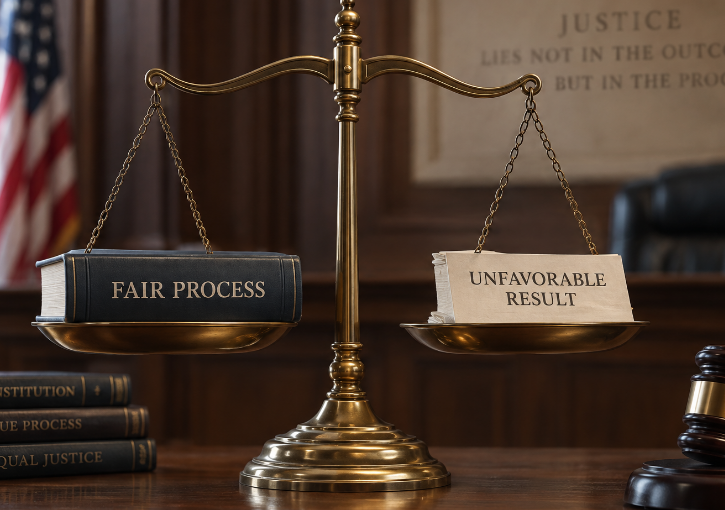
Just as due process does not guarantee victory, equal protection does not guarantee identical outcomes for everyone.
A legal system can apply the same governing principles and still produce different results.
One party may have stronger evidence.
One person may satisfy statutory requirements while another does not.
One defendant's conduct may fall within an exception that does not apply to another.
One litigant may meet the burden of proof while another fails to do so.
Different outcomes therefore do not, by themselves, demonstrate unequal justice.
The focus must be on the reasons for those outcomes.
Were the same legal principles available to both parties?
Were legally comparable cases treated consistently?
Were differences based on legitimate considerations?
Was an impermissible classification involved?
Was the decision made by a neutral institution applying law rather than personal preference?
Those questions move the analysis beyond appearances and toward the actual operation of legal equality.
Appeals Help Promote Consistency
Appellate courts play an important role in maintaining equal application of law.
Trial courts resolve individual disputes, but appellate decisions can establish or clarify legal principles that govern many future cases.
When lower courts disagree about the meaning of a statute or constitutional provision, appellate review can provide a more uniform rule.
Higher courts can also correct legal errors and explain how governing principles should apply.
This does not eliminate disagreement.
Judges can reasonably interpret difficult legal questions differently. Appellate courts themselves sometimes disagree, and higher courts may later change existing precedent.
But a hierarchical court system creates mechanisms for resolving at least some inconsistencies.
That structure helps transform individual decisions into a more coherent body of law.
Equal Justice Is a Discipline, Not Merely a Slogan
“Equal justice under law” is easy to endorse in the abstract.
Its practical application is considerably harder.
Real disputes require courts and government officials to decide whether two situations are genuinely comparable, whether a difference is legally relevant, whether a classification is constitutionally permissible, and whether individualized treatment reflects legitimate judgment or arbitrary preference.
Those questions rarely can be answered by demanding that everyone receive precisely the same outcome.
Equality under law is more demanding than that.
It requires consistency without blindness to relevant facts.
It permits distinctions while demanding legal justification for them.
It values individualized judgment while placing limits on arbitrary discretion.
It expects judges to remain neutral while recognizing that difficult cases require interpretation and judgment.
And it provides constitutional protections against certain forms of governmental discrimination.
The principle ultimately rests on a fundamental commitment:
Law should govern people according to legal rules and legally relevant circumstances—not according to who they are in the eyes of those exercising power.
Equal justice does not mean every person will experience the same result.
It means that when the government distinguishes between people, the distinction must be one the law permits—and when courts confront materially similar cases, the identity, wealth, influence, or popularity of the parties should not determine what the law becomes.
That is the practical challenge contained within the promise of equal justice under law.