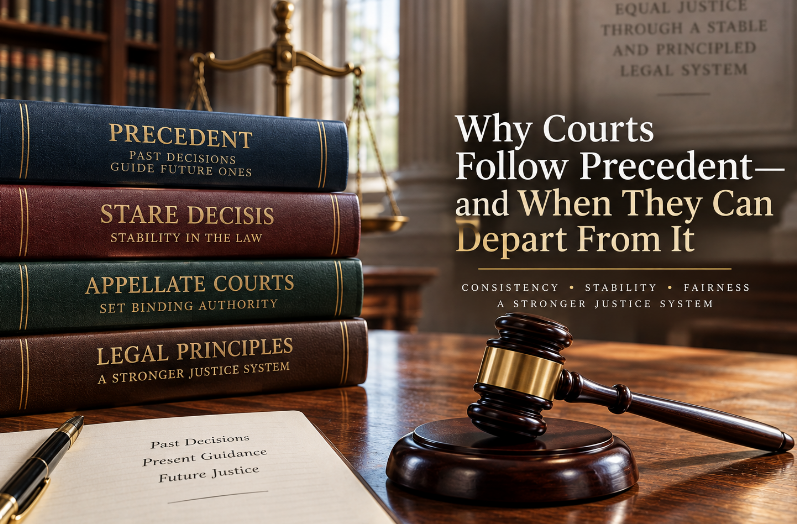
Why Courts Follow Precedent—and When They Can Depart From It
When a court decides a legal question, the decision can matter far beyond the people involved in that particular case.
A judicial opinion may establish a legal rule that courts apply again years—or even decades—later.
This practice is closely associated with precedent and the doctrine known as stare decisis, a Latin expression commonly translated as standing by things decided.
The basic idea is straightforward: when a court has already resolved a legal question, later courts generally give that decision significant weight and, in many circumstances, are required to follow it.
But precedent is not absolute.
Some prior decisions are binding. Others are merely persuasive. Courts sometimes distinguish earlier cases rather than follow them. And under certain circumstances, higher courts may overturn their own previous decisions entirely.
Understanding these distinctions helps explain why judicial decisions can shape the law long after an individual case has ended.
Why Does Precedent Matter?
Imagine a legal system in which every judge interpreted every law entirely from scratch.
One court might interpret a statute one way on Monday, another court differently on Tuesday, and a third might adopt yet another interpretation the following week.
People would have difficulty knowing what the law required.
Businesses could not confidently structure transactions. Lawyers would struggle to advise clients. Government officials might apply the same law differently depending on which courtroom was involved.
Precedent helps reduce that uncertainty.
Once an authoritative court resolves a legal question, its decision can provide a rule for resolving similar disputes in the future.
That promotes several important values: consistency, predictability, stability, and equal treatment under law.
Not Every Court Decision Is Binding Everywhere
One of the most important things to understand about precedent is that a judicial decision does not automatically bind every other court.
Courts operate within hierarchies.
In the federal system, trial courts are generally subject to controlling decisions from the federal appellate court governing their circuit and, ultimately, the United States Supreme Court on questions of federal law.
State court systems have their own hierarchies, usually consisting of trial courts, intermediate appellate courts where established, and a state's highest court.
A lower court ordinarily cannot disregard a controlling decision from a higher court merely because the lower-court judge believes the earlier case was wrongly decided.
The hierarchy matters.
Binding Authority and Persuasive Authority Are Different
Lawyers frequently distinguish between binding authority and persuasive authority.
Binding authority is legal authority a court is obligated to follow when it applies to the issue before it.
Persuasive authority may influence the court but does not necessarily control the result.
Suppose a court in one state faces a legal question that its own appellate courts have never addressed.
Courts in several other states may already have considered nearly identical questions.
Those decisions can provide useful reasoning, but they ordinarily do not become binding merely because they address the same issue.
The court may examine them, find their reasoning persuasive, and adopt a similar approach.
Or it may conclude that its own state's law requires a different result.
Precedent Depends on What the Earlier Case Actually Decided
Finding an earlier case with similar facts is only the beginning.
A court must determine what legal issue the earlier decision actually resolved.
Judicial opinions often discuss many subjects. Not every sentence necessarily establishes a rule binding future courts.
Lawyers therefore examine the reasoning necessary to the decision and distinguish it from observations that were not essential to resolving the case.
This is one reason legal research involves more than searching for favorable quotations.
The context of a judicial statement matters.
Similar Cases May Still Be Legally Different
Precedent does not require courts to produce identical results whenever two cases look generally similar.
Small factual differences can have major legal consequences.
Suppose an earlier decision establishes that a particular search was unconstitutional because officers lacked a warrant and no recognized exception applied.
A later case may involve a superficially similar search, but the government might argue that consent was given or that another exception to the warrant requirement applies.
The earlier case remains precedent.
The question becomes whether its rule controls the new facts.
Courts Can Distinguish Earlier Cases
When a court concludes that a precedent does not govern because the current dispute is materially different, it may distinguish the earlier case.
Distinguishing a precedent is not the same as overruling it.
The earlier decision remains valid.
The court is instead explaining why the rule established there does not dictate the result in the present circumstances.
This is a routine part of legal reasoning.
A lawyer arguing that precedent controls will emphasize similarities between the cases. A lawyer arguing that it does not will often emphasize legally significant differences.
The court then determines which characteristics matter under the governing law.
Lower Courts Generally Cannot Overrule Higher Courts
The distinction between distinguishing and overruling is particularly important for lower courts.
A trial court may believe that a controlling appellate precedent is outdated or poorly reasoned.
But that ordinarily does not give the trial court authority to declare the precedent invalid.
The lower court generally must apply controlling law unless a legally recognized development has displaced it.
That preserves the hierarchical structure of the judiciary.
Otherwise, every lower court could effectively nullify decisions from courts charged with reviewing it.
Higher Courts Can Reconsider Their Own Precedent
The situation becomes more complicated when a court is asked to reconsider one of its own previous decisions.
Courts generally treat their prior decisions with respect because stability in the law has value.
But stare decisis is not an absolute command that every precedent must remain unchanged forever.
Higher courts sometimes overturn earlier decisions.
When that occurs, the court concludes that the previous legal rule should no longer govern.
The consequences can be substantial because numerous lower courts and private parties may have relied on the earlier rule.
Why Would a Court Overturn Precedent?
There is no single universal formula governing when precedent should be overturned.
The analysis depends on the court, jurisdiction, subject matter, and governing law.
Courts considering whether to retain or abandon precedent may examine considerations such as the quality of the earlier decision's reasoning, its consistency with related legal principles, subsequent developments in the law, whether the rule has proved workable, and reliance interests that developed around the existing rule.
Different judges may weigh those considerations differently.
That is why cases involving possible changes to major precedents can produce sharply divided opinions.
A Decision Being Wrong May Not Always End the Inquiry
Stare decisis creates an unusual feature of judicial decision-making.
A judge may believe an earlier decision was incorrectly reasoned but still conclude that it should remain in place.
Why?
Because the legal system values more than reaching the theoretically best interpretation in every individual case.
Stability also matters.
People organize their affairs around existing law. Businesses enter contracts. Governments create programs. Property changes hands. Lawyers advise clients. Courts decide thousands of subsequent cases.
Changing an established legal rule can therefore have consequences beyond correcting the original decision.
This does not mean erroneous precedent can never be changed.
It means the existence of precedent itself may become part of the analysis.
Reliance Interests Can Matter
Suppose courts have interpreted a commercial statute the same way for forty years.
During that period, thousands of contracts may have been drafted based on that interpretation.
Changing the rule could disrupt arrangements made in reliance on the existing law.
Courts may therefore consider reliance interests when deciding whether precedent should be disturbed.
Reliance can be particularly significant in areas where people structure long-term conduct around established legal rules.
Its importance can vary considerably depending on the type of precedent involved.
Constitutional Precedent Presents Special Questions
Precedent can take on particular significance in constitutional cases.
If a court interprets an ordinary statute and the legislature disagrees, lawmakers may often amend the statute, subject to constitutional limits.
Constitutional interpretation can be different.
A judicial interpretation of a constitutional provision may not be easily altered through ordinary legislation.
That can make disputes over constitutional precedent especially consequential.
Judges may disagree both about what the Constitution means and about how strongly stare decisis should protect an earlier interpretation.
Statutory Precedent Can Operate Differently
When a court interprets a statute, the legislature often retains the ability to respond.
Suppose a state's highest court interprets a statutory phrase in a particular way.
If the legislature believes the court misunderstood what the law should accomplish, it may amend the statute to clarify the rule for future cases.
Sometimes legislatures expressly change language after a judicial decision.
Other times they leave the statute unchanged.
The significance of legislative action or inaction can itself become a subject of legal argument.
Precedent Can Develop Gradually
Legal doctrine does not always change through a single dramatic decision.
Sometimes it develops incrementally.
One case establishes a broad principle.
A later case defines an exception.
Another explains the boundaries of that exception.
Still another applies the rule to circumstances that earlier courts never encountered.
Over time, these decisions form a body of law.
This is one reason lawyers often must read multiple cases to understand a legal rule fully.
The governing doctrine may not be contained neatly in a single opinion.
New Technology Can Test Old Precedent
Technological change frequently creates difficult questions for precedent.
A legal rule may have developed when communication occurred primarily through letters and landline telephones.
Years later, courts may have to determine how the same principles apply to smartphones, cloud storage, social media, location information, artificial intelligence, or technologies that did not exist when the earlier decisions were written.
The underlying precedent may remain relevant even though the factual environment has changed dramatically.
Courts must then decide whether the existing principle extends naturally to the new circumstances or whether legally significant differences require another approach.
Precedent Constrains Judicial Power
Precedent does more than make legal research easier.
It also constrains judges.
A judge deciding a case cannot ordinarily disregard controlling authority simply because the judge personally prefers another outcome.
The judge must address the law already established by courts with authority over the dispute.
This requirement connects individual judicial decisions to a broader legal system.
It reduces the extent to which outcomes depend entirely on the personal preferences of whichever judge happens to receive a case.
But Precedent Cannot Eliminate Judicial Judgment
No system of precedent can make judging entirely mechanical.
Courts still must determine whether an earlier case applies.
They must identify which parts of the decision were necessary to its result.
They must decide whether factual differences are legally significant.
They may confront conflicting precedents or questions no controlling court has previously answered.
And higher courts sometimes must decide whether an established rule should continue.
Precedent therefore guides judicial judgment without eliminating the need for it.
Lawyers Argue About Precedent From Both Directions
Legal arguments about precedent often follow recognizable patterns.
One side may argue:
This question has already been decided, and the existing rule controls.
The other may respond:
That case involved materially different circumstances and does not control this dispute.
Or the argument may go further:
The precedent is controlling, but the higher court should reconsider it.
These are fundamentally different arguments.
The first asks the court to follow precedent.
The second asks the court to distinguish it.
The third acknowledges the precedent and asks a court with sufficient authority to overturn it.
Understanding which argument is being made is essential to understanding the dispute.
Consistency and Correction Exist in Tension
The doctrine of precedent reflects two important goals that can sometimes conflict.
The law should be stable.
But the law should also be capable of correcting serious errors.
If precedent could never be changed, mistakes could become permanent.
If precedent changed whenever a new group of judges preferred another interpretation, legal rules could become unpredictable.
Stare decisis operates between those extremes.
It gives prior decisions substantial importance while preserving mechanisms through which legal doctrine can develop.
Why Precedent Is Central to the Rule of Law
A system governed by law requires some expectation that similar legal questions will receive similar treatment.
Precedent helps create that expectation.
It connects today's decisions with yesterday's decisions and provides guidance for tomorrow's disputes.
It also requires courts to engage with existing legal authority rather than treating each case as an isolated opportunity to decide what seems best.
That does not guarantee perfect consistency.
Courts disagree. Precedents conflict. Legal rules evolve. Higher courts sometimes reverse course.
But those changes occur within a structure that requires judges to explain how a new decision relates to the law that came before it.
That continuity is one of the central functions of precedent.
The Law Remembers
Every significant judicial decision enters a legal system that already has a history.
Courts inherit rules developed through earlier disputes, apply them to new circumstances, refine them when necessary, and occasionally reconsider them.
That is why an old case can still determine the outcome of a modern dispute—and why a decision issued today can influence cases that have not yet arisen.
Precedent gives the law a memory.
And stare decisis provides the principle that tells courts when that memory should guide what happens next.