 Justice is often discussed as an outcome. A person wins or loses. A defendant is convicted or acquitted. A lawsuit succeeds or fails. A government action is upheld or struck down.
But the legitimacy of a court system cannot depend only on whether a particular person agrees with the result.
A functioning system of justice also depends on how decisions are made.
Was the decision-maker impartial? Did the parties know what was being alleged or decided? Did they have a meaningful opportunity to respond? Could they present relevant evidence? Was the same law applied according to established legal principles? Did the court explain the basis for an important decision? And, where the law provides for review, could another court examine what happened?
These questions concern something deeper than winning and losing. They concern the integrity of the judicial process itself.
American law does not impose one identical procedure on every courtroom, agency, hearing, or dispute. A criminal prosecution, a civil lawsuit, an emergency injunction, and an administrative proceeding can require very different procedures. Nevertheless, several principles repeatedly appear in the law governing fair adjudication.
Together, they help explain what justice requires from a court system.
An Impartial Decision-Maker
The most elaborate hearing means little if the outcome has effectively been decided before it begins.
Judicial impartiality is therefore one of the foundations of a fair legal system.
Judges routinely make decisions that favor one party over another. Doing so is their job. An adverse ruling, even an important one, does not by itself establish bias.
The more fundamental concern is whether the person exercising judicial authority can decide the matter according to the law and the record rather than an improper personal interest, prejudgment, or disqualifying conflict.
This distinction matters.
A fair judge does not have to agree with both parties. A fair judge must be capable of hearing them and deciding the dispute under the governing law.
The principle extends beyond appearances. Courts exercise enormous power. Their decisions can affect liberty, property, families, businesses, reputations, and the authority of government itself. Confidence in those decisions depends in significant part on the understanding that the person making them is not improperly aligned with one side.
Due process doctrine accordingly recognizes the importance of a neutral and impartial tribunal.
That principle is simple to state, but indispensable in practice: the person deciding a dispute should not have an improper stake in its outcome.
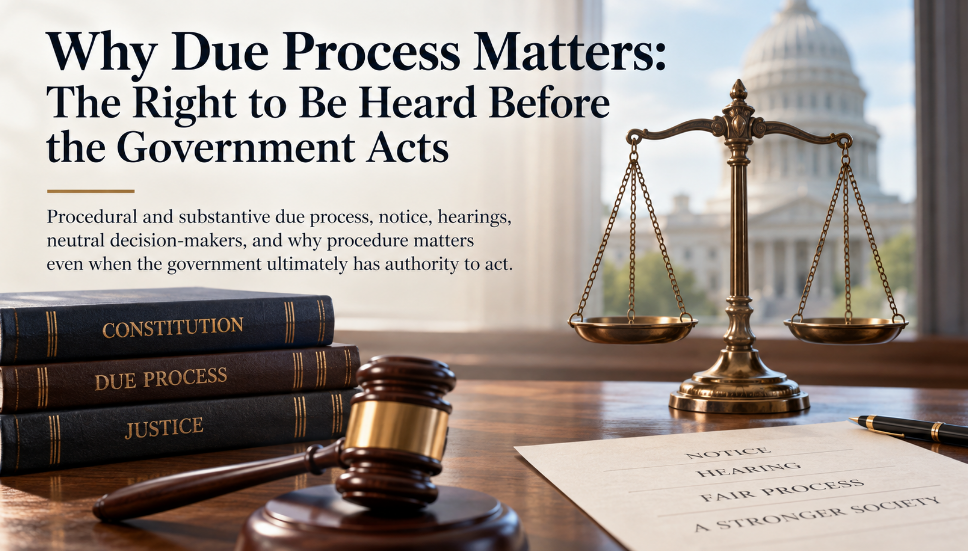
Notice: You Cannot Answer a Case You Do Not Know Exists
Fairness also requires information.
Before a person can meaningfully defend an interest, that person ordinarily needs to know that a proceeding exists and understand enough about what is at issue to respond.
This is the principle of notice.
Notice is not merely bureaucratic paperwork. It serves a practical purpose. It gives a person an opportunity to act.
Someone who does not know that property is at risk cannot defend it. A litigant who does not know the basis of a claim cannot meaningfully answer it. A party unaware of a hearing may lose the very opportunity the hearing was supposed to provide.
For that reason, notice and the opportunity to be heard are closely connected.
The law does not necessarily demand proof that every notice actually reached its intended recipient in every circumstance. Different proceedings have different service and notice rules. But constitutional due process has long concerned itself with whether the method used was reasonably designed, under the circumstances, to inform interested parties and give them an opportunity to object.
The underlying principle is straightforward:
A legal process should not ordinarily impose a binding adjudicative consequence while denying an affected person a meaningful chance to know that the decision is being made.
The Opportunity to Be Heard
Notice tells a person that something is happening.
A hearing provides the opportunity to do something about it.
The Supreme Court has repeatedly treated the opportunity to be heard as a fundamental component of due process. But “hearing” does not always mean a full courtroom trial with witnesses, a jury, and days of testimony.
What process is required depends on the circumstances.
Sometimes written submissions may be sufficient. Other proceedings require live testimony. Some require confrontation or cross-examination. Criminal cases carry protections that do not automatically apply to ordinary civil disputes. Emergency circumstances can sometimes justify governmental action before a complete hearing occurs.
The form changes.
The underlying idea remains remarkably durable: when government adjudication threatens a protected interest, the affected person should receive the kind of meaningful opportunity to respond that the law requires for that situation.
And the word meaningful matters.
A theoretical opportunity that cannot realistically be exercised may do little to protect against error. Timing can matter. Access to the allegations can matter. The ability to respond to significant evidence can matter.
A fair process is therefore concerned not merely with whether a hearing appeared somewhere on a procedural checklist, but with whether the legally required opportunity to be heard was actually provided in a meaningful manner.
Evidence Gives the Process Its Foundation
Courts do not ordinarily decide disputed facts by intuition.
They rely on records.
Testimony, documents, photographs, contracts, business records, expert opinions, physical evidence, stipulations, admissions, and other forms of proof can all contribute to the factual basis from which a court decides a case.
Rules of evidence and procedure determine what information may be considered and how it may be introduced or challenged.
Those rules sometimes frustrate litigants. A person may possess information that seems extremely important but discover that it cannot be introduced in the manner expected. Evidence may be excluded because of hearsay rules, authentication problems, privilege, relevance, procedural deadlines, or other legal requirements.
That does not necessarily mean a court is refusing to search for the truth.
The rules themselves are part of the system's attempt to determine facts through an orderly and legally controlled process.
In many proceedings, fairness also involves some ability to know and respond to the evidence being used against a party. Depending upon the type of case, that may include discovery, objections, contrary evidence, impeachment, confrontation, or cross-examination.
The exact protections vary considerably.
The larger principle does not: important factual decisions should have a legitimate basis in the record rather than speculation or information that the parties were improperly denied an opportunity to address.
The Law Must Be Applied Consistently
Justice requires more than good intentions.
It requires rules.
The rule of law rests in part on the idea that legal disputes are decided according to laws and legal principles that extend beyond the identities of the particular people standing before the court.
That does not mean every case must have the same outcome.
Cases that look similar from a distance may involve materially different facts. Different statutes may apply. Procedural posture may differ. One party may have preserved an issue while another did not. The applicable burden of proof may be different. Controlling precedent may have changed.
Consistency therefore does not mean mechanical uniformity.
It means that legally relevant differences—not favoritism or arbitrary preference—should explain different treatment.
Precedent plays an important role in that system. Under principles of stare decisis, prior judicial decisions can constrain or guide how later courts resolve legal questions. The strength of that constraint depends on the court, jurisdiction, issue, and type of precedent involved.
This produces a legal system that can develop while retaining continuity.
The law can change. Precedents can be distinguished. Higher courts can reverse lower courts. Legislatures can amend statutes. Courts sometimes overrule earlier decisions.
But legal change itself occurs within a structure.
That structure helps distinguish adjudication from the simple exercise of personal power.
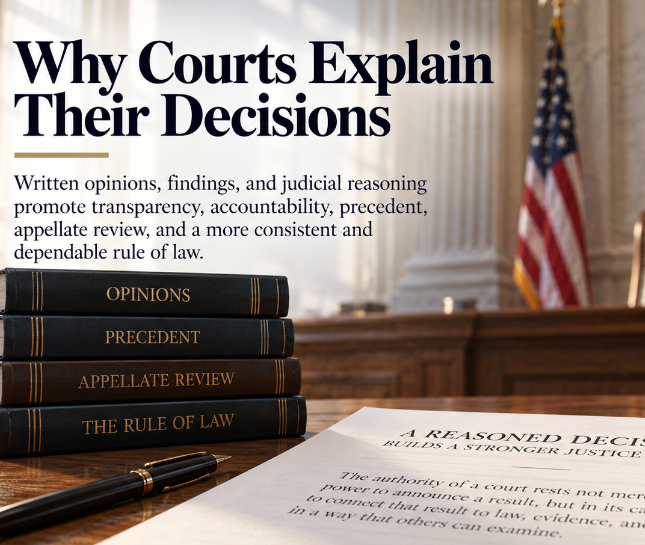
Courts Should Have Reasons for What They Decide
A judicial decision is more credible when its legal and factual basis can be understood.
For many significant rulings, courts provide findings, explanations, written orders, or opinions identifying the grounds for the decision. The amount of explanation legally required varies substantially by proceeding and ruling; not every judicial decision requires a lengthy written opinion.
Nevertheless, reasoned decision-making serves several important purposes.
First, it tells the parties why something happened.
A losing party may strongly disagree with the court and still be able to understand the rule the court applied and the facts the court considered important.
Second, giving reasons disciplines decision-making.
A conclusion that seems obvious at first may become more difficult to defend when the decision-maker must connect it to the evidence and governing law.
Third, reasons make review possible.
An appellate court examining a lower court's ruling may need to know what legal standard was used, what factual findings were made, and why judicial discretion was exercised in a particular way.
Finally, reasoned opinions contribute to the development of law itself.
Published judicial opinions allow lawyers, judges, scholars, government officials, and members of the public to understand how legal rules are being interpreted. Some decisions become precedent that guides disputes far beyond the original case.
The explanation is therefore not merely an accessory to adjudication.
In many contexts, it is part of what makes judicial power accountable to law.
Fairness Does Not Mean Everyone Wins
This may be one of the most important distinctions in understanding courts.
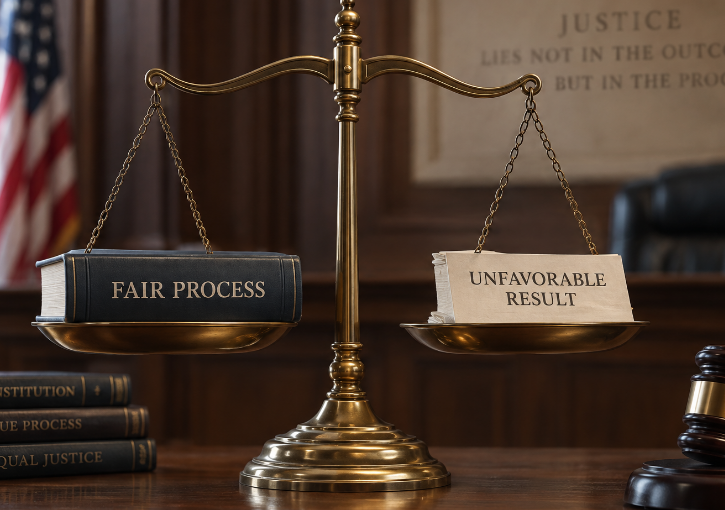
A fair process can produce an unfavorable result.
Two parties can receive notice, present their arguments, introduce admissible evidence, appear before an impartial judge, and receive a reasoned decision—and one of them will usually still lose.
That does not make fairness meaningless.
It demonstrates why procedural fairness and substantive outcome are different concepts.
A person can legitimately argue that a judge interpreted the law incorrectly. A factual finding can be challenged as unsupported. An evidentiary ruling may be erroneous. A court can abuse discretion. A constitutional rule can be violated.
The legal system provides mechanisms for raising many such errors.
But disagreement with the result alone does not establish that the proceeding was unjust.
If fairness meant receiving the outcome one wanted, no contested case could ever be fair to both sides.
The more useful question is often not simply, “Who won?”
It is:
How was the decision reached?
Review Provides Another Safeguard
Trial judges are not infallible.
Neither are juries, administrative decision-makers, or appellate judges.
Legal systems therefore employ mechanisms for correcting at least some errors.
Depending upon the proceeding, those mechanisms may include motions for reconsideration, motions for a new trial, administrative review, direct appeals, discretionary appellate review, extraordinary writ proceedings, or other remedies.
Appellate review is especially important, but it is frequently misunderstood.
An appeal is generally not a complete second trial.
Appellate courts apply different standards of review to different types of decisions. Legal questions may receive relatively independent review, while factual findings or discretionary decisions can receive substantially greater deference.
Procedural requirements also matter. Issues may need to have been properly raised and preserved. Deadlines can determine whether review remains available. Some rulings are immediately appealable; others must await a final judgment. Some decisions are reviewable only under limited circumstances.
These restrictions reflect a competing principle: cases eventually need to end.
A legal system that permitted every issue to be relitigated indefinitely would provide review without finality.
Justice therefore requires a balance.
There must be meaningful ways to identify and correct qualifying legal error, while judgments must eventually become sufficiently final for people and institutions to rely upon them.
Procedure Is Not the Enemy of Justice
Court procedure is sometimes described as an obstacle standing between a person and “the merits” of a dispute.
Poorly designed or unnecessarily complex procedures certainly can create barriers.
But procedure itself serves an essential function.
Deadlines tell parties when action must occur. Rules of evidence govern what information can support factual findings. Pleading requirements identify the issues in dispute. Rules governing service provide notice. Standards of review define the relationship between trial and appellate courts. Requirements for objections allow alleged errors to be identified when they may still be corrected.
Without procedure, judicial decisions would become less predictable, not more fair.
The real question is whether procedure serves legitimate adjudicative purposes while preserving the meaningful protections the law requires.
That is why due process is flexible rather than identical in every setting. The Supreme Court has recognized that the procedures appropriate to one kind of dispute may be unnecessary or inadequate in another.
Fair procedure is not necessarily maximum procedure.
It is the process that is legally appropriate to the interests, risks, and circumstances involved.
Justice Is Both a Result and a Method
Courts exist to decide disputes.
Results therefore matter enormously.
An impeccably organized proceeding cannot justify a judgment that violates controlling law, just as a correct result reached through fundamentally defective procedures may raise serious legal concerns.
Justice requires attention to both.
The substantive law determines rights, duties, powers, prohibitions, and remedies.
The judicial process determines how competing claims about those things will be heard and decided.
That process is strongest when several principles operate together:
An impartial decision-maker.
Adequate notice.
A meaningful opportunity to be heard.
Decisions grounded in an appropriate evidentiary record.
Consistent application of governing law.
Reasoned decision-making where explanation is required or important.
And meaningful review where the legal system provides it.
None of these principles guarantees that courts will never make mistakes. No human institution can provide that guarantee.
Instead, they create structures designed to make arbitrary or erroneous decisions less likely, make legal authority more accountable, and provide mechanisms for challenging mistakes when they occur.
That may be one of the most enduring lessons of the rule of law.
Justice is not demonstrated merely by announcing the right result.
It is demonstrated by a system capable of showing how, and according to what law, that result was reached.