A court can resolve a dispute with only a few words.
- Motion granted.
- Motion denied.
- Judgment for the plaintiff.
- Judgment for the defendant.
- Conviction affirmed.
- Conviction reversed.
Those statements tell the parties what happened. But they do not answer another question that is often just as important:
Why?
In many significant cases, courts do more than announce who prevailed. Judges identify the governing law, describe relevant facts, evaluate arguments, make findings, and explain how they reached their conclusions.
Sometimes that explanation is contained in a lengthy published opinion. Sometimes it appears in a shorter written order. Trial judges may make findings of fact and conclusions of law. Other rulings may be explained orally from the bench.
The form varies according to the court and proceeding, and not every judicial decision requires an extensive written explanation.
But the practice of giving reasons serves a fundamental purpose.
A legal system based on rules should be capable, when appropriate, of showing how those rules produced a decision.
That makes judicial explanation more than an exercise in legal writing.
It is part of what makes courts accountable institutions.
A Result and a Reason Are Different Things
Consider two hypothetical orders resolving the same dispute.
The first says:
The defendant's motion is granted.
The second says that the motion is granted because a particular statute governs the dispute, controlling precedent interprets that statute in a particular way, and the undisputed facts satisfy the resulting legal standard.
Both orders may produce exactly the same immediate outcome.
But they provide very different amounts of information.
The first tells the parties who won.
The second tells them why.
That distinction matters because judicial authority is not supposed to rest merely on the fact that a judge possesses the power to decide.
Courts are institutions of law. Their decisions are expected to have a legal foundation.
Explaining a decision can reveal that foundation.
Written Opinions Make Judicial Reasoning Visible
One of the most familiar forms of judicial explanation is the written opinion.
A judicial opinion may describe the procedural history of a case, identify important facts, state the legal questions presented, discuss statutes and earlier cases, evaluate the parties' arguments, and explain the court's conclusions.
Opinions vary enormously in length and complexity.
A straightforward appeal may require a relatively concise explanation. A major constitutional dispute may produce hundreds of pages when majority, concurring, and dissenting opinions are considered together.
The purpose, however, is not simply to produce a lengthy document.
The important feature is the reasoning.
A useful opinion creates a path between the law and the result.
It allows a reader to ask:
What rule did the court apply?
What facts did it consider important?
How did it interpret the relevant authority?
Which arguments did it accept or reject?
How did those conclusions lead to the judgment?
Without that reasoning, the public may know the result while knowing very little about the judicial decision itself.
Explanation Promotes Transparency
Courts exercise governmental power.
Their decisions can determine ownership of property, enforce contracts, invalidate governmental actions, impose criminal sentences, resolve disputes involving enormous sums of money, and determine important individual rights.
Transparency provides a way to examine how that power is being exercised.
When a court explains its reasoning, lawyers, litigants, journalists, scholars, other judges, and members of the public can evaluate the decision for themselves.
They may agree with the reasoning.
They may strongly disagree.
But they have something concrete to examine.
A decision that provides reasons can be criticized on the basis of those reasons. A legal interpretation can be compared with the statutory text. A court's use of precedent can be evaluated against the cases it cites. Its characterization of the facts can be compared with the record where that record is available.
Explanation therefore makes judicial action more visible.
That visibility does not guarantee correctness.
It makes scrutiny possible.
Reasons Encourage Accountability
Judicial independence is an important feature of the American court system. Judges should not decide cases according to political pressure, popularity, threats, or the preferences of powerful individuals.
But independence does not mean the absence of accountability.
One important form of judicial accountability comes from the obligation to ground decisions in law and, in many circumstances, explain that reasoning.
A judge writing an opinion must ordinarily do more than reach an intuitive conclusion.
The judge may have to identify authority, confront contrary arguments, distinguish unfavorable precedent, explain factual findings, and connect the applicable rule to the result.
That process imposes discipline.
It requires a decision to be expressed in terms that other people can evaluate.
A conclusion that initially appears obvious may become more difficult when the decision-maker must explain precisely which legal principle supports it.
Writing can expose gaps in reasoning.
It can reveal inconsistencies.
It can force difficult questions into the open.
The requirement or practice of explanation therefore affects not only how a decision is communicated after it has been made.
It can improve the process through which the decision is made.
Findings Explain What the Court Believed Happened
Not every judicial dispute turns primarily on the meaning of law.
Many depend on facts.
Did a party breach a contract?
Was a statement made?
Did particular conduct occur?
What amount of damage resulted?
Was testimony credible?
In proceedings where a judge acts as the factfinder, the court may make findings identifying the facts it determined to be established.
Findings serve an important explanatory function.
Suppose two witnesses give conflicting accounts of an event and the court ultimately rules for one side.
A bare judgment may reveal nothing about how the factual conflict was resolved.
Findings can show which facts the court accepted and which issues mattered to the outcome.
This becomes particularly important when the case is later reviewed.
An appellate court cannot meaningfully evaluate certain claims of error if it cannot determine what the trial court actually decided or the basis upon which it acted.
Findings help create that record.
Explanation Makes Appellate Review More Meaningful
The relationship between explanation and appellate review is especially important.
Appellate courts generally review decisions made by lower courts. But meaningful review requires some understanding of what the lower court did.
Imagine an appellate court receiving an order that simply says:
Denied.
Depending on the issue and governing law, the appellate court may be able to infer the basis for the ruling from the record. In other circumstances, the absence of findings or reasoning can make review substantially more difficult.
What legal standard did the trial judge use?
Was a relevant factor considered?
Did the court misunderstand the governing statute?
Was the decision based on a factual finding or a legal conclusion?
Did the court exercise discretion, or did it incorrectly believe it had no discretion?
An explanation can answer those questions.
This does not mean every order must contain a comprehensive opinion. Different types of rulings carry different requirements, and appellate courts sometimes review decisions whose reasoning is brief or implicit.
But where explanation is required or provided, it gives reviewing courts a clearer basis for determining whether legal error occurred.
In that sense, reasons create a bridge between the original decision and the process for reviewing it.
Opinions Create Precedent
Judicial explanations can have consequences far beyond the parties to a particular case.
In systems that follow precedent, certain judicial decisions establish legal principles that guide later courts.
This is one of the most significant reasons written opinions matter.
If a higher court merely announced:
Affirmed,
future judges might know the outcome of that particular case but learn little about the rule that should govern the next one.
A reasoned opinion can do much more.
It can interpret statutory language.
It can define a legal standard.
It can explain how constitutional principles apply to a particular situation.
It can resolve disagreement among lower courts.
It can distinguish an earlier precedent.
It can establish a framework that lawyers and judges will use for years.
The reasoning, not merely the winner's name, is what gives the decision much of its value as precedent.
Precedent Promotes Consistency
This connection between opinions and precedent also supports equal application of law.
If courts explain the rules they use, later courts have a reference point for deciding similar cases.
That encourages consistency.
Suppose a court interprets a statute in one case. A later court confronting materially similar statutory language can examine that reasoning rather than beginning from nothing.
Depending on the court hierarchy and the type of precedent involved, the earlier decision may be binding or merely persuasive.
Either way, the written explanation contributes to an ongoing legal conversation.
The later court can follow it.
It can distinguish it because the facts are materially different.
Where legally permitted, it may disagree with it.
A higher court may eventually overrule it.
But each of those actions requires engagement with reasoning.
That process makes legal development more structured and visible than a system in which courts simply announce outcomes without explaining the principles connecting one case to another.
Reasons Help Lawyers Advise Their Clients
Judicial explanations also have a practical function outside the courtroom.
People regularly need to know what the law is likely to require before a dispute reaches court.
Businesses structure transactions.
Attorneys advise clients.
Government agencies design policies.
Individuals decide whether to file claims, settle disputes, or change their conduct.
Written judicial opinions help make those decisions possible.
A collection of unexplained outcomes would provide limited guidance.
Knowing that a plaintiff won one case and lost another tells a lawyer relatively little if the reasons for those results are unknown.
Reasoned decisions allow lawyers to identify the facts and legal principles that affected the outcomes.
That makes the law more predictable.
Perfect predictability is impossible. New disputes present new facts, statutes change, precedent evolves, and judges sometimes disagree.
But explaining decisions allows people to understand the legal landscape more clearly than unexplained judgments would.
Explanation Helps the Losing Party Understand the Decision
A court's explanation also matters to the people who do not prevail.
Losing a legal dispute can have serious consequences.
A litigant may lose money, property, liberty, a business opportunity, or a claim the person sincerely believed was valid.
A reasoned decision cannot eliminate that disappointment.
But it can answer an important question:
Why did I lose?
Perhaps the claim was filed too late.
Perhaps a statute did not create the right the plaintiff believed it created.
Perhaps the evidence failed to satisfy the required burden of proof.
Perhaps controlling precedent foreclosed an argument.
Perhaps the judge found one witness more credible than another.
Perhaps the court agreed that an error occurred but concluded that the error did not legally justify the requested remedy.
Understanding the reason does not require agreeing with it.
But there is a significant difference between being told that the law does not support your position and simply being told that you lost.
Explanation recognizes that people subject to judicial authority have an interest in understanding how that authority was exercised.
A Reasoned Decision Can Still Be Wrong
An explanation should not be confused with proof that a decision is correct.
Courts can write detailed opinions and still commit errors.
A judge may misunderstand a statute.
A precedent may be interpreted incorrectly.
A factual finding may lack sufficient support.
An appellate court may later reject the reasoning.
Judges themselves may disagree sharply.
Some of the most important cases in American legal history contain majority opinions and dissents presenting fundamentally different understandings of the same constitutional text, precedent, or historical record.
The value of explanation is not that it makes disagreement disappear.
Its value is that it makes the disagreement intelligible.
When judges disagree in writing, readers can compare their reasoning.
The dispute becomes one about identifiable legal principles rather than unexplained conclusions.
That is a strength of reasoned decision-making even when no single explanation commands universal agreement.
Dissents and Concurrences Also Matter
Appellate decisions sometimes include more than a majority opinion.
A judge may concur, agreeing with the judgment but reaching it through different reasoning.
Another judge may dissent, explaining why the majority's conclusion is wrong.
Neither separate opinion changes the immediate result if it does not command the necessary votes.
Yet concurrences and dissents can still influence the development of law.
A concurrence may identify a narrower basis for resolving a case.
A dissent may expose what its author sees as weaknesses in the majority's analysis.
Later courts, lawyers, and scholars may return to those arguments.
In some instances, reasoning initially expressed in dissent may influence later legal developments.
Separate opinions illustrate an important feature of judicial explanation:
Courts do not merely record decisions. They preserve legal arguments.
That written record allows the reasoning of one generation of judges to be examined by the next.
Not Every Decision Requires a Long Opinion
The importance of explanation does not mean every judicial act should generate dozens of pages.
Courts handle enormous numbers of matters.
Many rulings concern routine procedural issues. Some questions are controlled directly by settled precedent. Some applications are uncontested. Other matters require prompt resolution.
The amount of explanation appropriate for a decision can therefore vary substantially.
A brief order may be entirely appropriate in one situation and inadequate in another.
Some appellate decisions are unpublished or designated as nonprecedential under applicable rules. Trial courts may issue minute orders or oral rulings. Certain requests can be resolved without extensive findings.
The broader principle is not that more words always produce more justice.
Length and quality are different things.
A five-page opinion that clearly identifies the issue, governing law, and reasoning may explain a decision better than fifty pages of unnecessary discussion.
What matters is whether the explanation is adequate for the function it needs to serve.
Transparency Has Limits
Judicial transparency is also not absolute.
Courts sometimes handle information that cannot appropriately be made fully public.
Proceedings may involve minors, confidential business information, protected personal information, national security concerns, sealed records, or other matters subject to legal restrictions.
Courts must sometimes balance public access against competing legal interests.
Similarly, judges generally are not expected to disclose every private thought or every preliminary reaction that occurred during deliberation.
Judicial explanation concerns the legal basis for the court's decision, not unrestricted access to the internal mental process of the judge.
The goal is sufficient transparency to understand and evaluate the exercise of judicial authority while respecting legitimate limits imposed by law.
Reasons Constrain Arbitrary Power
There is a deeper reason explanations matter.
Power is easier to exercise arbitrarily when no explanation is required.
If a decision-maker can simply announce an outcome, there may be little visible distinction between a decision based on law and one based on personal preference.
Requiring reasons changes that dynamic.
A court explaining its ruling ordinarily must connect the outcome to something outside the judge's personal will—to constitutional text, statutes, regulations, precedent, evidence, procedural rules, or recognized principles of law.
Other people can then examine that connection.
Does the cited case actually support the proposition?
Does the statute say what the court says it says?
Do the findings support the judgment?
Did the court address the governing legal standard?
Could the same reasoning be applied consistently in the next case?
Those questions are possible because reasons have been given.
Explanation therefore functions as a constraint.
It requires power to speak the language of law.
Explaining Why Can Be Nearly as Important as Announcing Who Won
Every case eventually needs an outcome.
Courts cannot simply analyze disputes indefinitely. At some point, a judgment must be entered, a motion granted or denied, a conviction affirmed or reversed, or some other decision made.
The result has immediate importance to the parties.
But courts also serve a broader institutional role.
They interpret law.
They establish precedent.
They resolve uncertainty.
They create records for appellate review.
They demonstrate how governmental authority is being exercised.
And they provide future courts and future litigants with principles that extend beyond a single dispute.
Those functions depend heavily on explanation.
A judgment tells us what the court did.
A reasoned decision tells us why.
In a legal system committed to the rule of law, that difference is fundamental.
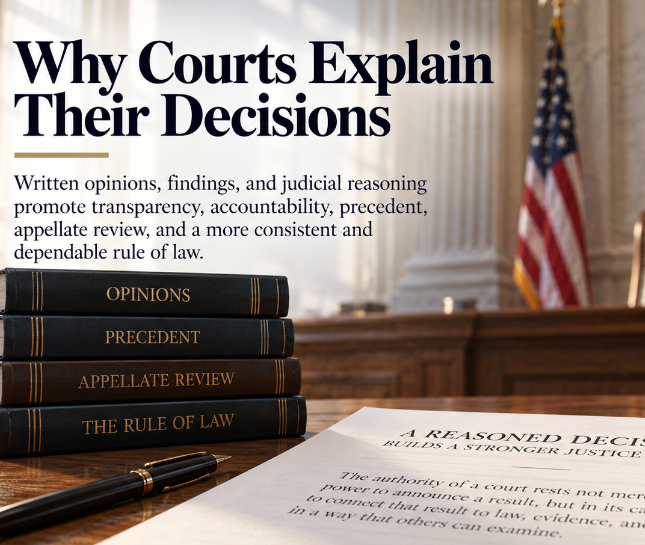
The authority of a court rests not merely in its power to announce a result, but in its capacity to connect that result to law, evidence, and reason in a way that others can examine.
That is why explaining a judicial decision can be nearly as important as announcing who prevailed.