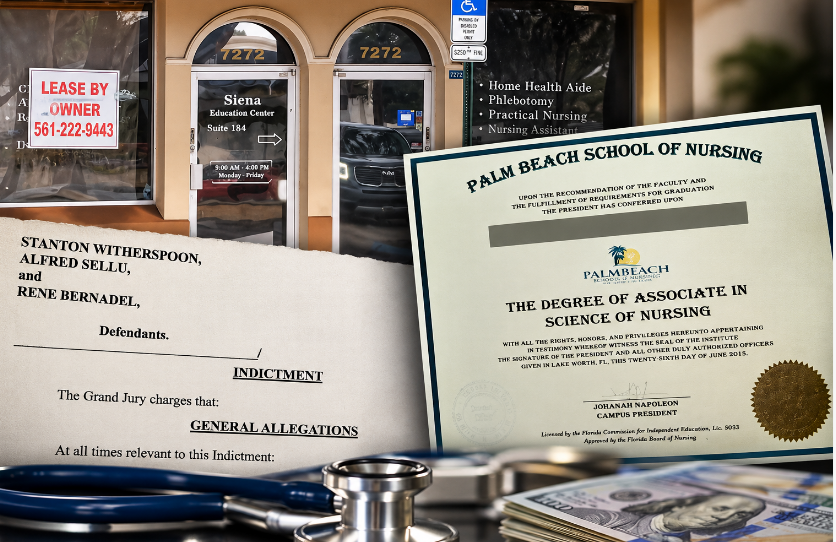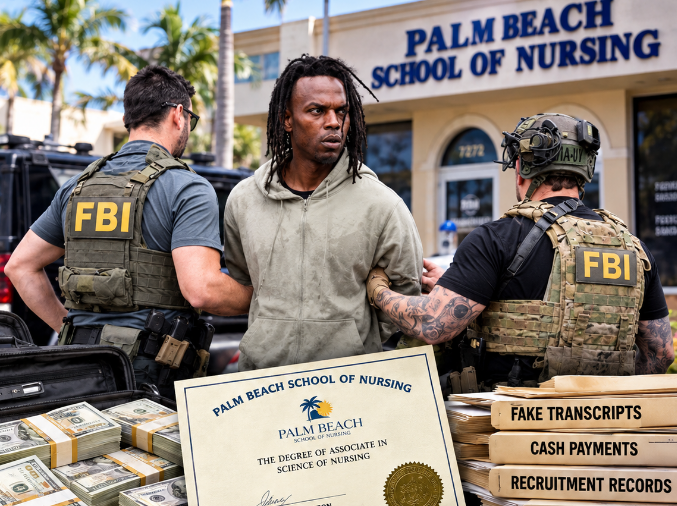
 When federal investigators announced Operation Nightingale, the most visible defendants were nursing-school operators, employees and recruiters accused of selling fraudulent diplomas and transcripts.
But thousands of other people were on the opposite side of those transactions.
They were the recipients.
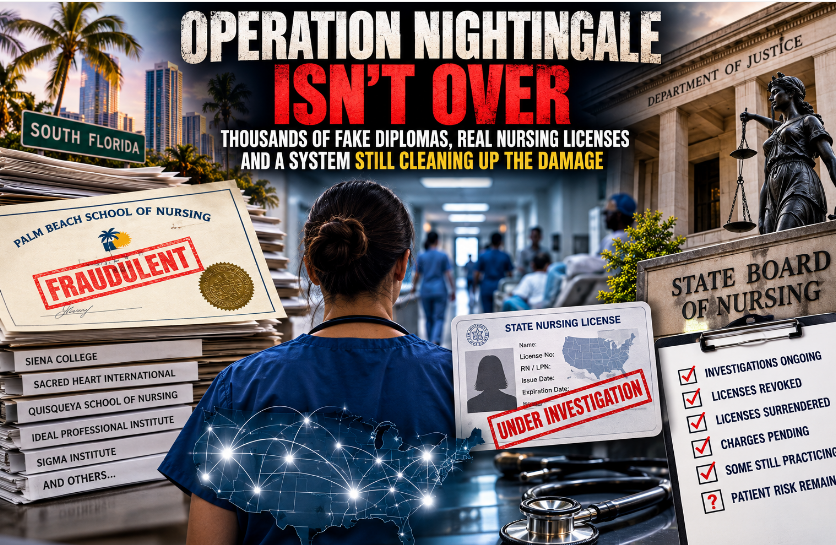
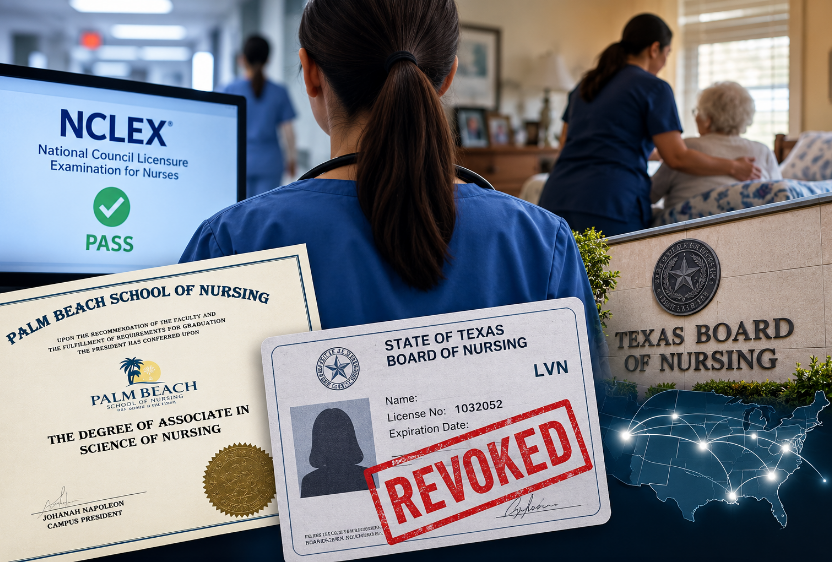
Federal authorities said the first phase of the investigation involved more than 7,600 fraudulent nursing diplomas and transcripts. The credentials allowed purchasers to satisfy the educational prerequisite for the NCLEX nursing examination; those who passed could then obtain licenses and nursing jobs.
Phase II expanded the problem substantially. In 2025, federal prosecutors said another group of South Florida schools had generated approximately 7,300 fraudulent diplomas. Prosecutors said recipients used those credentials to obtain licenses in states including Florida, California and Pennsylvania, with some obtaining multistate privileges under the Nurse Licensure Compact.
In June 2026, prosecutors provided another extraordinary number: approximately 2,274 recipients of fraudulent credentials from Carleen Noreus's two schools passed nursing board examinations, enabling them to obtain licenses and work as nurses.
The criminal cases answered what happened to many of the people selling the credentials.
What happened to the people who obtained them has been considerably more complicated.
Buying a Fraudulent Diploma Did Not Automatically Produce a Criminal Prosecution
One distinction is essential.
The federal Operation Nightingale prosecutions announced by the Justice Department have principally targeted the people accused of operating the schemes, selling the credentials and recruiting customers.
In 2023, federal authorities charged and ultimately convicted defendants involved in the credential-selling operation. Phase II similarly brought fraud charges against school owners, operators and employees for their alleged roles in selling fraudulent credentials.
Contemporaneous reporting in 2023 quoted federal investigators as saying that purchasers themselves had not, at that point, been targeted for criminal prosecution as authorities focused on the people running the schemes and identifying unqualified nurses.
That distinction matters.
A nurse whose license was obtained through an invalid diploma can lose the legal right to practice without necessarily being convicted of a crime.
And that is exactly where much of the enforcement moved:
state nursing boards.
The License Itself Became the Consequence
Nursing licenses are issued by states.
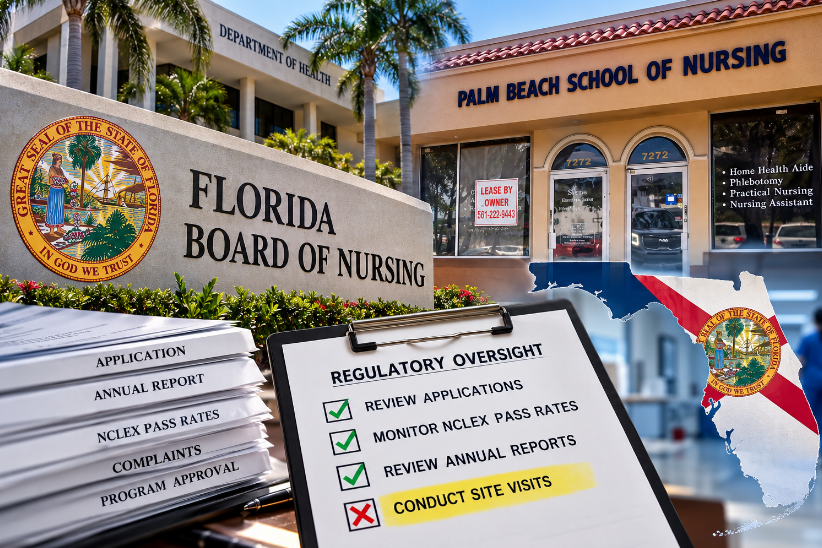
Once federal investigators identified the schools and individuals potentially associated with fraudulent credentials, nursing regulators around the country began examining their own licensing records.
The National Council of State Boards of Nursing said state regulatory bodies were investigating individual cases and taking actions that could include loss of license. California likewise began identifying applicants and licensees connected with the implicated programs.
Delaware went further in describing its objective.
Its Board of Nursing said it was working with other regulators and authorities to resolve the cases, specifically including the annulment of licensure obtained through fraudulent means.
For someone who had used the credential to build a nursing career, that consequence could be enormous.
The diploma had opened the door to the NCLEX.
The NCLEX had opened the door to the license.
The license had opened the door to employment.
Attack the validity of the diploma, and the entire chain could collapse.
Some Nurses Simply Surrendered Their Licenses
California's experience reveals another consequence that received far less attention than the federal criminal cases.
Some nurses apparently decided not to fight.
In its 2026 Sunset Review, the California Board of Registered Nursing reported that its staff had identified several licensees who obtained licenses using fraudulent nursing degrees.
According to the Board, many expressed a willingness to voluntarily surrender their licenses rather than undergo a lengthy and expensive disciplinary proceeding.
That presented California with an unusual legal problem.
The Board explained that its existing voluntary-surrender procedure was cumbersome. The licensee and Board could agree to surrender, but the matter still had to move through a disciplinary process.
The Board therefore sought a statutory mechanism specifically allowing a licensee to surrender a nursing license when it had been obtained using fraudulent educational credentials.
The aftermath of Operation Nightingale was effectively forcing states to rethink their licensing procedures.
The government had thousands of questionable educational records to examine.
Not every recipient wanted a hearing.
Others Fought to Keep Their Licenses
Other nurses did contest the allegations.
That is important because appearing on an Operation Nightingale list did not, by itself, establish that someone knowingly purchased a fraudulent diploma.
Some implicated schools had legitimate students.
California's Board specifically warned against assuming that every person associated with one of the schools possessed fraudulent credentials. It said each individual was entitled to due process before the state could take action against a license.
Texas administrative records illustrate why individual proceedings matter.
In the case of Grace Ekpesu, an administrative record involving Sacred Heart International Institute found that the school's issuance of her diploma was unlawful.
But the findings also stated that Ekpesu had no previous nursing discipline, was considered trustworthy and had caused no proven actual harm to patients or the public through her nursing practice.
Those findings do not make the underlying educational problem disappear.
The same record states that an LVN who is not properly educated and trained poses a risk to patients or the public.
But it illustrates the difference between two questions:
Was the nursing credential valid?
And did the individual nurse knowingly participate in fraud?
Those are not necessarily the same inquiry.
Passing the NCLEX Didn't Save the License
For purchasers who passed the NCLEX, one argument might initially seem compelling:
If they could pass the same national licensing examination as everyone else, why shouldn't they remain nurses?
State regulators have generally rejected the premise that the examination replaces nursing education.
Nursing licensure requires both components.
Candidates must complete qualifying nursing education and pass the licensing examination.
The Justice Department emphasized that requirement again in Phase II, explaining that candidates seeking RN or LPN/VN licensure must graduate from an approved prelicensure program and pass the NCLEX.
The exam therefore could not retroactively supply hundreds of hours of classroom instruction and clinical experience that a fraudulent transcript falsely claimed had occurred.
That distinction became central to the licensing cases.
A purchaser could have passed the NCLEX.
A purchaser could have been licensed for years.
A purchaser could even have a clean employment record.
And a nursing board could still conclude that the person was never legally qualified for the license in the first place.
Some Could Continue Working While Their Cases Were Pending
The process also created an uncomfortable period between accusation and final discipline.
Regulators could not simply erase thousands of nursing licenses because a person's name appeared in federal investigative material.
California explicitly said every individual was entitled to due process and that it could not presume all graduates of the implicated schools possessed fraudulent credentials.
Texas similarly reported that formal charges had been filed against some licensees and emphasized that the Board had to follow state due-process requirements before revoking a license.
That meant some individuals could remain licensed while their cases moved through the administrative system.
The reason was not that regulators considered fraudulent nursing credentials acceptable.
It was that a government license is a legal interest that generally cannot simply be taken away based solely on suspicion.
Investigators had to establish what happened person by person.
And Not Everyone From These Schools Was a Fraud
That may be the most important caution in examining the purchasers.
Operation Nightingale involved schools that also had legitimate students.
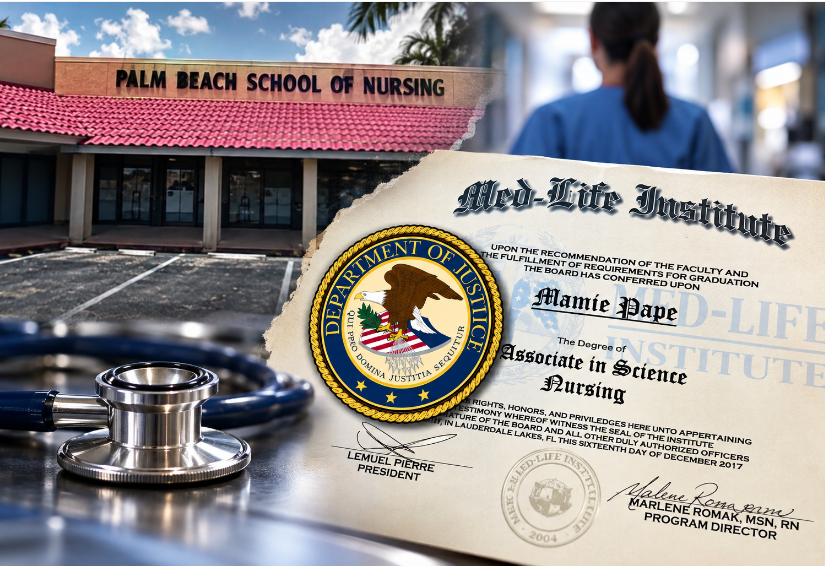
California's Board explained that allegedly fraudulent diplomas could look essentially the same as documents issued to legitimate graduates.
So merely saying someone graduated from Palm Beach School of Nursing, Sacred Heart, Siena or another implicated institution is not enough to establish that the person purchased a fraudulent credential.
Regulators needed evidence showing what education the individual actually completed.
That could mean reviewing transcripts, enrollment information, clinical records, school databases and other evidence.
And that is why the cleanup has taken years.
The Consequences Can Follow a Nurse Across State Lines
A nursing license is not necessarily confined to one state.
Phase II prosecutors said some people who obtained licenses through fraudulent credentials also obtained multistate privileges under the Nurse Licensure Compact, potentially allowing them to practice in other participating states without obtaining another individual state license.
Disciplinary information can travel as well.
California says final disciplinary actions involving licensees are publicly available through its licensing system and that relevant information is also reported through the national Nursys system used by nursing regulators.
Losing one license therefore does not necessarily mean simply moving somewhere else and starting over.
The educational defect can follow the nurse.
They Could Lose More Than a License
There is also an economic consequence that is easy to overlook.
Federal prosecutors said the fraudulent credentials were used to obtain nursing jobs, salaries and benefits from health-care providers that believed they were hiring properly qualified nurses.
Once the underlying license disappears, so does the legal basis for continuing to work as an RN or LPN/LVN.
That can mean the loss of a career, wages and professional standing built over years.
And for someone who knowingly participated in obtaining false educational records, licensing discipline does not necessarily define the outer limit of possible legal exposure. The specific consequences depend on the person's conduct and applicable state and federal law.
What the public record does not support is treating every Operation Nightingale credential recipient as though he or she has already been criminally convicted.
The federal cases against the sellers and the administrative cases against licensees are different proceedings with different burdens and different consequences.
The Sellers Went to Federal Court. The Purchasers Went Before Nursing Boards.
That may ultimately be the clearest way to understand the two sides of Operation Nightingale.
The people who operated and facilitated the credential schemes faced federal fraud prosecutions.
The people whose licenses rested on those credentials faced a different reckoning.
Their names were sent to nursing regulators.
Their educational histories were reopened.
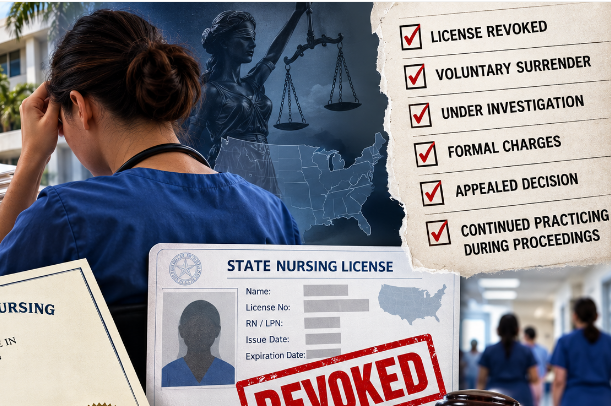
Some licenses were revoked.
Some nurses surrendered them voluntarily.
Others demanded hearings and contested the allegations.
Some continued practicing while those proceedings remained unresolved.
And regulators had to distinguish people who actually completed legitimate nursing education from people whose records merely said that they did.
Operation Nightingale therefore did not end when federal agents arrested the diploma sellers.
For thousands of credential recipients, that was when an entirely different investigation began.
They had already used the diplomas to get through the door.
Now the government had to determine, one nurse at a time, who had ever been legally entitled to walk through it.