 It began with something that should have been impossible.
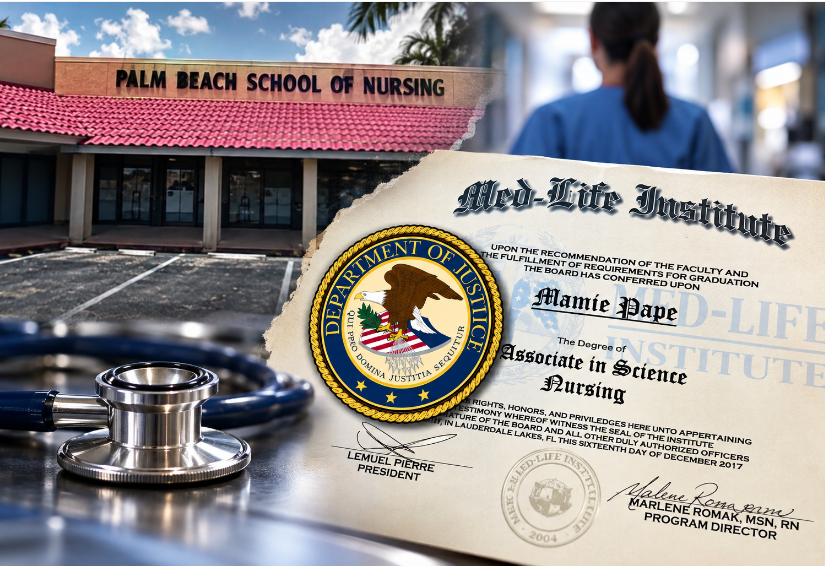
People who had not completed the nursing education and clinical training represented on their school records obtained diplomas and transcripts from Florida nursing schools.
- Some used those documents to become eligible for the NCLEX.
- Some passed.
- States issued them nursing licenses.
- Healthcare facilities hired them.
- And patients encountered them not as people suspected of possessing fraudulent educational credentials, but as licensed nurses.
That is what makes Operation Nightingale considerably more significant than an ordinary diploma-fraud prosecution.
The fraudulent documents did what they were purchased to do.
They penetrated the system.
More Than 7,600 Credentials in the First Investigation
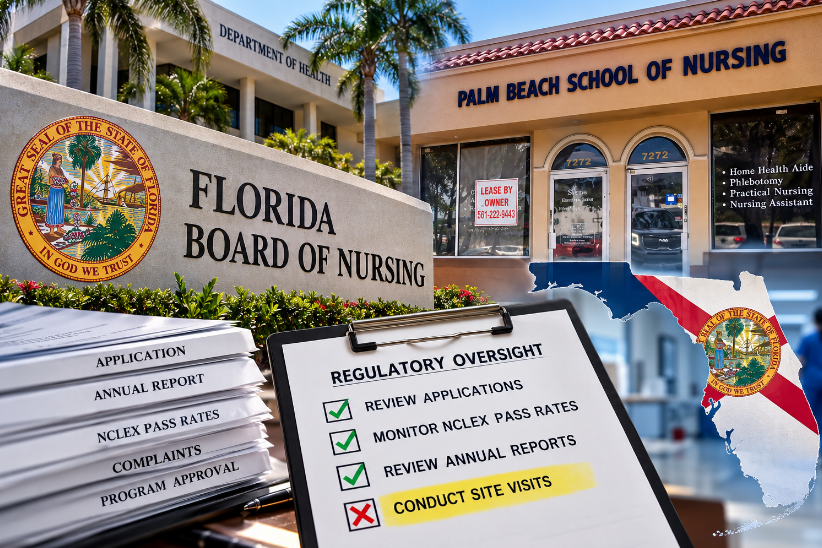
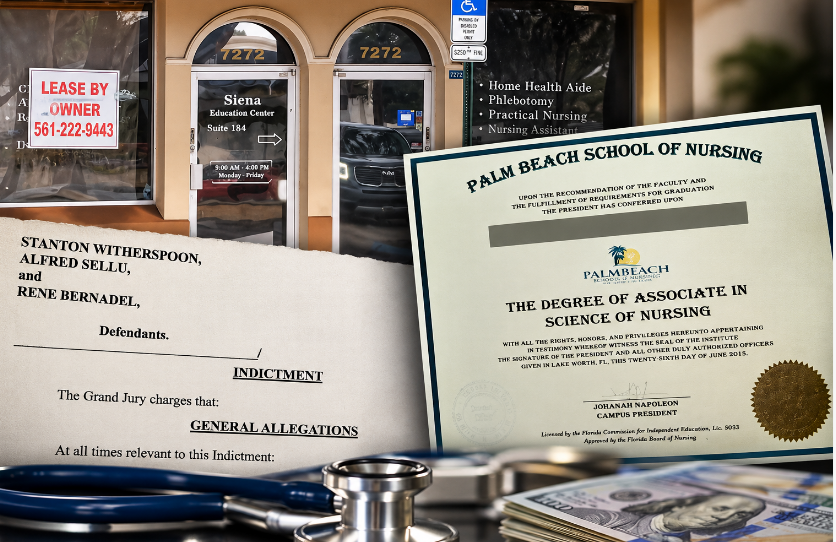
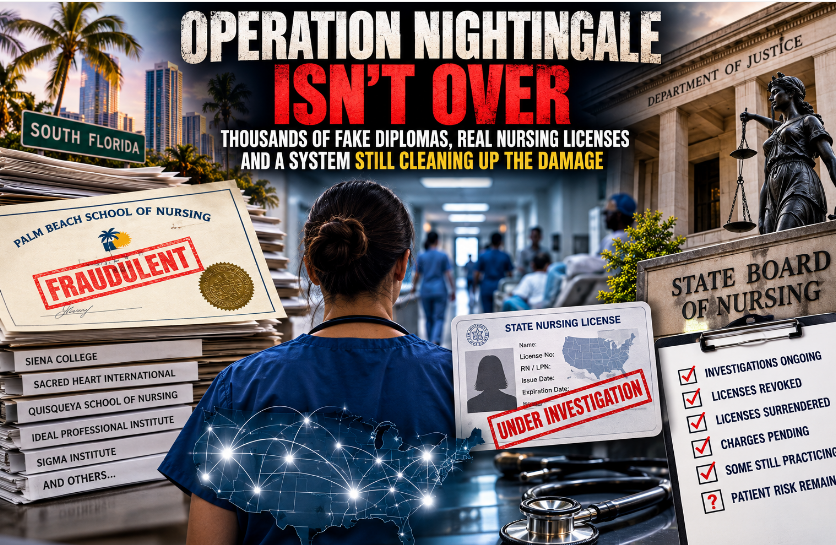
When federal authorities publicly announced Operation Nightingale in January 2023, prosecutors said more than 7,600 fraudulent nursing diplomas had been distributed through three South Florida nursing schools: Palm Beach School of Nursing, Siena College and Sacred Heart International Institute.
The schools are now closed.
The Justice Department said the fraudulent diplomas and transcripts allowed purchasers to qualify for the national nursing board examination. Those who passed could then obtain RN or LPN/VN licenses and nursing jobs.
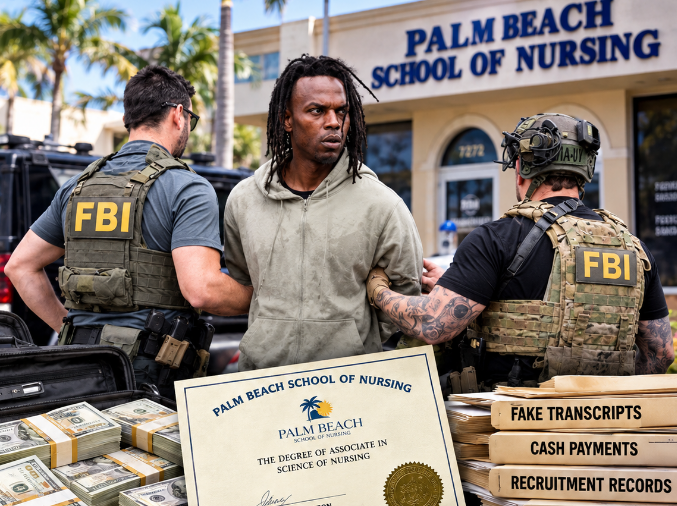
Federal prosecutors eventually reported that 30 defendants were charged and convicted by guilty plea or trial in Phase I.
But shutting down those operations did not end the problem.
It exposed it.
Then Investigators Found Thousands More
In September 2025, the Justice Department announced Phase II of Operation Nightingale.
This time, prosecutors alleged schemes involving multiple additional Florida for-profit nursing schools.
The numbers were again staggering.
According to the Justice Department, the Phase II schemes generated approximately 7,300 fraudulent diplomas.
Prosecutors alleged that recipients had not completed the coursework and clinical training represented on their records. Nevertheless, some used the documents to obtain nursing licenses in states including Florida, California and Pennsylvania.
Some also obtained multistate licensing privileges, potentially allowing them to practice in other Nurse Licensure Compact states.
And federal prosecutors said the fraudulent credentials were used to obtain nursing jobs, salaries and benefits from unwitting healthcare providers across the United States.
The scandal was no longer about three schools.
It was evidence of a much larger vulnerability.
The Fake Diploma Could Lead to a Real License
Operation Nightingale worked because the documents were not the final product.
The license was.
A fraudulent diploma could satisfy the educational documentation needed to reach the NCLEX.
Passing the NCLEX could lead to a state nursing license.
And the state license provided something enormously valuable to its holder:
credibility.
A hospital administrator did not have to personally determine whether a nurse had actually completed hundreds of hours of classroom and clinical education.
That was what the licensing process was supposed to establish.
Employers could look at the license and reasonably believe the state had already answered the fundamental question:
Is this person qualified to practice nursing?
Operation Nightingale demonstrated that, in some cases, the answer embedded in that license was wrong.
Passing the NCLEX Didn't Fix the Missing Education
One of the most uncomfortable facts in the investigation is that some recipients of fraudulent credentials passed the nursing board examination.
That can create the impression that perhaps the education didn't matter.
Federal and state regulators have taken the opposite position.
Nursing licensure requires both qualifying education and passage of the licensing examination. The NCLEX does not substitute for the clinical training that nursing programs are supposed to provide.
That distinction became even more important as Phase II progressed.
In June 2026, the owner of two South Florida nursing schools, Carleen Noreus, pleaded guilty after her federal trial had begun.
The Justice Department then disclosed an extraordinary statistic.
Approximately 2,274 people who obtained fraudulent credentials from her schools passed nursing board examinations, allowing them to obtain nursing licenses and work as nurses in Florida and elsewhere around the country.
That number demonstrates both sides of the problem.
Thousands of recipients were capable of passing a standardized examination.
But prosecutors said they had not completed the education and clinical training their records represented.
The test could measure one thing.
It could not recreate the missing education.
They Were Already Working
By the time authorities identified the schemes, this was not merely a licensing problem.
It was an employment problem.
The Justice Department says people who passed the NCLEX using fraudulent credentials obtained nursing jobs with healthcare providers that did not know the qualifications were fraudulent.
That means the fraudulent records crossed another important boundary.
They reached patients.
Court St Legal found no authoritative nationwide accounting establishing that Operation Nightingale nurses caused a particular number of patient injuries. That distinction matters, and individual nurses should not be accused of harming patients without evidence.
But the absence of documented injuries is not the same thing as establishing that no harm occurred.
Federal authorities themselves described the scheme as a patient-safety concern because professional licensing exists to ensure that people entrusted with nursing care possess minimum qualifications and competencies.
The unanswered question is how many patient encounters occurred before the credentials were discovered.
No nationwide public accounting appears to answer it.
Florida's Regulatory System Had Its Own Weaknesses
The investigation also exposed a problem larger than individual fraud.
These were not certificates created by someone operating a fake university from a laptop.
The Phase II Justice Department announcement specifically noted that the schools involved had, at one time, been authorized to issue nursing diplomas and transcripts.
That gave their documents an appearance of legitimacy.
Florida regulators monitored nursing programs through mechanisms including applications, reporting requirements and NCLEX performance.
But as Court St Legal previously examined in this series, the scandal raised a much more fundamental regulatory question:
Who was actually verifying that the education appearing on those transcripts had taken place?
Operation Nightingale ultimately required federal investigators to reconstruct that answer.
By then, credentials had already traveled far beyond Florida.
The Federal Cases Didn't Automatically Resolve the Licenses
Federal agents could investigate the schools.
Federal prosecutors could prosecute the people responsible for selling fraudulent credentials.
But nursing licenses belong to a different system.
They are issued and regulated primarily by states.
That meant thousands of potentially affected records had to move into state administrative processes.
Regulators needed to determine whether each individual actually possessed fraudulent credentials.
They could not simply assume that every person who attended an implicated school was illegitimate.
Some schools had real students.
Some recipients contested the allegations.
Professional licenses generally cannot be revoked without the process required by state law.
The result has been a cleanup operation measured in years rather than months.
Texas Shows How Large the Cleanup Became
Texas created dedicated Operation Nightingale pages to track the aftermath.
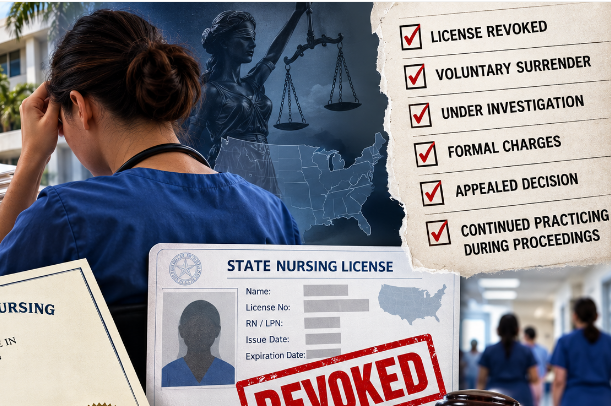
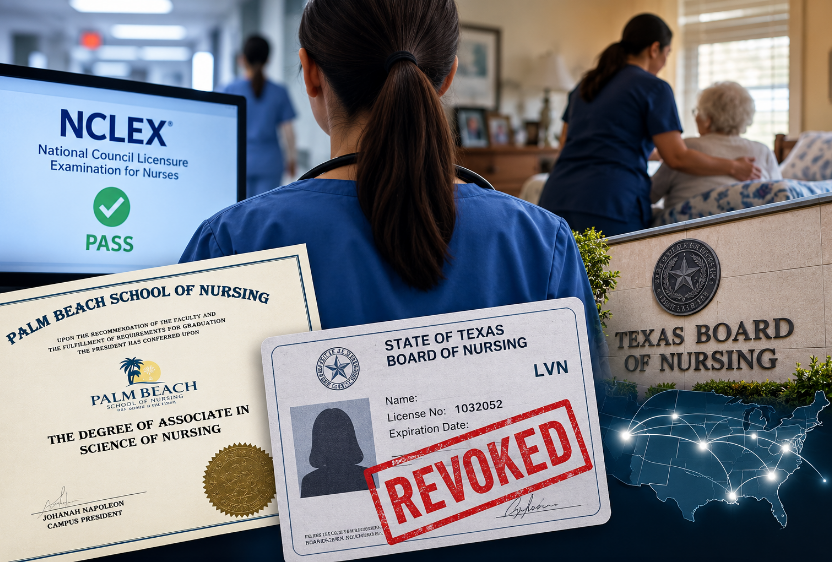
Its Board of Nursing publicly lists people whose licenses have been revoked or voluntarily surrendered after the Board took disciplinary action for fraudulently obtained educational credentials.
The list remains active and says it will continue to be updated as additional disciplinary cases are finalized.
Texas separately maintains another list:
nurses facing formal charges.
That page carries an important warning.
Formal charges are not final disciplinary findings.
And under Texas procedure, a nurse may continue working as a nurse while those charges remain pending.
Texas also lists applicants whose applications for nursing licenses have been denied because of fraudulent educational credentials.
Those three lists demonstrate how many different stages of the Nightingale problem still exist.
Some people have lost licenses.
Some surrendered them.
Some never received one.
And others remain in administrative proceedings.
California Was Still Dealing With It in 2026
California provides perhaps the clearest evidence that Operation Nightingale did not end with the 2023 arrests.
The California Board of Registered Nursing says it continues to identify and investigate California applicants and licensees associated with fraudulent nursing education and continues gathering evidence concerning potentially fraudulent credentials.
Then, in its 2026 Sunset Review, the Board described another consequence.
California investigators had identified licensees who obtained licenses using fraudulent nursing degrees.
According to the Board, many of those individuals were willing to voluntarily surrender their nursing licenses rather than go through prolonged and expensive disciplinary proceedings.
California was seeking a more efficient legal procedure specifically for processing those fraudulent-license surrenders.
That is remarkable when placed on the timeline.
Operation Nightingale became public in January 2023.
Three years later, a major state nursing regulator was still asking lawmakers for better tools to clean up licenses produced by the scheme.
There May Still Be Nurses in the System
The existence of unresolved proceedings requires careful wording.
It would be inaccurate to say that every person associated with an Operation Nightingale school is a fraudulent nurse.
It would also be inaccurate to say that everyone facing formal charges has already been found responsible.
But Texas's current public records establish something significant: there remain nurses facing formal Operation Nightingale charges, and the Board expressly states that nurses are permitted to work while those charges are pending.
California likewise says investigations of particular licensees generally cannot be publicly disclosed while they remain ongoing.
So the public disciplinary lists cannot necessarily tell us the full size of the unresolved population.
That makes it difficult to answer one of the simplest questions raised by this investigation:
How many people whose education is currently under investigation are still practicing nursing?
There does not appear to be a single national public number.
The Purchasers Faced a Different Reckoning
The people who sold the fraudulent credentials faced federal criminal prosecutions.
The people who obtained them have largely encountered another system.
State nursing boards.
For purchasers whose credentials were determined to be fraudulent, the consequences have included revocation, voluntary surrender and denial of licensure.
For others, proceedings remain contested.
And an important distinction remains throughout the entire investigation:
An invalid educational credential does not automatically establish that its holder knowingly committed a crime.
That is why criminal prosecutions of the sellers and administrative licensing proceedings involving nurses cannot simply be treated as interchangeable.
The evidence must be examined individually.
The Healthcare Facilities Were Victims Too
Operation Nightingale also placed healthcare employers in an extraordinary position.
Federal prosecutors have repeatedly described the facilities hiring these nurses as unwitting healthcare providers.
The facilities relied upon nursing licenses that appeared valid.
Those employers may have put the nurses on hospital floors, in nursing homes, inside patients' homes or in other clinical settings believing that the state licensing process had already established their minimum educational qualifications.
In some cases, it had not.
That creates another unresolved question.
How many healthcare facilities have gone back through their own records to determine which patients were treated by employees later linked to fraudulent educational credentials?
No comprehensive national public accounting appears to exist.
And Then There Are the Patients
They are the people largely absent from the federal indictments and licensing orders.
The patients did not purchase diplomas.
They did not approve nursing schools.
They did not issue licenses.
They did not hire investigators.
They simply encountered someone wearing scrubs with "RN" or "LPN" after their name and had every reason to believe the system had established that person's qualifications.
That trust is part of what a professional license represents.
A patient in a hospital bed cannot realistically investigate where a nurse attended school, determine whether clinical rotations occurred or authenticate the transcript used years earlier to obtain a license.
The patient depends on the institutions that exist specifically to do those things.
Operation Nightingale demonstrated what happens when that chain of trust fails.
This Was More Than a Florida Fraud Case
The individual fraud prosecutions are important.
People created and sold false records.
Recruiters found purchasers.
Money changed hands.
Federal prosecutors obtained guilty pleas and convictions.
But focusing only on the defendants misses what makes Operation Nightingale extraordinary.
The scheme exploited the connections between multiple legitimate systems:
A real nursing school.
A real transcript.
A real national examination.
A real state licensing agency.
A real nursing license.
A real healthcare employer.
And ultimately, a real patient.
Once fraudulent information entered that chain, every institution farther down could rely upon what the institution before it had accepted.
That is how a fraudulent educational history could eventually become a legitimate-looking nursing badge.
The Arrests Were the Beginning of the Cleanup
Operation Nightingale has already produced federal convictions, guilty pleas, closed schools, revoked licenses, surrendered licenses, denied applications and years of regulatory proceedings.
Yet the public record in 2026 shows that the aftermath continues.
Texas says its Operation Nightingale disciplinary list will continue to be updated. It also maintains a current list of formal charges, including proceedings that have not reached final disciplinary outcomes.
California says it continues investigating potentially fraudulent educational credentials, and its 2026 report describes licensees surrendering licenses obtained using fraudulent nursing degrees.
Meanwhile, Phase II has greatly expanded the known scope of the schemes.
The government found the schools.
It found the sellers.
It found thousands of fraudulent credentials.
State regulators are finding the licenses.
What remains far less visible are the years between those events—the healthcare facilities where the recipients worked, the patients they treated, the clinical decisions they made, and the consequences, if any, that occurred before anyone knew to question the education behind the license.
That is the part of Operation Nightingale no indictment can completely reconstruct.
The scandal was never merely that thousands of people obtained pieces of paper saying they had completed nursing school.
It was that the pieces of paper worked.