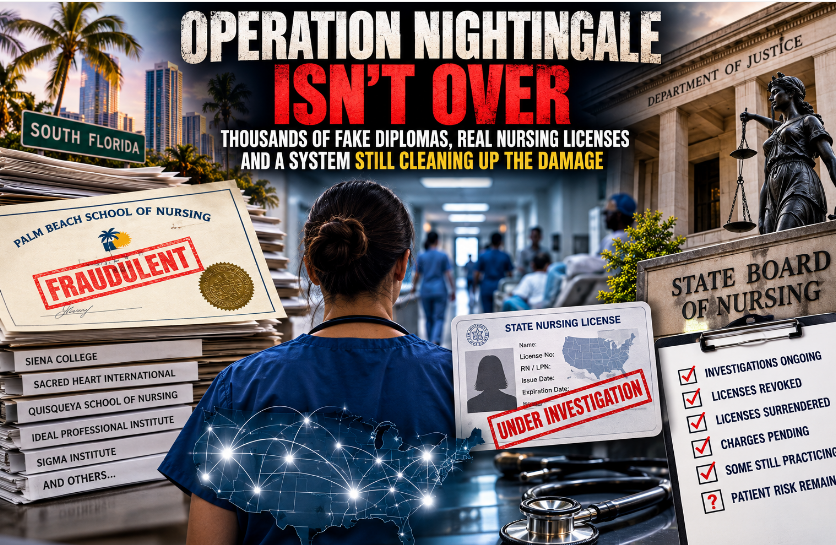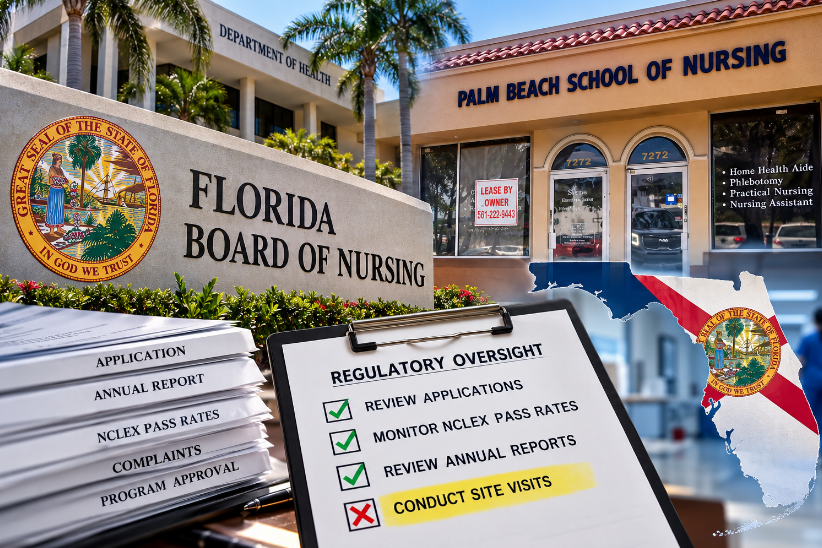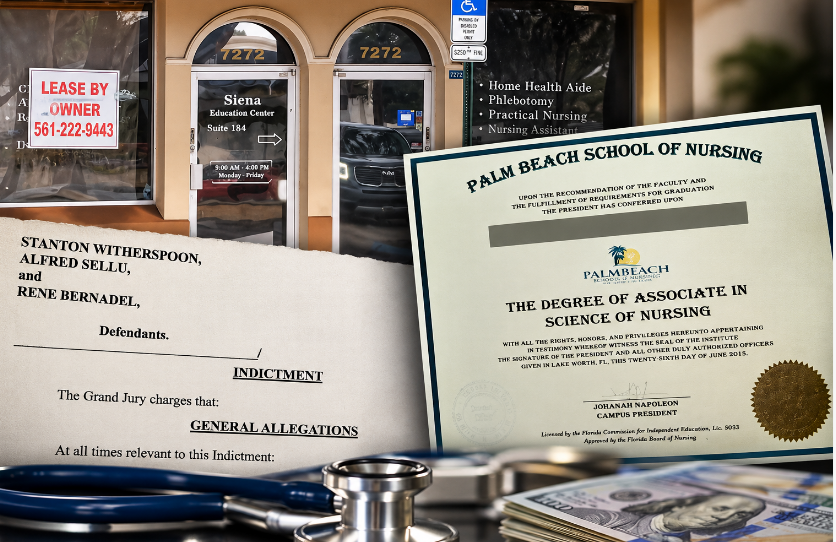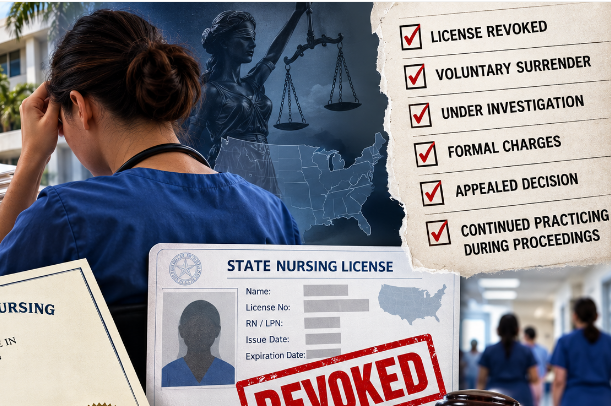
 The fraudulent nursing diplomas uncovered by Operation Nightingale were not simply pieces of paper that sat unused in someone's home.
For some recipients, they worked.
The credentials got them through the educational requirement for the nursing board examination. Some passed the NCLEX. State regulators issued them nursing licenses.
And some went to work.
By the time federal authorities publicly announced Operation Nightingale in January 2023, the problem facing state nursing boards was therefore no longer simply how fraudulent educational records had been created in Florida.
Regulators had to find people who had already entered the nursing profession using credentials now under scrutiny—and decide whether they should continue treating patients.
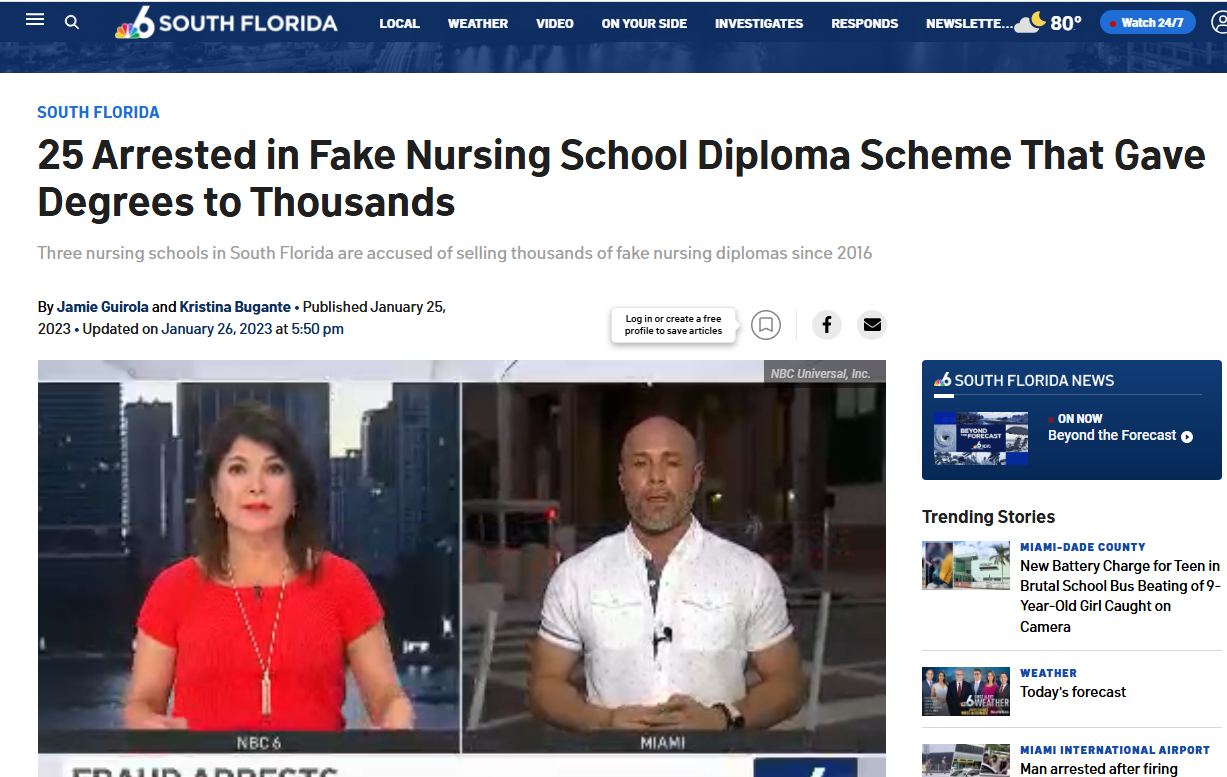
Federal authorities said the first phase of Operation Nightingale involved more than 7,600 fraudulent diplomas and transcripts. The Justice Department later described the operation as an illegal shortcut to both licensure and employment, explaining that purchasers who passed the NCLEX obtained nursing licenses and jobs in states across the country.
The second phase was larger still. In June 2026, prosecutors reported that approximately 2,274 people who received fraudulent credentials from just two South Florida schools passed nursing board examinations, enabling them to obtain licenses and work as nurses in Florida and elsewhere.
Then came the task of finding them.
Texas Found Hundreds of Licenses and Applications to Review
Texas provides one of the clearest public records of what happened next.
The FBI and national nursing regulatory systems alerted the Texas Board of Nursing that numerous Texas nurses had attended schools implicated in Operation Nightingale.
The Board eventually reported reviewing 670 Texas licensees and applicants, resulting in 181 investigations involving nurses believed to have been licensed based upon fraudulent education.
But identification did not mean automatic revocation.
That distinction is important.
Some of the Florida schools caught up in Operation Nightingale had legitimate students as well as people associated with fraudulent credentials. California regulators similarly cautioned that a person's connection to one of the schools did not itself establish that the person's diploma was fraudulent.
Texas therefore began bringing individual administrative cases.
The resulting records provide a rare look at what at least some of these nurses were doing after their questionable education had successfully produced a license.
Edith Omietimi Was Already Working as a Nurse
One of those cases involved Edith Okechukwu Omietimi.
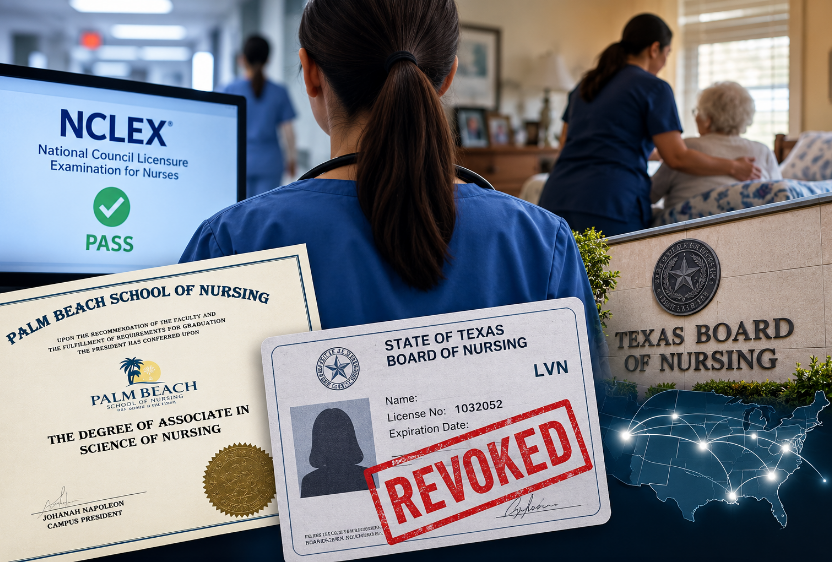
Omietimi obtained a Florida practical-nursing license in February 2021. The following month, she applied to Texas for a license by endorsement, representing that she had graduated from Sacred Heart International Institute, a Florida nursing program.
Texas approved the application.
She became Texas LVN No. 1032052.
And she began practicing nursing.
The FBI later identified Omietimi as potentially connected to Operation Nightingale.
When she attempted to renew her Texas license in 2023, the Texas Board of Nursing took another look at the education underlying it.
What investigators discovered was significant.
Although her licensing records identified Sacred Heart in Florida, the Board determined that Omietimi had actually attended nursing instruction in Houston, Texas, through an operation known as Jean's NCLEX Review.
That program was not approved by the Texas Board of Nursing to operate a nursing education program.
The administrative proceedings also found that the education Omietimi received did not cover all five nursing subject areas Texas required and that she did not complete clinical hours involving live patients.
Yet she had passed the NCLEX-PN.
And for approximately two years before Operation Nightingale surfaced, she possessed a license permitting her to work as a nurse.
She Was Working in Home Health
The administrative record goes even further.
It tells us what Omietimi did with the license.
According to the Texas administrative findings, she had worked part-time as an LVN at various facilities, changed employers several times and remained steadily employed.
At the time of the proceeding, she was working for Heritage, a home-health agency.
Her supervisors knew that she had been identified in Operation Nightingale and knew about the licensing proceeding.
They continued employing her.
There is another important fact in her record.
There had been no complaints against her nursing practice.
And the administrative law judge did not find that Omietimi herself had committed fraud.
The record says she genuinely believed she had enrolled in legitimate programs and was properly obtaining a nursing education.
That makes her case considerably more complicated than simply describing her as someone who knowingly bought a fake diploma.
Texas nevertheless confronted a separate question:
Regardless of what Omietimi believed, did she possess the education required to hold a nursing license?
The Board concluded that she did not.
Texas Would Not Renew Her License
An administrative law judge found that Omietimi had not received an adequate nursing education and recommended denying renewal of her LVN license.
The Texas Board of Nursing adopted that recommendation in April 2024.
It concluded that allowing her to practice without the required nursing education presented a public-safety risk.
Omietimi challenged the decision in court.
She also sought to continue practicing while that dispute proceeded.
In August 2024, a Texas judge denied her request for a temporary injunction, meaning she could not continue practicing nursing during the licensing appeal.
The litigation continued.
In July 2026, the Texas Fifteenth Court of Appeals affirmed the decision against her, concluding that substantial evidence supported the Board's determination that she had not graduated from an approved nursing program and did not meet the minimum requirements for a Texas LVN license.
Her case demonstrates one way Operation Nightingale reached beyond the people who sold the credentials.
A person could pass the NCLEX.
A state could issue a license.
An employer could hire the person.
The person could work with patients for years without a disciplinary complaint.
And the license could still ultimately disappear because the education underneath it did not satisfy the legal requirements for becoming a nurse.
Others Lost Their Licenses or Gave Them Up
Omietimi was far from alone.
The Texas Board of Nursing now maintains a public Operation Nightingale disciplinary list containing nurses whose cases have resulted in regulatory action.
The consequences include license revocations and voluntary surrenders.
For example, the Board lists RN Helen Anagor as revoked, RN Victoria Awodunmila as revoked and RN Marie Epah as revoked. Other nurses—including Ruby Allen, Linda Baiye, Marie Bifon, Thomas Bogonko, Ahmed Bombata, Anthonia Brown and numerous others—are listed as having voluntarily surrendered their licenses.
Texas also maintains a much longer list of nurses against whom formal charges have been filed.
But a formal charge is not the same thing as a final finding.
The Board explicitly warns that those proceedings remain pending and that, under Texas law, a nurse may continue working as a nurse while formal charges are pending.
That created an unusual situation.
A regulator could have information questioning the educational foundation of someone's nursing license while that person remained legally authorized to practice until the administrative process ran its course.
California Faced the Same Problem
The problem was national.
California's Board of Registered Nursing publicly acknowledged the obvious question: why were people suspected of obtaining illegitimate educational credentials still being allowed to practice?
The Board's answer was due process.
Regulators could not assume that everyone associated with an implicated school had obtained fraudulent credentials. Each individual case had to be investigated and established before a license could be revoked or other discipline imposed.
California instructed health-care employers that identified nurses associated with the schools to report the nurse's name, license number and employing organization to the Board.
The Board said disciplinary action against proven cases could include loss of the nursing license.
The challenge was enormous because the documents themselves could appear legitimate.
The schools were real.
Some had legitimate graduates.
The transcripts looked like school transcripts.
And many recipients had accomplished something that made the credentials appear even more convincing:
They had passed the NCLEX.
Passing the NCLEX Wasn't Enough
That may be the most consequential lesson to emerge from the licensing cases.
The NCLEX is an important barrier to entry into nursing, but regulators did not treat passing it as a replacement for nursing school.
Omietimi had passed the NCLEX-PN.
She had received licenses from two states.
She had worked as an LVN.
She had no documented complaints against her practice in the administrative record.
None of those facts supplied the nursing education and clinical experience Texas determined was missing.
And that distinction explains why state nursing boards began pursuing people who had already demonstrated that they could pass the national examination.
The federal investigation uncovered fraudulent or deficient educational credentials.
State regulators then had to confront what those credentials had already produced:
licensed nurses.
Operation Nightingale Didn't End When the Schools Closed
The schools at the center of the first Operation Nightingale cases are closed.
Many of the people who sold the credentials have been convicted.
But the regulatory aftermath continues.
Texas's public records show dozens of licenses already surrendered or revoked and many more nurses facing formal charges.
And Phase II expanded the universe substantially.
Federal prosecutors said the newer schemes generated approximately 7,300 additional fraudulent diplomas, with fraudulent credentials used to obtain licenses in states including Florida, California and Pennsylvania and, in some cases, multistate privileges that allowed nursing practice elsewhere.
That leaves a question much more concrete than how thousands of fraudulent transcripts escaped South Florida.
It is what happened after they did.
Omietimi's administrative record gives us one documented answer: she obtained a license, worked at multiple facilities, and ultimately worked in home health before regulators determined that the education underlying her license was insufficient and stopped her from practicing.
There are thousands of other credentials.
The next question is where all of those nurses worked—and how many patients were treated before anyone discovered the education behind their licenses was not what their transcripts said it was.