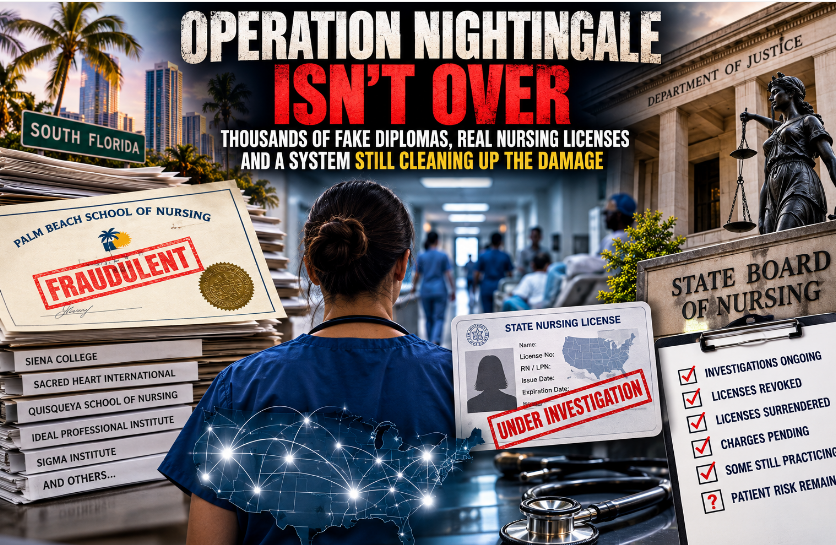
 They did not merely obtain pieces of paper.
Some became nurses.
They walked into hospitals, nursing homes, home-health agencies and other healthcare facilities carrying licenses that told employers and patients something very important: this person had completed the education and clinical preparation required to practice nursing.
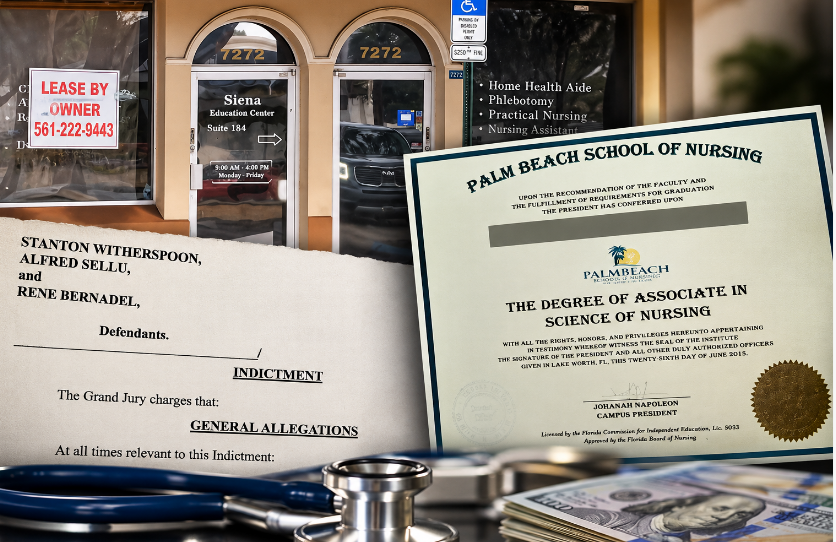
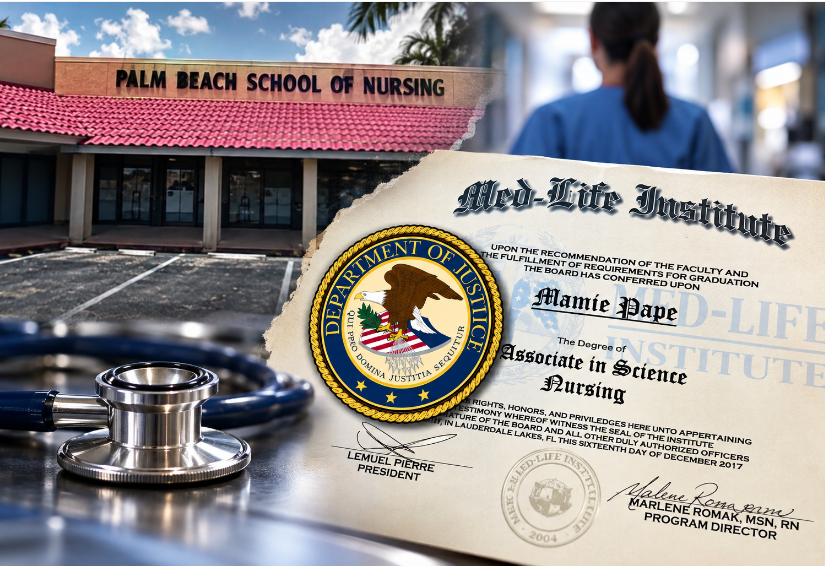
For an unknown number of people exposed through Operation Nightingale, federal investigators say that representation was false.
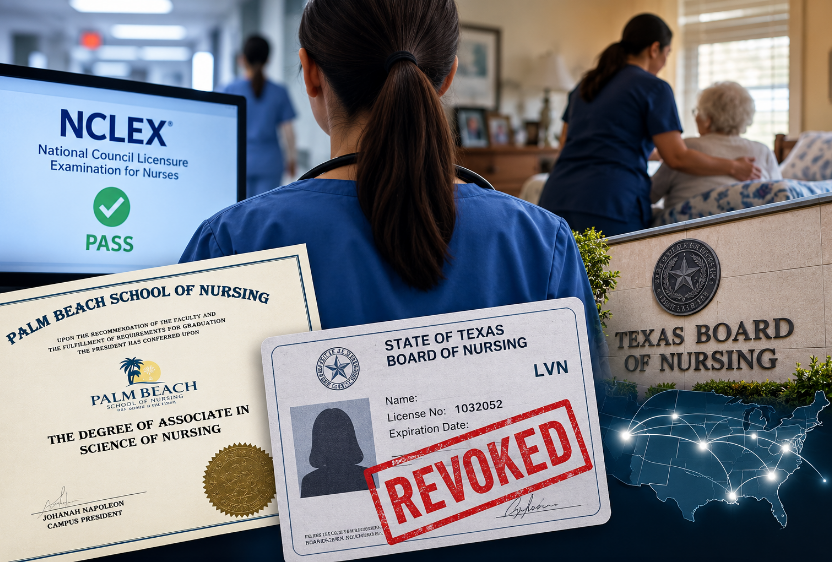
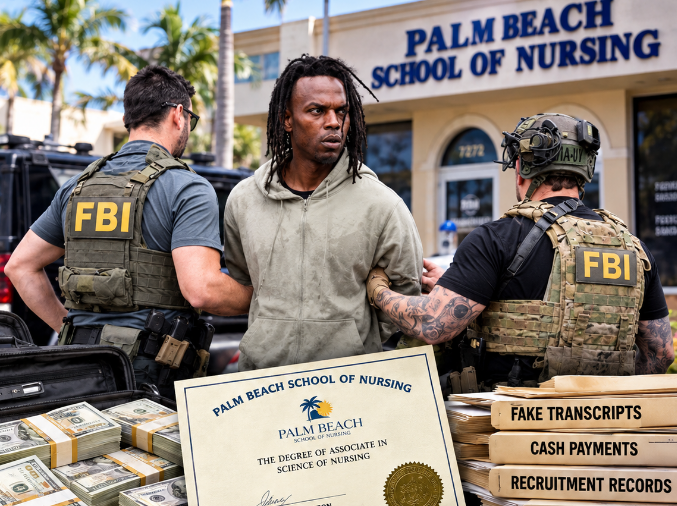
The Justice Department says purchasers of fraudulent nursing diplomas and transcripts used those records to qualify for the NCLEX. Those who passed could obtain nursing licenses, and licensed recipients then obtained nursing jobs from healthcare providers across the United States.
In the second phase of Operation Nightingale, prosecutors alleged that recipients had not completed the coursework and clinical training represented by their records. Yet fraudulent credentials were used to obtain licenses in states including Florida, California and Pennsylvania, and some recipients obtained multistate privileges allowing practice elsewhere.
The obvious question is also the most difficult one:
What happened to the patients they treated?
Nursing School Isn't Just About Passing a Test
Operation Nightingale presents a misconception that is easy to fall into.
Some recipients of fraudulent credentials passed the NCLEX.
Doesn't that prove they knew how to be nurses?
Not necessarily.
The NCLEX is one part of the licensing process. Nursing education and clinical training are another.
Federal prosecutors emphasized this distinction when announcing Phase II. Candidates are expected to graduate from an approved prelicensure nursing program and pass the NCLEX before obtaining an RN or LPN/VN license.
Clinical training is particularly significant because nursing is not simply an academic profession.
Nurses assess patients.
They administer medications.
They monitor changes in medical conditions.
They communicate with physicians.
They recognize emergencies.
They perform procedures.
And they make decisions affecting patients who may be elderly, unconscious, critically ill or otherwise unable to protect themselves.
A multiple-choice examination cannot reproduce months of supervised interaction with real patients.
The federal government described the concern directly in 2025: nursing practiced by an unprepared or unqualified individual poses a serious risk to public health and safety.
Healthcare Facilities Didn't Know What They Were Hiring
There is another important part of the Nightingale story.
The hospitals and other healthcare providers hiring these nurses generally were not being told that the educational credentials were fraudulent.
Federal prosecutors describe them as unwitting healthcare providers.
According to the Justice Department, recipients used the fraudulent credentials to obtain nursing jobs, salaries, wages and benefits from employers that relied upon those qualifications.
From an employer's perspective, the normal safeguards appeared to have worked.
There was a nursing-school transcript.
There was a diploma.
There was an NCLEX result.
And, most importantly, there was a state nursing license.
The employer had little obvious reason to suspect that the education underneath that license might never have occurred.
That placed the problem directly inside patient-care facilities.
What Could an Improperly Educated Nurse Get Wrong?
The potential harm is not difficult to understand.
A nurse without adequate clinical preparation could fail to recognize deterioration in a patient's condition.
Medication errors could occur.
A nurse could misunderstand an order, miss a contraindication, improperly assess a wound, fail to recognize infection, mishandle an IV, fail to respond appropriately to respiratory distress or inadequately document information another healthcare professional needs.
That does not mean Operation Nightingale nurses are known to have committed any of those errors.
The distinction is important.
Those are examples of the kinds of patient-safety risks nursing education and supervised clinical training are designed to reduce—not documented injuries attributable to particular Nightingale licensees.
And that leads to one of the largest unanswered questions in the entire investigation.
Where Are the Patient-Harm Cases?
Despite the extraordinary number of fraudulent credentials, Court St Legal could not locate a government accounting identifying patients who were physically harmed by nurses licensed through the Operation Nightingale schemes.
That does not establish that nobody was harmed.
It establishes something different:
The publicly available enforcement record has not established the extent of patient harm.
One Texas proceeding makes that distinction unusually clear.
Grace Ekpesu was identified in connection with Sacred Heart International Institute. A Texas administrative proceeding found that the school's issuance of her diploma was unlawful and stated that an LVN who is not properly educated and trained poses a risk of harm to patients or the public.
But the administrative law judge also made an important factual finding:
There was no evidence of actual harm to patients, clients or the public resulting from Ekpesu's nursing practice. She had no previous nursing discipline, and the proceeding described her as trustworthy.
That is significant.
It demonstrates why the entire population of Operation Nightingale licensees cannot responsibly be characterized as nurses who injured patients.
Some may have worked without incident.
Some may have acquired substantial practical knowledge elsewhere.
Some may have been legitimate students of schools that also issued fraudulent credentials.
And some may still be contesting whether their own education was fraudulent at all.
But none of that changes the underlying public-safety problem.
The government cannot know in advance which inadequately trained nurse will make the mistake that matters.
Patient Harm May Also Be Difficult to Reconstruct Years Later
There is another complication.
If an inadequately educated nurse made an error several years before Operation Nightingale became public, would anyone have connected the error to the nurse's educational history?
Probably not automatically.
An employer investigating a medication error or poor clinical decision would ordinarily begin with what it believed was a properly licensed nurse.
The license itself would suggest that the state had already verified the nurse's basic educational qualifications.
Operation Nightingale turned that assumption upside down.
Federal investigators did not publicly announce the first major enforcement action until January 2023. HHS-OIG says the initial operation involved more than 7,600 fraudulent nursing diplomas and transcripts.
Phase II then uncovered schemes involving approximately 7,300 additional fraudulent diplomas, according to prosecutors.
That means any serious attempt to determine actual patient consequences could require looking backward through years of employment records, disciplinary complaints, incident reports, medication errors and patient outcomes.
There is no indication that such a comprehensive nationwide patient-by-patient review has been publicly completed.
Some Nurses Are Still Being Investigated
There is an equally uncomfortable question:
Are people connected to Operation Nightingale still working as nurses?
The answer requires care.
A person merely associated with one of the implicated schools cannot automatically be called a fraudulent nurse. Some schools had legitimate students, and regulators must determine individually whether a particular person's education was valid.
But years after Operation Nightingale became public, nursing boards were still processing cases.
The Texas Board of Nursing reported in April 2025 that it continued working with regulators, schools, accreditation organizations and law-enforcement authorities to investigate the matter and seek revocation of licenses obtained fraudulently.
Texas also reported that formal charges had been filed against some licensees believed to have been involved.
California's records demonstrate another problem.
The California Board of Registered Nursing explains that it cannot publicly identify people merely because they are being investigated. The identities generally remain confidential until formal disciplinary proceedings begin.
In other words, the public list of disciplined nurses does not necessarily tell us how many cases remain unresolved.
Regulators Have Quietly Flagged Nurses Across State Lines
California revealed one of the mechanisms regulators are using behind the scenes.
Licensees under investigation because of Operation Nightingale can be flagged in Nursys, the national nursing-license system.
Those flags provide confidential notice to other state nursing boards.
If a flagged nurse applies for a license elsewhere, the receiving nursing board can see the warning and decide what action to take under its own laws.
Patients cannot see those confidential investigative flags.
Employers generally cannot treat an investigation as though it were a final finding.
And regulators cannot simply revoke a professional license because someone's name appeared in investigative material.
Due process still applies.
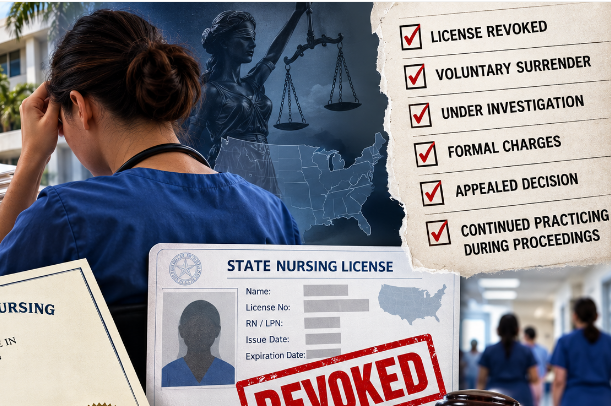
That leaves a potentially lengthy period during which regulators may suspect that a person's educational credentials are invalid but have not yet established the facts necessary to take final disciplinary action.
California Was Still Cleaning Up Nightingale in 2026
This is not merely unfinished business from 2023.
California's 2026 Sunset Review discusses Operation Nightingale as an ongoing regulatory problem.
The Board reported identifying several California licensees who obtained their licenses using fraudulent nursing degrees. It said many were willing to surrender their licenses rather than undergo prolonged and costly disciplinary proceedings.
California was seeking a more efficient statutory mechanism for handling those fraudulent-license surrenders.
Think about what that means chronologically.
The first major federal Operation Nightingale announcement occurred in January 2023.
California was still discussing how to process the resulting fraudulent licenses in its 2026 regulatory review.
The scandal did not end with the FBI announcement.
For nursing regulators, it became years of cleanup.
The Numbers Make the Patient Question Much Larger
The second phase makes the issue harder still.
Federal prosecutors said in 2025 that approximately 7,300 fraudulent diplomas were generated through the newly charged schemes.
Recipients obtained licenses in multiple states.
Some obtained multistate nursing privileges.
And the fraudulent credentials were used to obtain nursing employment from unsuspecting healthcare providers throughout the country.
Those facts dramatically expand the potential number of patient encounters.
A nurse does not treat one patient during a career.
Depending on the setting, one nurse can interact with hundreds or thousands of patients.
A home-health nurse may enter patients' homes with little direct supervision.
A long-term-care nurse may administer medications to numerous vulnerable residents during a single shift.
A hospital nurse can be responsible for several acutely ill patients simultaneously.
That is why the unresolved issue cannot be measured simply by counting fraudulent diplomas.
The more meaningful question is how many patient encounters occurred under licenses that should never have been issued.
The government has not publicly supplied that number.
An Invalid License Can Create Problems for the Facility Too
There may also be consequences for the institutions that unknowingly employed improperly licensed personnel.
Federal health programs impose requirements concerning the people who provide reimbursed medical services.
Recent HHS-OIG enforcement actions—not identified as Operation Nightingale cases—illustrate the financial problem facilities can face when nursing services are provided without valid licenses.
In May 2026, a Minnesota healthcare and rehabilitation center agreed to pay approximately $47,000 after self-disclosing claims for services provided by unlicensed nurses. HHS-OIG calculated damages using the salary and benefits paid during the period those nurses worked without valid licenses.
A California continuing-care facility previously paid approximately $37,000 over claims involving services provided by an individual who did not possess a valid RN license.
Those cases are not evidence that Nightingale nurses caused those settlements.
They demonstrate why discovering an invalid nursing license can create consequences extending beyond the individual nurse.
Employers, insurers and government healthcare programs can all become part of the aftermath.
The Absence of Proven Injuries Is Not the Same as Proof of Safety
Operation Nightingale presents an unusual evidentiary problem.
The government has proven extensive credential fraud.
People have pleaded guilty.
Others have been convicted at trial.
States have revoked or accepted surrender of nursing licenses.
Federal prosecutors say recipients obtained jobs from unsuspecting healthcare providers.
Yet the public record does not presently provide a corresponding nationwide list of patients injured by those nurses.
That gap should not be filled with speculation.
But neither should it be mistaken for evidence that the scheme created no danger.
The purpose of requiring nursing education before someone is placed beside a hospital bed is to prevent the government from having to discover incompetence through injured patients.
Federal prosecutors made essentially that point when announcing Phase II: professional nursing licensure exists to protect the public by ensuring that qualified and competent practitioners provide nursing care.
Operation Nightingale defeated part of that safeguard.
The Investigation Found the Diplomas. The Patient Story Is Still Incomplete.
We know how the scheme worked.
We know thousands of fraudulent credentials were generated.
We know some recipients passed the NCLEX.
We know licenses were issued.
We know recipients obtained nursing jobs from healthcare providers that believed their qualifications were legitimate.
We know regulators have revoked licenses, accepted surrenders and continued investigating individual nurses.
What the public still does not know is how many patients those nurses treated, what facilities employed all of them, how many clinical incidents occurred during their employment, and whether any patient injury that appeared at the time to be an ordinary medical error can ultimately be traced to a nurse who never received the clinical education the license was supposed to guarantee.
And the issue is not entirely historical.
Regulatory records show that Operation Nightingale cases continued being investigated years after the first arrests, while California confirms that some investigated licensees are confidentially flagged so other nursing boards can see the concern even when the public cannot.
That leaves Operation Nightingale with perhaps its most important unanswered question.
Federal investigators found the people who sold the fake education. Nursing boards are still sorting through the licenses it produced. But no one has yet publicly accounted for all the patients who were placed in their care.