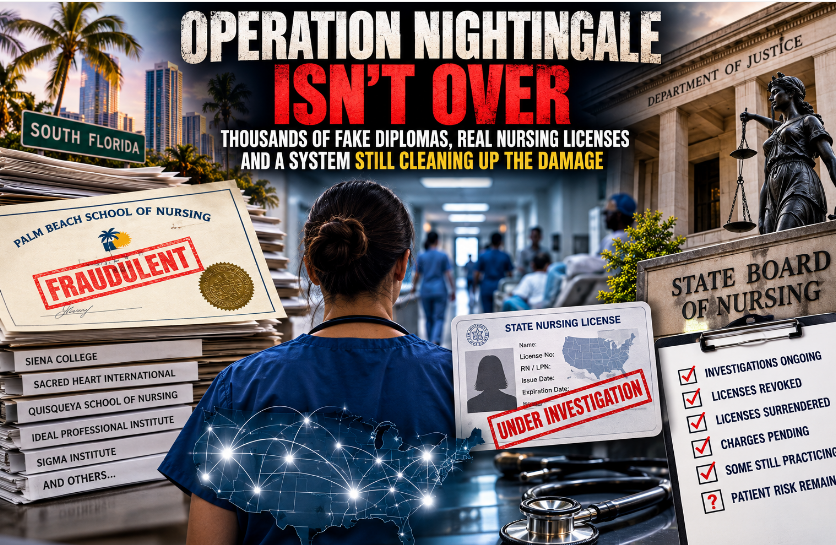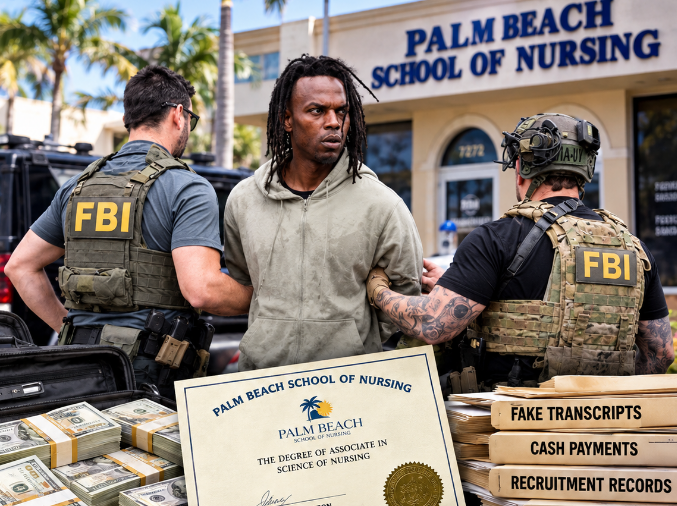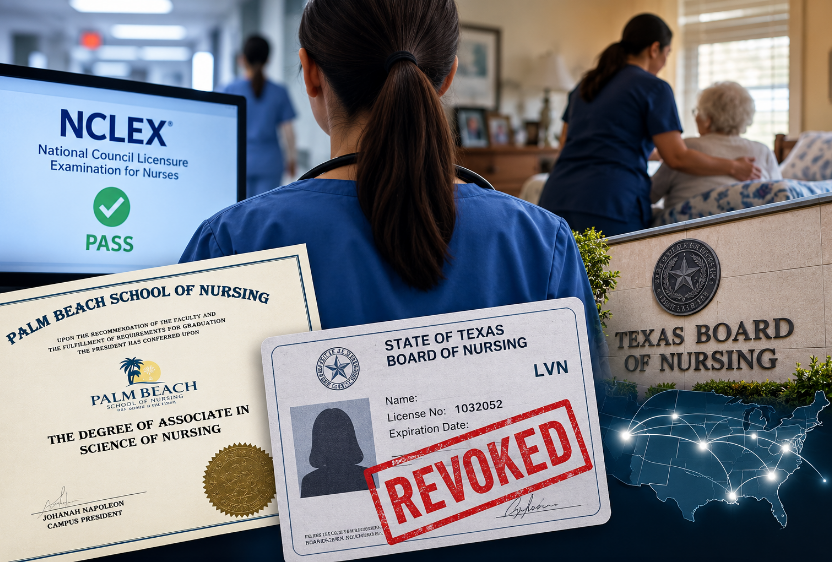
 Thousands of fraudulent nursing diplomas eventually emerged from South Florida.
Some recipients passed the NCLEX.
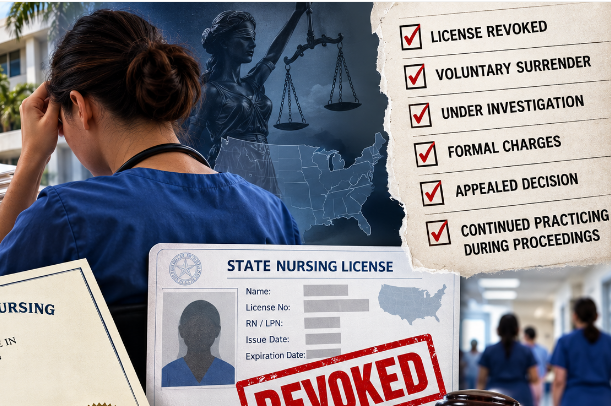
Some obtained nursing licenses.
Some went to work caring for patients.
But before Operation Nightingale became a nationwide federal investigation, many of the schools at the center of the scandal existed inside Florida's own nursing-education regulatory system.
That raises a question bigger than what the school owners did:
How could it happen for so long?
The answer found in Florida's own records is troubling.
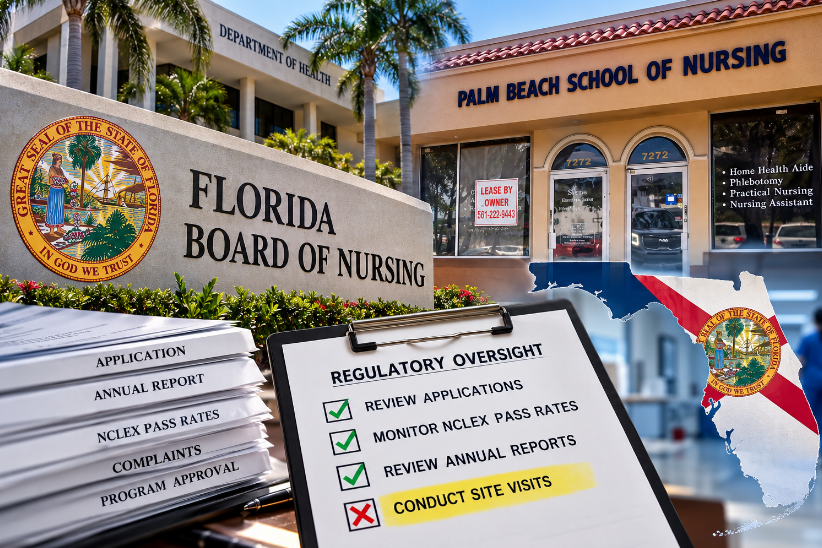
The Florida Board of Nursing currently warns consumers that its authority over established nursing education programs is limited by state law.
More remarkably, the Board states that it is not authorized to conduct site visits of approved nursing education programs.
That limitation matters when the thing regulators need to determine is not merely whether a school filed the correct paperwork—but whether the education described on that paperwork is actually taking place.
Florida's Approval System Was Largely Built Around Paperwork and Test Results
Florida law establishes requirements for becoming an approved prelicensure nursing program.
A proposed program submits an application. Its curriculum is supposed to include appropriate clinical training, including experience in acute care, long-term care and community settings. The program must identify clinical sites and have agreements with the facilities where that training is supposed to occur.
Once established, approved programs submit annual reports.
Those reports include information such as enrollment, graduates, retention rates and accreditation status.
And Florida closely watches another number:
NCLEX passage rates.
The Board explains that it monitors the examination performance of graduates and compares each program's results with national averages.
When a program's passage rate remains below the statutory minimum for two consecutive years, it can be placed on probation. Continued poor performance can ultimately result in termination.
On paper, that provides a mechanism for identifying poorly performing schools.
But Operation Nightingale exposed a different kind of problem.
The issue wasn't simply whether students were being taught badly.
Federal prosecutors said schools were issuing diplomas and transcripts representing that people had completed nursing education and clinical training that they had not actually completed.
A test-score monitoring system was never designed to answer the most basic question in that situation:
Did this person actually attend nursing school?
Regulators Could See the Failure Rates
There were warning signs.
Federal prosecutors have repeatedly said that Palm Beach School of Nursing and Quisqueya School of Nursing eventually closed because of the excessive failure rates of their students on the nursing licensing examination.
Other schools later connected to Operation Nightingale had also appeared before Florida regulators because of poor performance.
For example, Florida Board of Nursing records from 2021 identify Siena College of Health and Sigma Institute of Health Careers among practical-nursing programs moving through probation because of NCLEX performance.
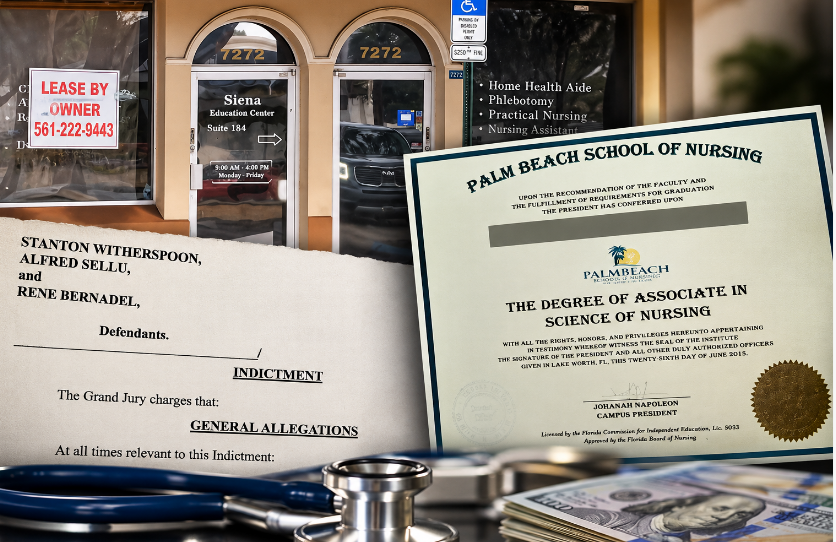
Years earlier, Board records also show Siena Education Center in a probation category, while Ideal Professional Institute, another school later named in Phase II of Operation Nightingale, appeared among programs moving from approved status to probation.
Those records do not establish that Florida regulators knew fraudulent diplomas were being sold.
Poor NCLEX performance can have many explanations and does not itself prove fraud.
But the records do establish something important:
Florida's regulatory system was already detecting serious performance problems at some of these institutions.
What it could not necessarily do was walk through the door and investigate what was actually happening inside.
The Board Says It Cannot Conduct Site Visits
The Florida Board of Nursing's own website now says it plainly:
“The Board is not authorized to conduct site visits.”
The Board further tells consumers that its oversight of approved nursing-program quality measures is limited by Florida law.
Complaints concerning approved nursing education programs are instead directed to the Florida Department of Education's Commission for Independent Education.
That creates a fragmented regulatory structure.
The Board of Nursing approves programs and monitors nursing-specific performance measures.
The Commission for Independent Education handles complaints concerning many private postsecondary institutions.
Meanwhile, the Department of Health licenses the individual nurses who emerge from those programs.
Operation Nightingale demonstrated what can happen when the underlying problem does not fit neatly into one of those boxes.
A school could exist.
A transcript could exist.
A student could appear to have graduated.
And the licensing system could receive documents from what appeared to be a legitimate Florida nursing program.
But determining whether the person actually sat in classrooms and completed clinical training requires something substantially different from reviewing an annual report.
It requires investigation.
Florida Lawmakers Are Now Considering the Power Regulators Didn't Have
Perhaps the strongest evidence of the regulatory gap comes from what Florida lawmakers are considering after Operation Nightingale.
In February 2026, a Florida Senate committee analysis described proposed legislation that would give the Department of Health—or an authorized agent—the power to conduct onsite evaluations and inspections of approved nursing programs.
The proposed authority would allow investigators to collect evidence to determine whether schools were complying with Florida law.
And the legislative analysis provided a remarkably specific example of when that authority could be used:
An allegation that a nursing education program was issuing fraudulent transcripts.
Then the analysis made the existing limitation explicit:
Neither the Board nor the Department currently has that investigative authority.
That is difficult to separate from what Operation Nightingale revealed.
28 Approved Programs Were Allegedly Out of Compliance
The same 2026 legislative analysis provides another significant number.
Based on information identified during Operation Nightingale, Florida officials said 28 of the state's 512 approved nursing programs were alleged to be operating out of compliance with Chapter 464, the Florida law governing nursing.
Twenty-eight programs.
That does not mean all 28 sold fraudulent diplomas, nor does the legislative document establish that every allegation was substantiated.
But it shows that the problems uncovered by Operation Nightingale reached well beyond a single rogue school.
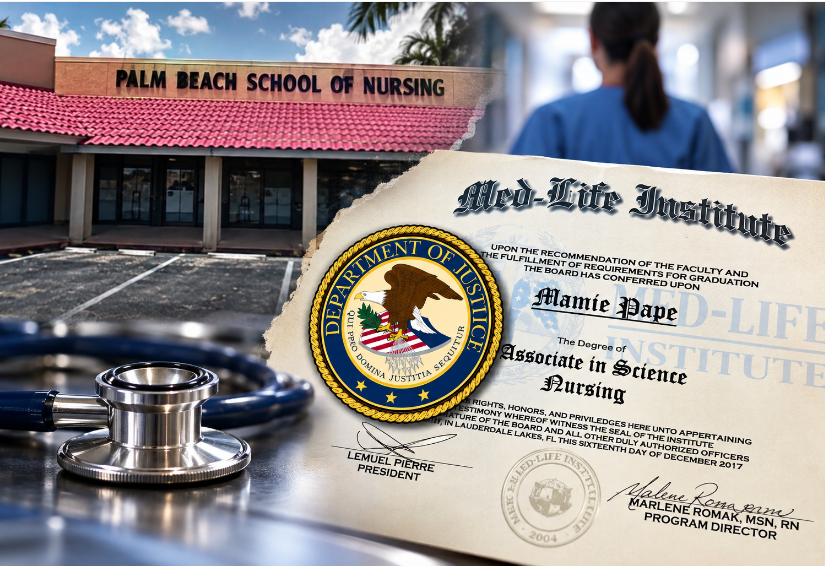
Federal prosecutors' Phase II cases likewise expanded the investigation to numerous Florida institutions, including Carleen Home Health School, Sigma Institute of Health Careers, Techni-Pro Institute, Agape Academy of Sciences, Med-Life Institute, Ideal Professional Institute, Azure College and Academus University.
The federal government was now investigating exactly the kind of conduct that Florida's proposed legislation would give state health regulators additional authority to investigate themselves.
The System Could Detect Bad Test Scores. It Couldn't Necessarily Detect a Fake Education.
Florida's regulatory framework was not devoid of oversight.
Schools had reporting requirements.
Programs had curriculum requirements.
NCLEX results were monitored.
Poorly performing programs could be placed on probation and eventually terminated.
Florida law also required probationary programs to disclose that status to students and applicants.
But Operation Nightingale exposed the limitation of using outcomes to monitor something that may never have happened in the first place.
Consider what regulators were trying to detect.
A legitimate nursing student attends school, completes clinical training, graduates and then fails the NCLEX.
That failure appears in the school's performance statistics.
Now consider a different person.
That person allegedly never completes the required education at all, obtains a fraudulent transcript and diploma, and then passes the NCLEX.
From a system focused heavily on examination outcomes, that person can look like a success.
The exam was passed.
The license was issued.
But the clinical education supposedly underlying the license may never have occurred.
That is precisely why the fraudulent records were so consequential.
And Some of the Recipients Passed
The scale became even clearer in Phase II.
In June 2026, federal prosecutors announced that Carleen Noreus, owner and operator of two South Florida nursing schools, pleaded guilty to conspiracy to commit wire fraud and conspiracy to commit money laundering after her trial had begun.
Prosecutors said approximately 2,274 people who obtained fraudulent credentials from the schools passed nursing board examinations, enabling them to obtain nursing licenses and work as nurses in Florida and elsewhere.
Those people did not generate failing NCLEX scores.
They passed.
That means the very metric Florida used to evaluate nursing-program performance could not, by itself, reveal whether those individuals actually completed the education their transcripts represented.
Operation Nightingale Exposed More Than Diploma Fraud
It would be easy to tell Operation Nightingale solely as a story about dishonest school operators.
Federal prosecutors have charged and convicted numerous people involved in selling fraudulent nursing credentials.
Those individuals are responsible for their own conduct.
But that does not answer the regulatory question.
Florida authorized nursing programs.
Florida received their annual reports.
Florida monitored their graduates' examination results.
Florida could place programs on probation when those results became sufficiently poor.
Yet Florida's own Board of Nursing says it lacks authority to conduct site visits, and a 2026 legislative analysis says neither the Board nor the Department currently possesses the proposed investigative authority to inspect approved programs when, for example, there is an allegation that a school is issuing fraudulent transcripts.
Operation Nightingale ultimately required the FBI, the U.S. Department of Health and Human Services Office of Inspector General and other federal and state law-enforcement agencies to unravel what had happened.
By then, the problem had escaped Florida.
Fraudulent educational records had crossed state lines.
Nursing boards had issued licenses.
Health-care facilities had hired nurses.
And patients had been placed in their care.
Florida's experience therefore raises a regulatory question that reaches far beyond Operation Nightingale:
If the government approves a nursing school but lacks the authority to walk inside and verify that the education on its transcripts is actually taking place, what exactly does that approval tell the public?