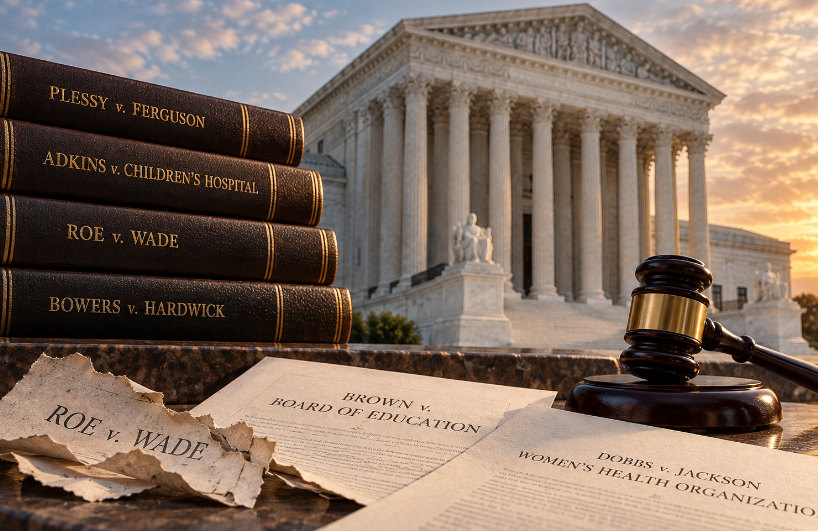
In 1896, the Supreme Court decided that Louisiana could require Black and white railroad passengers to ride in separate cars.
The decision in Plessy v. Ferguson became associated with one of the most consequential phrases in American constitutional history: “separate but equal.”
For more than half a century, Plessy stood as Supreme Court precedent.
Then another group of litigants arrived at the Court.
Their case concerned children, public schools and a question the country had supposedly already received an answer to: could government constitutionally separate people by race as long as the facilities it provided were nominally equal?
This time, the Supreme Court answered differently.
In Brown v. Board of Education, decided in 1954, the Court unanimously held that racial segregation in public schools violated the Equal Protection Clause of the Fourteenth Amendment. Separate educational facilities, the Court concluded, were inherently unequal.
The Court had changed course. The legal foundation supporting government-mandated racial segregation had been fundamentally repudiated. The Supreme Court itself describes Plessy as having been overruled more than 50 years later by Brown.
It is one of the clearest examples of an uncomfortable but essential feature of the American judicial system:
The Supreme Court's interpretation of the Constitution can become precedent. But Supreme Court precedent can itself be overturned.
That creates a difficult question.
If courts are supposed to follow earlier decisions, when is the Supreme Court justified in deciding that an earlier Supreme Court was wrong?
The answer has changed American law repeatedly.
Precedent Is Powerful—But It Is Not Permanent
The principle usually associated with following precedent is known as stare decisis, from a Latin expression generally understood as standing by things decided.
The idea serves important purposes.
If courts reconsidered every legal rule from the beginning every time a new lawsuit arrived, the law would become difficult to predict. People, businesses and governments make decisions based on existing law. Lower courts need rules they can apply consistently. Similar cases should ordinarily produce similar results.
Precedent supplies that continuity.
But the Supreme Court has never treated every constitutional precedent as permanently untouchable.
That would create another problem.
Imagine that five justices interpret the Constitution incorrectly. If their interpretation became absolutely irreversible, no later Supreme Court could correct the mistake except through a constitutional amendment.
The Court has instead developed a system containing two competing principles:
Earlier decisions deserve respect.
And some earlier decisions should not survive forever.
The tension between those principles has produced some of the Court's most consequential decisions.
The Court Once Protected a Constitutional Freedom of Contract
Long before Brown, the Supreme Court reversed course in an area that affected the relationship between government and the economy.
During the early twentieth century, the Court used constitutional due-process principles to invalidate some economic regulations interfering with what it regarded as liberty of contract.
In Adkins v. Children's Hospital in 1923, the Supreme Court invalidated a minimum-wage law for women in the District of Columbia.
Fourteen years later, the Court considered another minimum-wage law.
This one came from Washington State.
The case began when Elsie Parrish, a chambermaid at the Cascadian Hotel, sued for the difference between what she had been paid and the minimum wage established under state law.
The dispute eventually became West Coast Hotel Co. v. Parrish.
In 1937, the Supreme Court upheld Washington's minimum-wage law and rejected the constitutional reasoning that had controlled Adkins.
The change was significant.
The Court was moving away from an era in which constitutional “liberty of contract” had been used aggressively to scrutinize economic regulation.
Decades later, Supreme Court opinions would point to West Coast Hotel as a classic example of the Court abandoning an earlier constitutional approach. The Court itself has described West Coast Hotel as overruling Adkins and the broader line of cases with which it was associated.
The consequences extended far beyond one hotel employee's wages.
The decision became part of a fundamental transformation in the Court's treatment of economic legislation, leaving elected governments substantially greater room to regulate wages and other economic relationships.
Sometimes reversing precedent changes one rule.
Sometimes it marks the end of an entire judicial era.
Brown Was More Than a New Interpretation of an Old Rule
Brown v. Board of Education demonstrates another reason precedent can fall: an earlier rule can become impossible to reconcile with the Constitution as the Court understands it.
Plessy had involved railroad accommodations rather than schools, but its constitutional acceptance of government-imposed racial separation became a foundation for segregation.
By the time the school cases reached the Supreme Court, the justices confronted what that principle meant when applied to public education.
The Court concluded that separating children in public schools solely because of race deprived minority children of equal educational opportunities even when physical facilities and other tangible factors might appear comparable.
Later Supreme Court opinions discussing precedent have described Brown as repudiating the factual and constitutional foundation underlying Plessy.
The aftermath also illustrates something important about overruling precedent:
A Supreme Court decision can change constitutional law immediately without changing society immediately.
Brown did not cause segregated school systems to disappear overnight.
The Court returned to the issue in Brown II in 1955 to address implementation. Resistance continued for years, and desegregation became the subject of additional litigation, federal legislation, executive action and political conflict.
Overturning precedent can therefore be the beginning of a legal transformation rather than its conclusion.
Sometimes the Court Says the Earlier Court Was Simply Wrong
Nearly three decades separated two Supreme Court cases concerning laws criminalizing private sexual conduct between consenting adults.
The first was Bowers v. Hardwick, decided in 1986.
The Court rejected a constitutional challenge involving Georgia's sodomy law.
Seventeen years later, another challenge reached the Court from Texas.
Police had entered the home of John Lawrence and found Lawrence and another man engaged in private consensual sexual conduct. The men were arrested under a Texas law prohibiting certain sexual conduct between people of the same sex.
The resulting case was Lawrence v. Texas.
The Supreme Court could have attempted to distinguish Bowers narrowly.
Instead, in 2003, it confronted the earlier decision directly.
The majority concluded that Bowers had been wrong when decided and should no longer remain binding precedent. The Court overruled it and held that the Texas statute violated the liberty protected by the Due Process Clause.
That is one of the most direct forms a reversal can take.
The Court did not merely announce that circumstances had changed enough to produce a different result.
It concluded that its predecessor had gotten the constitutional question wrong.
But Declaring an Earlier Court Wrong Creates Another Problem
If saying “the earlier decision was wrong” were enough, stare decisis would provide little restraint.
Every Supreme Court majority presumably believes its own interpretation of the law is correct.
A newly constituted Court could reconsider disputed cases whenever five justices disagreed with the reasoning of their predecessors.
That is why debates over overruling precedent rarely stop with the question of whether an earlier decision was correctly decided.
Justices have considered factors such as the quality of a precedent's reasoning, whether its rule has proved workable, whether later legal developments have undermined it, whether its factual assumptions have changed, and whether people have developed substantial reliance interests around the existing rule.
The justices have disagreed—sometimes profoundly—over how those considerations should be weighed.
Few modern cases demonstrate that disagreement more clearly than Dobbs v. Jackson Women's Health Organization.
Roe Survived One Major Challenge—and Not the Next
In 1973, Roe v. Wade held that the Constitution protected a woman's decision to terminate a pregnancy, while permitting increasing government regulation as pregnancy progressed.
Nearly twenty years later, the Court was explicitly asked to reconsider Roe in Planned Parenthood of Southeastern Pennsylvania v. Casey.
Casey did not simply apply Roe mechanically.
The Court changed important parts of its framework while reaffirming what the controlling opinion called Roe's “essential holding.”
And Casey devoted substantial attention to stare decisis itself.
Its controlling opinion discussed Brown and West Coast Hotel as examples of circumstances in which abandoning precedent had been justified.
For another three decades, the constitutional right recognized in Roe remained.
Then Mississippi enacted a law generally prohibiting abortions after 15 weeks of pregnancy, and the resulting challenge reached the Supreme Court.
On June 24, 2022, the Court decided Dobbs v. Jackson Women's Health Organization.
This time the Court did what Casey had declined to do.
It overruled both Roe and Casey.
The majority concluded that the Constitution does not confer a right to abortion and that the issue should be returned to the political process. In its stare decisis analysis, the majority argued that Roe was egregiously wrong, had weak constitutional reasoning, produced a rule the majority regarded as unworkable and had distorted other areas of law.
The dissent saw the precedent question very differently.
Justices Stephen Breyer, Sonia Sotomayor and Elena Kagan argued that the majority had discarded precedents on which women had relied in structuring their lives and participating in society. They also disputed the majority's comparisons between overruling Roe and landmark reversals such as Brown and West Coast Hotel.
The disagreement demonstrates why stare decisis cannot be reduced to a mechanical formula.
Both sides invoked the history of precedent.
They disagreed about what that history required.
What Happens the Day After a Precedent Falls?
Overruling a Supreme Court decision can have effects far beyond the parties whose names appear on the case.
After Dobbs, the Supreme Court granted several pending petitions, vacated lower-court judgments and sent cases back for reconsideration in light of the new decision.
But that was only the judicial system's immediate response.
Because Dobbs removed the federal constitutional protection previously recognized under Roe and Casey, abortion law increasingly depended upon state statutes, state constitutions and subsequent litigation.
That pattern is not unique to abortion.
When a major precedent disappears, lawyers begin asking what else depended upon it.
Lower courts must determine which earlier decisions remain valid.
Legislatures may enact new statutes.
Old laws that had been unenforceable may become relevant again.
Cases already moving through courts can change direction.
Legal arguments that would have failed a week earlier may suddenly become viable.
The Supreme Court may decide one case.
The legal system then has to determine what the decision changed.
Not Every Change Is an Explicit Overruling
There is also a quieter way for Supreme Court doctrine to change.
Sometimes the Court does not say, “This case is overruled.”
Instead, later decisions narrow an earlier rule, distinguish it repeatedly or replace parts of its reasoning until the original precedent means considerably less than it once did.
That can make identifying the exact moment when doctrine changed difficult.
Lawyers therefore look beyond whether a precedent has technically been overruled. They examine how subsequent courts have treated it.
Does the Court still rely on its reasoning?
Has its rule been confined to unusual circumstances?
Have later cases created exceptions?
Has the underlying doctrine changed so substantially that the old case survives mostly as a historical artifact?
Precedent is not always an on-or-off switch.
Sometimes it erodes.
The Supreme Court Cannot Overrule the Constitution
There is an important limit to all of this.
The Supreme Court can overrule its own interpretation of the Constitution.
It cannot rewrite the Constitution itself.
That distinction explains why constitutional interpretation carries such enormous consequences.
If Congress dislikes the Supreme Court's interpretation of an ordinary federal statute, Congress can often amend the statute, subject to constitutional limits.
But if the Supreme Court interprets the Constitution itself, ordinary legislation generally cannot simply reverse that interpretation.
A later Supreme Court can reconsider the precedent.
Or the Constitution can be amended through the extraordinarily demanding amendment process.
That gives constitutional precedent unusual staying power—even though it is not permanent.
Today's Landmark Can Become Tomorrow's Overruled Case
The Supreme Court's history contains decisions once treated as controlling law that later generations know principally because the Court abandoned them.
Plessy was precedent.
So was Adkins.
So was Bowers.
So were Roe and Casey.
Their eventual overruling did not mean precedent had never mattered.
Quite the opposite.
Some survived for decades precisely because precedent matters.
Plessy stood for more than half a century. Roe remained a central constitutional precedent for almost 50 years. Bowers lasted 17.
Their stories demonstrate both sides of stare decisis.
Precedent gives law stability because courts ordinarily do not start over.
But constitutional law retains a mechanism for correction because sometimes the Court concludes that starting over is exactly what the Constitution requires.
The hardest question is determining when that moment has arrived.
And there is no neutral mathematical formula capable of answering it.
Every time the Supreme Court considers abandoning one of its own precedents, it confronts two risks.
Leave the precedent untouched, and an erroneous constitutional rule may survive simply because it came first.
Overrule it too readily, and constitutional law can begin to look as though it changes whenever the membership of the Court changes.
The history of the Supreme Court is, in part, the history of trying to navigate between those dangers.
And some of the most important decisions in American law exist because, eventually, the Court decided that what it had said before should no longer be the law.