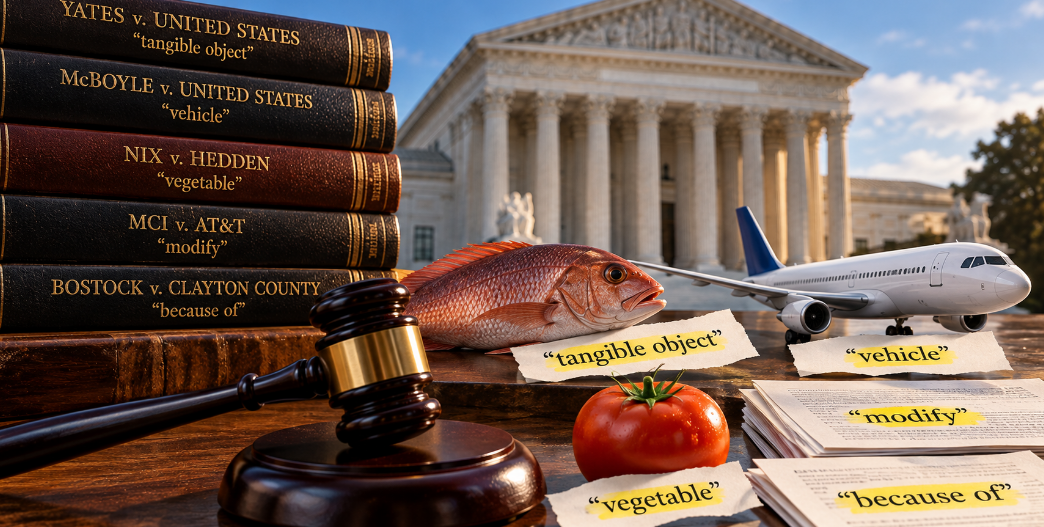
The object at the center of John Yates's Supreme Court case was unquestionably tangible.
It was a fish.
More precisely, it was a red grouper caught in the Gulf of Mexico.
Federal authorities accused Yates, a commercial fishing captain, of ordering a crew member to throw undersized grouper overboard after a federal officer had instructed him to preserve the fish as evidence.
Prosecutors charged him under a federal law making it a crime, under specified circumstances, to destroy or conceal a “record, document, or tangible object” with the intent to obstruct a federal investigation.
A fish is an object.
A fish can be touched.
That would seem to make a fish a “tangible object.”
The Supreme Court concluded otherwise.
For purposes of this particular statute, the Court held in Yates v. United States in 2015, “tangible object” referred to an object used to record or preserve information—not every physical object that happens to be tangible.
Yates's conviction under that statute was reversed.
It is a wonderfully strange Supreme Court case.
It also illustrates something serious about law.
Enormous disputes sometimes turn not on what happened, but on what one word means.
How a Fish Became a Question About Language
The statute used against Yates had an interesting history.
Congress enacted it as part of the Sarbanes-Oxley Act of 2002, legislation passed following corporate accounting scandals including Enron.
The provision prohibited knowingly altering, destroying, mutilating, concealing or covering up a “record, document, or tangible object” with the intent to obstruct certain federal matters.
Prosecutors read “tangible object” literally.
A fish is a physical object. Yates allegedly had fish destroyed to interfere with an investigation. Therefore, the government argued, the statute applied.
The Supreme Court plurality looked beyond those two words in isolation.
“Record,” “document” and “tangible object” appeared together. Other language in the statute included actions such as making a false entry. And the statute itself concerned destruction or falsification of records in federal investigations and bankruptcy.
In that context, the plurality concluded that “tangible object” meant something used to record or preserve information.
Justice Samuel Alito supplied the crucial fifth vote for the judgment on somewhat narrower reasoning.
Four justices disagreed.
Justice Elena Kagan's dissent argued that “tangible object” meant exactly what it ordinarily sounds like it means: a physical object capable of being touched. She even invoked a Dr. Seuss book while arguing that a fish is, quite plainly, an object.
The disagreement exposes one of the hardest problems in legal interpretation.
A word can have an obvious dictionary definition and still acquire a narrower meaning from the words surrounding it.
Consider the sentence:
He works with televisions, radios, computers and other devices.
“Device” can describe an enormous number of things.
But in that sentence, a reader naturally expects “other devices” to mean things somewhat like televisions, radios and computers.
Lawyers have names for interpretive principles like this. But ordinary speakers use the same kind of contextual reasoning constantly without thinking about it.
Yates's case demonstrates what happens when that linguistic instinct determines whether a federal criminal statute applies.
An Airplane That Wasn't a Vehicle
John Yates was hardly the first criminal defendant whose fate depended on an ordinary noun.
More than 80 years earlier, the Supreme Court confronted an even stranger question:
Is an airplane a vehicle?
The defendant in McBoyle v. United States had been convicted under the National Motor Vehicle Theft Act after knowingly transporting a stolen airplane from Illinois to Oklahoma.
The statute covered stolen “motor vehicles.”
And Congress had supplied a definition.
A motor vehicle included an automobile, automobile truck, automobile wagon, motorcycle “or any other self-propelled vehicle not designed for running on rails.”
An airplane certainly propels itself.
It certainly transports people.
And it certainly does not run on rails.
Nevertheless, in 1931, the Supreme Court unanimously reversed McBoyle's conviction.
Justice Oliver Wendell Holmes Jr. reasoned that in ordinary speech, a “vehicle” called to mind transportation on land. The other words Congress placed around it—automobiles, trucks, wagons and motorcycles—reinforced that understanding.
There was another consideration.
This was a criminal law.
People are entitled to fair warning about what conduct the criminal law prohibits. The Court was unwilling to stretch statutory language beyond the meaning an ordinary person would naturally give it merely because an airplane could technically fit a broader conception of a vehicle.
Congress could prohibit interstate transportation of stolen aircraft.
But courts could not simply rewrite the existing statute to make it say so.
One ordinary word—“vehicle”—stood between a federal conviction and its reversal.
The Tomato That Became a Vegetable in Court
Not every word dispute involves prison.
Some involve money.
In the nineteenth century, a family of produce importers brought a case that ultimately required the Supreme Court to decide whether a tomato was a fruit or a vegetable.
The Tariff Act of 1883 imposed a 10 percent duty on imported vegetables.
Fruit could enter free of that particular duty.
The Nix family imported tomatoes from the West Indies and paid the vegetable duty under protest. They wanted the money back.
Botanically, their argument had considerable force.
Tomatoes are fruits.
But the Supreme Court wasn't writing a botany textbook.
It was interpreting a tariff statute.
In Nix v. Hedden, the Court unanimously held in 1893 that tomatoes were vegetables for purposes of the law.
The Court reasoned that when statutory words have not acquired a special commercial meaning, they generally receive their ordinary meaning. Tomatoes may be fruits botanically, but in common usage they were treated as vegetables: typically served with the principal part of a meal rather than as dessert.
The case produced a wonderfully counterintuitive result.
A tomato did not cease being a botanical fruit.
It became a legal vegetable for the purpose of that tariff statute.
That qualification is everything.
Courts do not necessarily ask what a word means in every possible context.
They ask what the word means here.
Then One Verb Determined the Power of a Federal Agency
Sometimes the disputed word looks almost trivial compared with the power riding on it.
Consider:
modify.
The Communications Act required telecommunications common carriers to file tariffs with the Federal Communications Commission.
Congress also authorized the FCC to “modify” certain requirements.
As competition developed in the long-distance telephone market, the FCC attempted to make tariff filing optional for nondominant long-distance carriers.
The agency believed its statutory authority to “modify” the requirement allowed it to do that.
AT&T disagreed.
The resulting case, MCI Telecommunications Corp. v. AT&T, reached the Supreme Court.
The dispute effectively came down to how much change can still be called a modification.
The Supreme Court concluded in 1994 that “modify” ordinarily connotes moderate or limited change rather than fundamental transformation.
And the FCC had done much more than make a modest adjustment.
Its policy essentially eliminated the tariff-filing requirement for a major portion of the industry.
That exceeded the authority Congress had given the agency to “modify” the requirement.
The difference between change somewhat and change fundamentally was enough to determine the limits of a federal regulator's power.
This is why statutory language matters so much in disputes involving government agencies.
Congress frequently gives an agency authority through verbs:
regulate.
prescribe.
waive.
adjust.
modify.
require.
Each word grants something.
But each can also establish a boundary.
Two Words Helped Decide a Major Civil-Rights Case
Few modern examples demonstrate the consequences of statutory language better than Bostock v. Clayton County.
Title VII of the Civil Rights Act of 1964 makes it unlawful for covered employers to discriminate against an individual “because of” that person's race, color, religion, sex or national origin.
The cases before the Supreme Court involved employees who alleged they had been fired for being gay or transgender.
The dispute generated enormous social and political controversy.
But Justice Neil Gorsuch's majority opinion began with language.
What did it mean for an employer to discriminate against someone “because of” sex?
The Court interpreted “because of” to incorporate traditional but-for causation: if changing the employee's sex would have changed the employer's decision, sex was a cause of the decision.
From there, the majority reasoned that an employer who fires a male employee for being attracted to men while tolerating the same attraction in a female employee necessarily treats the employee differently in part because of sex.
Likewise, treating an employee differently for being transgender necessarily requires consideration of that individual's sex.
The Court therefore held in 2020 that Title VII prohibits employment discrimination against people for being gay or transgender.
The majority acknowledged something striking.
The lawmakers who enacted the Civil Rights Act in 1964 might not have anticipated that the language they adopted would eventually resolve these disputes.
For the majority, that did not change the statutory command.
The enacted words—not the limits of what legislators at the time may have expected those words eventually to cover—controlled.
The dissenting justices strongly disagreed with that interpretation, arguing in substance that the majority was extending Title VII beyond how its prohibition on discrimination because of sex would have been ordinarily understood when Congress enacted it.
That disagreement was not merely semantic.
It determined the scope of a major federal civil-rights law affecting workplaces across the country.
Courts Don't Always Reach for the Dictionary
Cases like these might create the impression that judges settle word disputes by opening dictionaries.
They do use them.
But dictionaries rarely end the inquiry.
Yates is an excellent example.
Nobody seriously needed a dictionary to establish that a fish was tangible.
The real question was whether “tangible object” carried that maximum literal breadth in the particular statutory provision Congress enacted.
The plurality looked at neighboring words, statutory structure, the history and purpose of the legislation and established principles of interpretation.
MCI involved dictionaries more directly, but even there the dispute was not simply a vocabulary quiz. The Court considered what “modify” meant in relation to the statutory scheme and the magnitude of the change the FCC had made.
Nix is even more revealing.
Dictionaries confirmed that tomatoes fit a technical conception of fruit.
The Court nevertheless concluded that Congress had used the ordinary culinary understanding reflected in everyday speech.
A dictionary provides meanings.
A court must still determine which meaning belongs in the law before it.
Context Can Make an Ordinary Word Extraordinary
This is one reason legal documents can produce disputes long after they were written.
Words do not exist independently.
Suppose a law prohibited “cars, trucks, motorcycles and other vehicles” from a location.
Does “other vehicles” include bicycles?
Golf carts?
Airplanes?
Wheelchairs?
A dictionary might define “vehicle” broadly enough to encompass several of them.
But the surrounding list may suggest something narrower.
Now change the sentence:
“Aircraft, boats, trains and other vehicles.”
The same word appears.
Its likely meaning changes because its surroundings changed.
That was essentially part of the problem in both McBoyle and Yates.
Context can expand a word.
Context can narrow it.
And sometimes Congress can eliminate the uncertainty by defining the word itself.
Tiny Words Can Carry Enormous Consequences
The most consequential words are not always impressive nouns like “liberty,” “property” or “justice.”
They can be extraordinarily ordinary.
“Because.”
“Any.”
“Shall.”
“May.”
“And.”
“Or.”
“Modify.”
“Vehicle.”
Entire cases can turn on them.
That may seem absurd from outside the legal system. Surely judges should concentrate on what a law was trying to accomplish rather than dissecting individual words.
But there is a reason courts care so much about language.
The words are the law Congress actually enacted.
A legislature may have broad objectives, but statutes accomplish those objectives by establishing particular rules. Courts must determine what those rules permit, prohibit and require.
Expanding a statute because doing so seems consistent with its general purpose can create its own problem: the judiciary may end up supplying language the legislature never enacted.
Reading statutory language too narrowly can create the opposite problem by preventing the law from reaching conduct its language fairly covers.
The fight over one word is therefore often a fight over something much larger:
Who gets to decide where the law ends?
Sometimes Congress Can Simply Change the Word
There is an important difference between these cases and constitutional decisions.
When the Supreme Court interprets a federal statute, Congress ordinarily retains the ability to respond.
If lawmakers believe the Court interpreted a word too narrowly, Congress can amend the statute.
If they believe the Court interpreted it too broadly, Congress can narrow it.
Congress can define an ambiguous term.
It can add exceptions.
It can replace one verb with another.
That possibility is one reason the exact statutory language matters.
A court interpreting a statute is not supposed to write what it considers the best law.
Its task is to determine what the law Congress enacted means.
If Congress wants different language, Congress can enact different language.
A Fish Is Still a Fish
None of these decisions actually changed the physical world.
An airplane did not stop being a means of transportation after McBoyle.
A tomato did not change its biology after Nix.
The grouper thrown overboard in Yates did not somehow become intangible.
And the word “modify” did not acquire a universal definition applicable in every sentence anyone might ever write.
What changed was the legal consequence attached to those words in particular laws.
That is what makes these cases so revealing.
Statutes governing millions of people are ultimately made from the same material as grocery lists, text messages and conversations:
words.
Most of the time, their meaning seems obvious.
Then a real dispute arrives.
A fishing captain throws grouper overboard.
A stolen airplane crosses state lines.
An importer brings tomatoes through customs.
A federal agency restructures an industry.
An employee loses a job.
Suddenly the meaning of a familiar word determines whether someone committed a federal crime, owes a tariff, whether an agency possessed regulatory authority, or whether federal civil-rights law protects millions of workers.
The word may be small.
The consequences rarely are.