Imagine two people file nearly identical federal lawsuits.
The same federal statute governs both cases.
The same legal question determines whether they win or lose.
One person lives in Virginia.
The other lives in Texas.
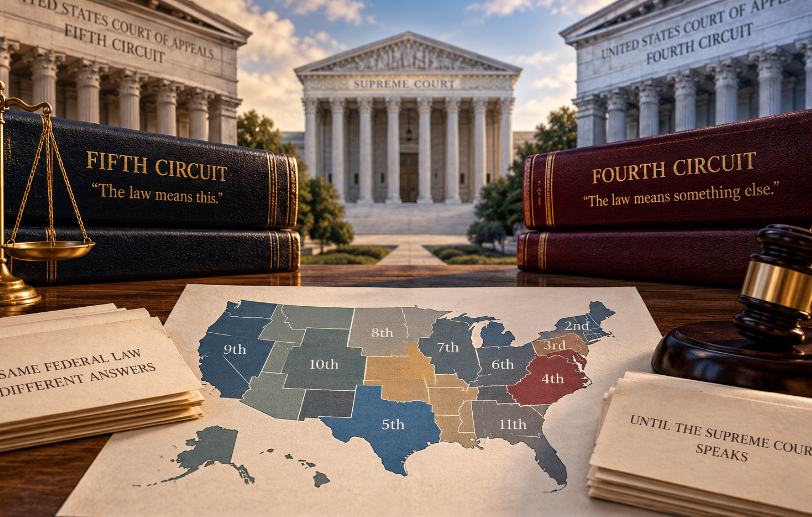
And because their cases are heard by different federal appeals courts, the statute can be interpreted differently.
Both courts are legitimate federal courts.
Neither decision is merely advisory.
And until the Supreme Court resolves the disagreement, both interpretations can remain binding within their respective regions.
This is known as a circuit split.
It is one of the stranger consequences of America's federal judicial system: Congress can enact one law for the entire country, yet that law can temporarily mean different things depending on where a case is filed.
The federal judiciary itself recognizes that conflicts among the courts of appeals occur regularly and that such conflicts play an important role in shaping the Supreme Court's docket.
Sometimes the disagreement concerns a technical procedural rule.
Sometimes it determines whether someone can sue at all.
And sometimes a split affects employment, criminal liability, government power or the rights of millions of people.
The Country Is Divided Into Judicial Circuits
Most federal cases never reach the Supreme Court.
They begin in one of the federal district courts. A party appealing the district court's decision will ordinarily go to the federal court of appeals responsible for that geographic region.
Those appellate regions are known as circuits.
The Ninth Circuit, for example, hears federal appeals from California and several other western states.
The Fifth Circuit covers Texas, Louisiana and Mississippi.
The Fourth Circuit includes Virginia, Maryland, West Virginia, North Carolina and South Carolina.
Each court of appeals establishes precedent that federal district courts within its circuit generally must follow.
But one circuit court ordinarily does not control another.
That creates the conditions for disagreement.
Suppose Congress passes a statute containing an ambiguous phrase.
A case reaches the Fifth Circuit, which interprets the phrase one way.
A year later, essentially the same question reaches the Fourth Circuit.
The Fourth Circuit can consider what the Fifth Circuit said.
It can find the reasoning persuasive.
But unless the Supreme Court has already resolved the issue, the Fourth Circuit generally is not required to adopt the Fifth Circuit's interpretation. Congressional Research Service materials describe precisely this phenomenon: different circuits can reach different conclusions on the same federal question, resulting in different treatment of similarly situated litigants depending on the circuit hearing their cases.
The Fourth Circuit can disagree.
Now there are two answers to one federal question.
A Woman's Employment Case Exposed Exactly This Problem
Lois Davis worked in information technology for Fort Bend County, Texas.
She alleged that she had experienced sexual harassment and retaliation. She filed a charge with the Equal Employment Opportunity Commission, as Title VII generally requires before an employee brings an employment-discrimination lawsuit in federal court.
Later, she attempted to add a claim involving religious discrimination.
The case went on for years.
Eventually almost everything except her religious-discrimination claim disappeared from the litigation.
Then Fort Bend County raised an argument with potentially devastating consequences.
Davis had not properly included religious discrimination in her formal EEOC charge, the county argued.
And according to the county, that wasn't merely a procedural mistake.
It meant the federal court lacked jurisdiction over the claim.
The distinction mattered enormously.
Ordinary procedural defenses can sometimes be forfeited when a party waits too long to raise them.
A genuine defect in subject-matter jurisdiction is different. An objection to subject-matter jurisdiction can arise even very late in litigation.
The district court agreed with Fort Bend and dismissed Davis's remaining claim.
The Fifth Circuit reversed.
And there was a bigger problem lurking behind the dispute.
Federal appeals courts disagreed about whether Title VII's EEOC charge-filing requirement really was jurisdictional.
The Supreme Court expressly took Fort Bend County v. Davis to resolve that conflict.
The Supreme Court Supplies One Answer
In 2019, the Supreme Court unanimously sided with Davis on that legal question.
Title VII's charge-filing requirement is mandatory, the Court explained, but it is not jurisdictional.
Instead, it is a claim-processing requirement.
That meant Fort Bend County could not wait until years into the litigation to characterize the issue as a jurisdictional defect that could never be forfeited.
The Court specifically contrasted the Fifth Circuit's position with an earlier Fourth Circuit decision that had treated failure to satisfy the charge-filing requirement as depriving federal courts of subject-matter jurisdiction.
Before the Supreme Court intervened, those competing approaches could matter enormously.
The same failure to comply with an employment-law procedure could be treated differently depending on which appellate precedent governed the case.
After the Supreme Court ruled, the disagreement was over.
Every federal circuit was bound by the Supreme Court's answer.
That is one of the Supreme Court's central functions in the federal judicial system.
It doesn't merely correct alleged mistakes in individual cases.
It can establish a single national interpretation when lower federal courts have divided over federal law.
But the Supreme Court Doesn't Automatically Resolve Every Split
This is where the system becomes more interesting.
When two circuits disagree, nobody automatically sends the dispute to the Supreme Court.
The losing party can ask the Supreme Court to hear a case by filing a petition for a writ of certiorari.
But Supreme Court review is highly selective.
A conflict among courts of appeals can be an important reason for the Court to take a case, but the existence of disagreement does not guarantee review. Circuit conflicts are nevertheless a significant factor in shaping the Court's docket.
That means a split can persist.
Other circuits may encounter the question while the disagreement remains unresolved.
Then the map can become more complicated.
Three circuits may take one position.
Two may take another.
Several may not yet have addressed the issue.
Lawyers sometimes describe the resulting landscape almost like election results:
the Second, Fourth and Seventh Circuits are on one side; the Fifth and Eleventh are on the other; the Ninth has not decided.
But this is not voting.
The side with the most circuits does not win.
Five appellate courts agreeing on an interpretation does not make their interpretation binding on a sixth circuit confronting the question for the first time.
Until controlling authority resolves the dispute, each circuit operates within the hierarchy of precedent governing it.
One Nationwide Rule Can Become a Geographic Patchwork
That has an unusual practical consequence.
Federal law is national.
Federal appellate precedent is regional.
Suppose a federal consumer-protection statute permits a particular type of lawsuit according to the Ninth Circuit but not according to the Eleventh Circuit.
A business operating nationwide may therefore face different legal exposure in different states even though Congress enacted only one statute.
The same can occur with employment law.
Or immigration law.
Or criminal law.
Or civil-rights litigation.
The Congressional Research Service notes that circuit splits can result in nonuniform treatment of similarly situated litigants and uncertainty in circuits that have not yet answered the question.
That is not necessarily evidence that either court is ignoring the law.
Both may be attempting in good faith to interpret exactly the same language.
They simply disagree about what it means.
Sometimes the Disagreement Is About a Supreme Court Decision
Circuit splits do not arise only because Congress wrote ambiguous statutes.
Lower courts can also disagree about what the Supreme Court itself meant.
That may sound surprising.
The Supreme Court issues an opinion. Lower courts are bound by it.
Shouldn't that end the matter?
Not always.
A Supreme Court decision may establish a general standard while leaving difficult questions unanswered.
The next cases arrive with different facts.
One circuit concludes that the Supreme Court's rule extends to the new situation.
Another concludes that it does not.
Now the disagreement is not over whether the Supreme Court's decision controls.
Everyone agrees that it does.
The disagreement is over what the controlling decision requires.
That is one reason litigation continues after landmark Supreme Court rulings.
A Supreme Court opinion can settle one case while generating the questions that define the next decade of cases.
A Circuit Can Sometimes Correct Its Own Split Internally
There is another kind of disagreement courts try particularly hard to avoid:
judges within the same circuit applying different rules.
Ordinarily, a later three-judge panel of a federal appeals court cannot simply disregard an earlier binding circuit precedent because its members believe the earlier panel was wrong.
One mechanism for reconsidering circuit precedent is en banc review.
Instead of an ordinary appellate panel deciding the matter, a larger body of the circuit's judges can reconsider the issue under the governing rules.
The Federal Judicial Center notes that the law-of-the-circuit doctrine and en banc review help maintain consistency within individual circuits, even though those mechanisms cannot guarantee consistency between different circuits.
That distinction matters.
A court system can insist that judges within one circuit follow the same rule while simultaneously tolerating disagreement between circuits.
At least temporarily.
The OSHA Vaccine-or-Test Litigation Showed How Fast Courts Can Diverge
One dramatic example unfolded in late 2021.
The Occupational Safety and Health Administration issued an emergency rule generally requiring employers with at least 100 employees to require COVID-19 vaccination or regular testing and masking, subject to the rule's terms and exceptions.
Legal challenges appeared across the country.
The Fifth Circuit stayed the rule, concluding among other things that the challengers were likely to succeed on their argument that OSHA had exceeded its statutory authority.
Because challenges had been filed in multiple circuits, federal procedures resulted in the cases being consolidated in the Sixth Circuit.
The Sixth Circuit went the other direction.
A three-judge panel dissolved the Fifth Circuit's stay and concluded that OSHA likely possessed the authority to issue the standard.
For a brief period, two federal appellate courts had taken sharply different positions during different stages of litigation over the same nationwide rule.
The dispute rapidly reached the Supreme Court.
In January 2022, the Supreme Court stayed the OSHA rule, concluding that the challengers were likely to succeed on their claim that the agency lacked authority to impose it. Three justices dissented from that decision.
That episode happened unusually quickly.
Many disagreements take years to reach the Supreme Court—if they reach it at all.
Sometimes the Supreme Court Changes a Rule Lower Courts Thought They Understood
Gerald Groff's dispute with the U.S. Postal Service illustrates a related phenomenon.
Groff, whose religious beliefs called for Sunday observance, sought accommodation from Sunday work.
Title VII requires employers to reasonably accommodate employees' religious practices unless doing so would create an “undue hardship” on the employer's business.
For decades, many lower courts interpreted an older Supreme Court decision, Trans World Airlines v. Hardison, as establishing that an employer faced an undue hardship whenever an accommodation imposed more than a de minimis cost.
The Third Circuit applied that understanding in Groff's case.
When Groff v. DeJoy reached the Supreme Court in 2023, however, the justices unanimously said that was not the proper standard.
The Court held that showing merely more than a de minimis cost does not establish undue hardship. The burden must be substantial in the overall context of the employer's business.
The Court did not say it was overruling Hardison. It said lower courts had placed too much weight on one phrase from the earlier opinion and clarified what Hardison actually required.
That distinction reveals another source of variation in federal law.
Courts can disagree about a statute.
They can disagree about the Constitution.
And they can disagree about how to read an earlier Supreme Court opinion that everyone agrees they must follow.
Why Doesn't the Supreme Court Just Resolve Every Disagreement?
Because that would transform the Supreme Court into something very different.
The federal courts of appeals decide tens of thousands of matters each year. The Supreme Court hears only a small fraction of the disputes presented to it.
Its role is not to serve as an automatic final appeal in every federal case.
Instead, the Court largely chooses which cases warrant its review.
A circuit conflict can make a case especially significant because the problem extends beyond the individual litigants. A Supreme Court ruling can eliminate uncertainty across the country.
But sometimes the Court may allow an issue to develop further in the lower courts.
Additional decisions can expose practical consequences and sharpen competing legal arguments.
Sometimes a supposed split is less clear than it initially appears because the cases involve materially different facts.
Sometimes Congress changes the statute.
Sometimes another case provides a better vehicle for resolving the question.
And sometimes the disagreement simply continues.
Where You Live Can Temporarily Affect What Federal Law Means
That is perhaps the most surprising part of the system.
Federal law is supposed to operate nationally.
Yet before the Supreme Court resolves a circuit split, geography can matter.
A federal district judge in California generally follows controlling Ninth Circuit precedent.
A federal district judge in Texas generally follows controlling Fifth Circuit precedent.
If those appellate courts disagree about an unresolved federal question, two district judges can correctly follow binding precedent and reach different legal conclusions.
That sounds contradictory.
Structurally, it is entirely possible.
Neither district judge has authority to declare the other circuit's precedent controlling.
Neither court of appeals has nationwide supremacy over its sister circuits.
Only a higher controlling authority—or sometimes Congress in a statutory dispute—can ultimately create uniformity.
Congress Can End Some Splits Without the Supreme Court
When the disagreement concerns a federal statute, there is another player capable of settling the issue:
Congress.
Suppose one circuit interprets a statutory phrase narrowly and another interprets it broadly.
Congress can amend the statute.
It can define the disputed term.
It can add language adopting one interpretation.
Or it can replace the provision altogether.
That is different from a dispute about the Constitution.
Congress cannot ordinarily overturn a Supreme Court constitutional interpretation merely by passing an ordinary statute.
But statutory circuit splits exist within a dialogue involving courts and the legislature.
Courts interpret what Congress enacted.
Congress can respond by changing what the statute says.
Disagreement Is Built Into the System
A circuit split can look like a defect.
One federal law should have one meaning.
Eventually, that is often the goal.
But disagreement also performs a function.
Different appellate courts can examine the same problem independently.
One court may identify a consequence another overlooked.
Judges can criticize competing interpretations.
Different factual situations can test how a rule works in practice.
By the time the Supreme Court takes the issue, it may have years of lower-court reasoning available to consider.
The disagreement becomes a kind of judicial conversation.
Eventually, however, some conversations need an answer.
That is when an ordinary lawsuit from Texas, Virginia, California or somewhere else can become nationally important.
The people who filed it may have wanted nothing more than to resolve their own dispute.
Instead, their case may become the vehicle through which the Supreme Court answers a question dividing the federal judiciary.
One statute.
Two courts.
Two answers.
And until someone with authority to settle the disagreement does so, both can be the law at the same time.