When the Supreme Court heard Hollingsworth v. Perry, the dispute appeared to present one of the largest constitutional questions in the country.
California voters had approved Proposition 8, amending the state constitution to provide that only marriage between a man and a woman would be recognized in California.
Two same-sex couples challenged the measure in federal court.
A federal district judge held Proposition 8 unconstitutional.
The case seemed headed toward a Supreme Court ruling about the Constitution and same-sex marriage.
But the Supreme Court never decided that question.
Instead, it asked something much more basic:
Who, exactly, had the right to appeal?
California's governor and other state officials had declined to defend the measure. The people attempting to preserve Proposition 8 in court were private individuals who had served as the initiative's official proponents.
The Supreme Court held in 2013 that those proponents lacked Article III standing to appeal the district court's judgment.
Their strong interest in defending Proposition 8 was not enough. They had not suffered the kind of personal, particularized injury required to invoke the jurisdiction of a federal court.
The Supreme Court therefore did not decide whether Proposition 8 itself violated the U.S. Constitution.
It decided that the people asking the Court to answer that question were not entitled to ask it.
That distinction reveals something fundamental about American courts.
Before a federal court decides who is right, it must determine whether it has the power to decide the dispute at all.
A Good Argument Isn't Enough
People often think of lawsuits as contests over the merits.
Did the government violate the Constitution?
Did the company break the law?
Was the regulation unlawful?
Was someone's civil right violated?
Those may eventually become the questions a court answers.
But federal courts are not general-purpose institutions for resolving every legal disagreement.
Article III of the Constitution gives federal courts authority over “Cases” and “Controversies.”
From those words has developed an extensive body of law governing whether a dispute is suitable for judicial resolution.
One of its most important components is standing.
Under the framework articulated in Lujan v. Defenders of Wildlife, a plaintiff invoking federal jurisdiction generally must establish three things: an injury that is concrete and particularized and actual or imminent; a sufficient causal connection between that injury and the challenged conduct; and a likelihood that the requested judicial relief will redress the injury.
That means a plaintiff can have an excellent argument that the government acted unlawfully and still lose before a court ever determines whether the argument is correct.
The question becomes:
Did this particular plaintiff suffer the kind of injury that permits a federal court to decide it?
The Endangered Animals Were Thousands of Miles Away
Few cases did more to shape modern standing law than Lujan v. Defenders of Wildlife.
The underlying dispute involved the Endangered Species Act.
Federal agencies were required in specified circumstances to consult regarding actions that could jeopardize endangered or threatened species.
The government adopted a regulation interpreting that consultation requirement as applying to actions in the United States and on the high seas, rather than to federal actions overseas.
Environmental organizations challenged that interpretation.
Their members cared deeply about endangered wildlife.
Some had previously traveled abroad to observe endangered species and said they intended to return.
The dispute therefore seemed to concern the geographic reach of one of America's most important environmental laws.
But the Supreme Court focused on the people bringing the lawsuit.
Had they suffered the necessary injury?
The Court concluded they had not adequately demonstrated an actual or imminent injury. Past visits to areas containing threatened species, coupled with intentions to return at some unspecified time, did not establish the required imminence on the record before the Court.
The environmental issue was real.
The legal disagreement was real.
But that was not enough.
The Court emphasized that a generalized complaint that the government is failing to follow the law does not by itself create an Article III case or controversy.
That principle can produce a result that seems strange outside a courthouse.
A court may effectively say:
Even if your interpretation of the law were correct, you have not shown that you are the person entitled to obtain this judicial remedy.
The Injury Must Belong to the Plaintiff
That point is easy to miss.
Standing ordinarily doesn't ask whether something bad happened.
It asks whether something happened to the person asking the court to act, in a way satisfying the applicable requirements.
The distinction became particularly important in environmental litigation.
Pollution may unquestionably exist.
An animal species may genuinely be threatened.
A government action may have significant environmental consequences.
But Article III standing still requires a plaintiff who can establish the necessary personal injury.
That does not mean environmental injuries cannot support standing.
They can.
In Friends of the Earth v. Laidlaw Environmental Services, environmental organizations sued over alleged violations of a wastewater discharge permit.
Members described how concerns about pollution affected their use and enjoyment of the affected area.
The Supreme Court concluded that the relevant question was not simply whether the environment itself had been injured. The standing inquiry concerned injury to the plaintiffs, and the members' recreational, aesthetic and economic interests supplied the necessary connection in that case.
Compare that with Lujan.
Both involved environmental concerns.
The threshold results differed because the plaintiffs' relationship to the alleged injury differed.
Then There Is the Question of Whether the Court Can Fix It
Being injured is only part of standing.
Suppose a plaintiff demonstrates a genuine personal injury.
There is still another question:
Would winning this lawsuit likely do anything about it?
This is redressability.
A plaintiff generally must show that the requested judicial relief is likely to redress the asserted injury rather than merely produce a legal declaration having no meaningful effect on it.
This becomes especially difficult when the alleged injury depends on the choices of people who aren't parties to the lawsuit.
Imagine a person challenges a government policy because she believes it causes private companies to increase prices.
Even if she can demonstrate that she is paying more, a court may have to ask:
Did the government policy actually cause the companies' decisions?
And if the court invalidates the policy, is it sufficiently likely that the companies will lower their prices?
The more the requested remedy depends on independent third parties behaving in a particular way, the more complicated causation and redressability can become. Lujan itself emphasized this difficulty when the plaintiff's alleged injury depends on government regulation—or nonregulation—of someone else.
So even a concrete injury doesn't automatically produce standing.
The defendant must be sufficiently connected to it.
And the court must be capable of providing meaningful relief.
Proposition 8 Presented a Different Standing Problem
The unusual thing about Hollingsworth v. Perry was that the original plaintiffs unquestionably had something personal at stake.
They were same-sex couples who wanted to marry.
They challenged Proposition 8 and won in federal district court.
Then California officials declined to appeal.
That left Proposition 8's private proponents attempting to carry the case forward.
The Supreme Court explained that standing is required not merely when a lawsuit begins but when a party seeks appellate review.
The initiative proponents had not themselves been ordered to do anything or prohibited from doing anything by the district court's judgment.
Their interest was in seeing a generally applicable California law enforced.
The Court characterized that as a generalized interest rather than the personal, tangible harm Article III requires.
So the Supreme Court dismissed the appeal for lack of jurisdiction.
The practical consequence was enormous.
The lower federal court judgment invalidating Proposition 8 remained in place, but the Supreme Court itself did not issue the nationwide constitutional ruling many observers had anticipated from the case.
Two years later, Obergefell v. Hodges would squarely present the broader constitutional question, and the Court held that same-sex couples may exercise the fundamental right to marry.
But Hollingsworth remains a striking example of a major constitutional controversy ending at the Supreme Court because the people pursuing the appeal were the wrong parties to pursue it.
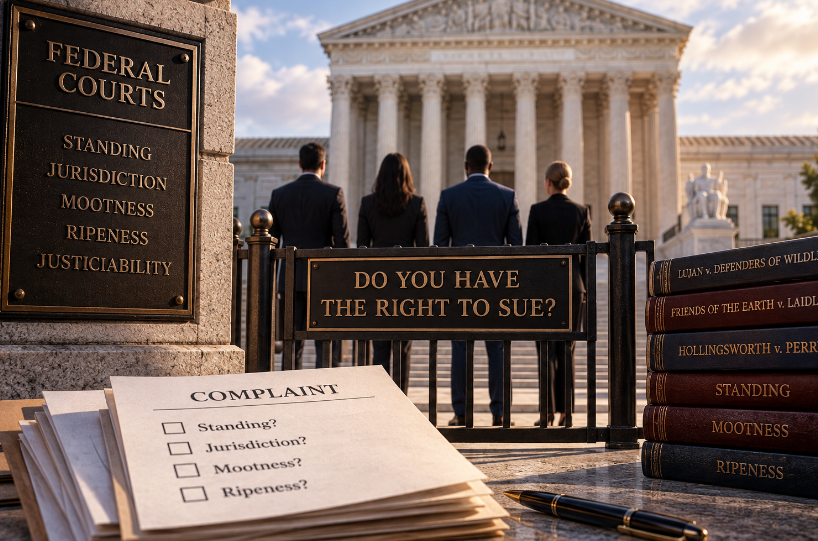
Standing Isn't the Only Doorway Into Court
A case can encounter other threshold barriers.
Jurisdiction asks whether a particular court has legal authority over the kind of dispute presented.
Mootness generally asks whether a live controversy that once existed has disappeared before the litigation concluded.
Ripeness concerns, broadly speaking, whether a dispute has developed sufficiently to be ready for judicial resolution.
There are also questions involving sovereign immunity, exhaustion requirements and other doctrines that can determine whether and where litigation proceeds.
These doctrines differ from one another.
But they share an important characteristic.
They can prevent a court from reaching the question everyone outside the courthouse is talking about.
A Case Can Be Alive When Filed and Dead Before Judgment
Mootness produces one of the strangest possibilities in litigation.
A plaintiff can have standing when the case begins.
The court can unquestionably possess jurisdiction at that moment.
The dispute can be intensely contested.
And then something happens.
The challenged policy expires.
The plaintiff receives the requested relief.
Circumstances change so that the court's decision would no longer affect the parties.
Now there may no longer be a live controversy for a federal court to resolve.
Standing and mootness both arise from Article III's case-or-controversy limitation, although the Supreme Court has emphasized that the two inquiries are distinct.
The difference can be understood roughly as a question of timing.
Standing: Was there a proper controversy for this plaintiff to bring?
Mootness: Is there still a controversy for the court to resolve?
But Defendants Can't Always Make a Lawsuit Disappear
Suppose a factory is accused of illegally discharging pollutants into a river.
An environmental organization sues.
Then the company stops the challenged discharge.
Can the company simply announce that the problem is over and have the lawsuit dismissed as moot?
Not necessarily.
That problem was central to Friends of the Earth v. Laidlaw.
After the litigation began, circumstances changed, including Laidlaw's compliance history and eventually the closure of the facility.
The Fourth Circuit had concluded that the action was moot because civil penalties would be paid to the government rather than directly remedy the plaintiffs' injuries.
The Supreme Court disagreed with the mootness determination.
Among other things, the Court applied the demanding standard associated with voluntary cessation: a defendant's decision to stop challenged conduct does not automatically eliminate the controversy if the conduct could reasonably recur.
Otherwise, defendants could potentially avoid judicial review by stopping whenever sued and restarting afterward.
So mootness isn't simply:
“The defendant stopped doing it.”
The court has to determine whether there remains a live controversy under the circumstances.
Sometimes the Lawsuit Outlives the Dispute That Created It
This produces another counterintuitive feature of federal litigation.
Courts care about what is happening now, not merely what happened when the complaint was filed.
A lawsuit can take years.
Life doesn't stop while judges consider it.
People graduate.
Elections end.
Policies expire.
Businesses close.
Government officials leave office.
Laws change.
Payments are made.
Contracts terminate.
Those events can fundamentally alter the court's authority to continue deciding a case.
That is why lawyers monitor jurisdiction throughout litigation.
A threshold issue isn't necessarily something resolved once at the courthouse door.
Article III requires an actual controversy to persist through the relevant stages of the litigation, and a party seeking appellate review must itself have standing to do so.
The Most Important Question May Be the One Nobody Came to Argue
From outside the legal system, these outcomes can seem frustrating.
People may spend years waiting for the Supreme Court to answer a major constitutional question.
Briefs are filed.
Advocacy groups organize.
News organizations prepare for a landmark ruling.
Then the decision arrives:
Dismissed for lack of standing.
Or:
The case is moot.
To someone interested in the underlying controversy, that can sound like the Court avoided the real question.
But from the perspective of Article III, the threshold question is a real question.
Federal courts possess enormous authority.
They can invalidate federal laws.
They can block executive actions.
They can declare state laws unconstitutional.
They can impose judgments worth billions of dollars.
The case-or-controversy requirement limits when that judicial power may be exercised.
Standing doctrine therefore isn't merely about paperwork or courtroom procedure.
It concerns the constitutional role of the judiciary itself.
Courts Don't Issue Legal Advice
There is a larger principle underneath these doctrines.
Federal courts ordinarily do not exist to answer hypothetical legal questions.
A person cannot generally walk into federal court and say:
“I think this law is unconstitutional. Please tell me whether I'm right.”
Nor can someone ordinarily litigate simply because he cares deeply about a political or legal issue.
The Constitution requires an actual case or controversy.
That means identifying a plaintiff.
Identifying an injury.
Connecting that injury to the defendant.
And identifying something the court can actually do about it.
Lujan became a landmark not because the Supreme Court definitively resolved every question about endangered species abroad, but because it articulated demanding requirements for the people asking federal courts to intervene.
Hollingsworth reached the Supreme Court amid a national debate about marriage but ended with a ruling about who could appeal.
Laidlaw concerned pollution but became an important decision about both standing and when changed circumstances make litigation moot.
The subjects of those cases could hardly be more different.
The underlying question was remarkably similar:
Is this a dispute that this court, at the request of this party, has constitutional authority to decide?
Sometimes “Who Wins?” Is the Wrong Question
Court cases are usually described as conflicts between two sides.
Plaintiff versus defendant.
Individual versus government.
Company versus regulator.
State versus federal government.
Someone wins.
Someone loses.
But some of the most consequential cases never reach that contest.
Before deciding which side has the better interpretation of the Constitution or a statute, a federal court may have to determine whether there is a proper case before it at all.
That can make the identity of the plaintiff as important as the legal argument.
A different plaintiff with a different injury might be able to bring essentially the same challenge.
A case dismissed today might return years later through another litigant.
And a controversy that seems destined to produce a landmark ruling can disappear because the people before the Court lack the legal right to obtain one.
That is why one of the first questions in a major lawsuit isn't always:
Who is right?
Sometimes it is:
Who has the right to ask the court?