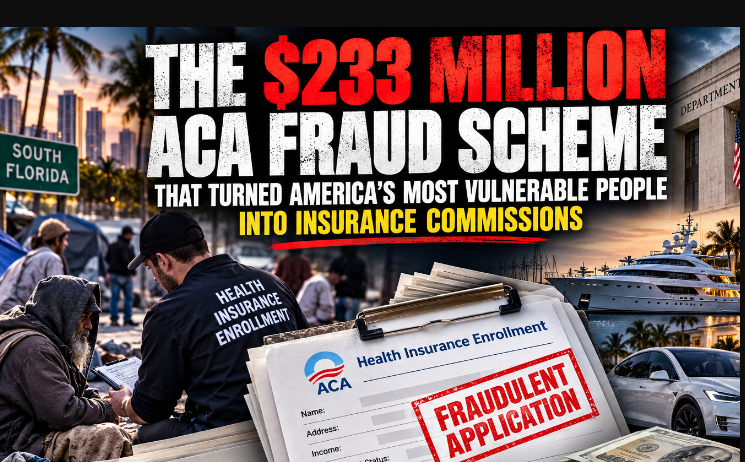
They were homeless.
Some were unemployed.
Some were struggling with mental-health conditions or substance-use disorders.
To the people behind a massive South Florida health-insurance operation, federal prosecutors proved, those vulnerabilities represented something else:
an opportunity to generate insurance commissions.
Over a period spanning approximately 2018 through 2022, an insurance brokerage president and the CEO of a marketing company built an operation that sought more than $233 million in Affordable Care Act subsidies, according to evidence presented in federal court.
At least $180 million was actually paid by the federal government.
The people being enrolled frequently did not qualify.
But the companies involved could still make money when insurance policies were issued.
In November 2025, a federal jury convicted Cory Lloyd, president of an insurance brokerage firm, and Steven Strong, CEO of a marketing company, on federal fraud charges arising from the operation. Strong was additionally convicted of money laundering.
On February 18, 2026, both men were sentenced to 20 years in federal prison and ordered to pay $180.6 million in restitution. Both have appealed their convictions and sentences.
But the convictions tell only part of the story.
Because behind the enormous dollar figures were thousands of ordinary people whose identities, incomes and health-insurance coverage became the raw material of the scheme.
How a Free Health-Insurance Policy Became Valuable
The mechanics began with an important feature of the Affordable Care Act.
Eligible consumers purchasing health insurance through an ACA marketplace can receive premium tax credits—commonly called subsidies—to reduce what they pay for insurance.
Instead of necessarily giving that money to the consumer, the federal government can send the subsidy directly to the insurance company to cover part or all of the person's monthly premium.
For eligible consumers, the system makes health insurance affordable.
For Lloyd and Strong, prosecutors proved, it created another opportunity.
Their businesses could earn commissions when people enrolled in insurance policies.
The more people enrolled, the more commissions could be generated.
There was one major obstacle.
Many of the people they were targeting did not meet the eligibility requirements for the fully subsidized plans.
So the information going into the applications was manipulated.
Street Marketers Went Looking for People
This was not simply an online advertising campaign where consumers happened to enter incorrect information.
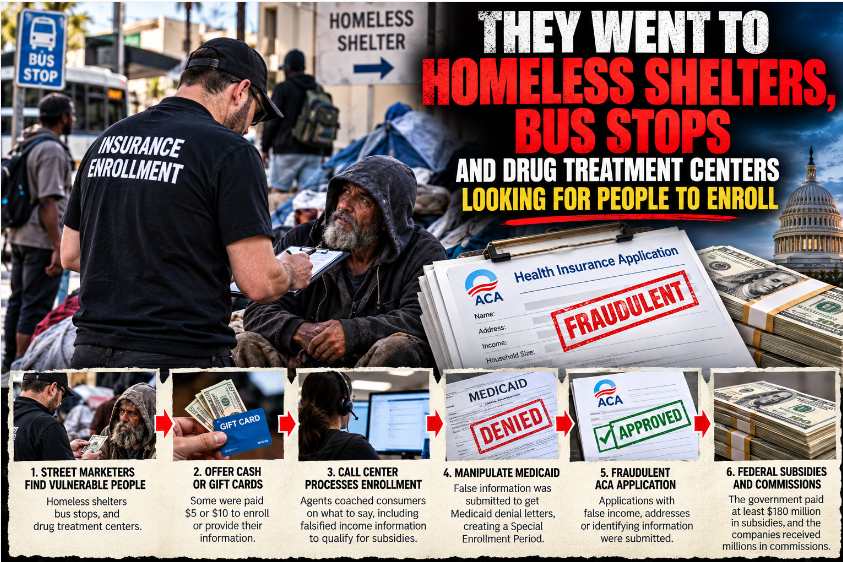
Federal prosecutors said Lloyd and Strong used "street marketers" to find prospective enrollees.
And the population they pursued was remarkable.
According to evidence presented at trial, the operation targeted low-income people experiencing:
homelessness,
unemployment,
mental-health challenges,
and substance-abuse disorders.
Street marketers sometimes offered people bribes to persuade them to enroll.
Marketers working for Strong's company also coached consumers on how to answer application questions in ways that would maximize federal subsidies.
Some applications contained addresses and Social Security numbers that did not match the people supposedly applying.
The people being enrolled could receive health coverage requiring little or no premium payment from them.
The insurance companies received federal subsidies.
And the businesses arranging the enrollments generated commissions.
The Income Problem
ACA subsidies have eligibility requirements.
One particularly important issue in the federal case involved income.
According to prosecutors, Lloyd and Strong's operation enrolled people in fully subsidized ACA plans even though their incomes did not satisfy the requirements for those subsidies.
The government proved that misleading sales scripts and deceptive techniques were used to convince consumers to say they would attempt to earn the minimum income necessary to qualify—even when the person initially expected to have no income.
The operation also attempted to circumvent federal efforts to verify income and other information.
What appeared in the federal system, therefore, could be very different from the person's actual circumstances.
And every successful enrollment could generate another commission.
Prosecutors Found an Extraordinary Text Conversation
Perhaps nothing captures the mentality behind the operation better than a text exchange introduced by federal prosecutors.
The two men discussed another possible source of vulnerable people:
hurricane shelters.
According to the Justice Department, Strong suggested sending street marketers into Florida hurricane shelters.
Lloyd responded enthusiastically, calling it a "killer idea."
The remainder of the exchange, as reproduced by prosecutors, used crude and graphic language about exploiting the people inside those shelters.
The exchange matters because it demonstrates something numbers alone cannot.
The homeless, addicted, mentally ill and disaster-displaced people being approached were not simply an accidental demographic produced by an indiscriminate marketing campaign.
Federal prosecutors established at trial that vulnerable populations were deliberately targeted.
At Least $180 Million Came From the Federal Government
The scale grew dramatically.
When Lloyd and Strong were originally indicted in February 2025, prosecutors alleged that the scheme had caused approximately $161.9 million in federal subsidy payments.
By the time the case went to trial, the government's evidence established an even larger operation.
Prosecutors said the scheme sought more than:
$233 million in fraudulent ACA subsidies.
The federal government actually paid at least:
$180 million.
Those subsidies went to insurers to pay premiums on policies generated through the enrollment operation.
Lloyd and Strong's companies, meanwhile, received millions of dollars in insurance commissions.
The Money Became Houses, a Yacht and a Tesla
Some of the proceeds eventually became very tangible.
Federal prosecutors said money from the scheme was used to purchase luxury property and vehicles.
That included a waterfront home in the Florida Keys.
An 80-foot yacht.
And a Tesla.
The contrast is difficult to miss.
At one end of the operation were people experiencing homelessness, addiction, unemployment and mental illness.
At the other were millions of dollars in commissions and luxury assets.
Between them was the federal health-insurance subsidy system.
Some Consumers' Medical Care Was Disrupted
The victims were not limited to taxpayers.
According to federal court records, some consumers enrolled in plans for which they did not qualify subsequently experienced disruptions in their medical care.
That introduces an important part of this story that Court St Legal will examine separately.
Health insurance is not merely an accounting entry.
Changing someone's coverage can affect doctors, treatment facilities, prescriptions, networks and access to ongoing care.
For a person already struggling with addiction, mental illness or unstable housing, those disruptions can have consequences considerably more serious than an incorrect insurance application.
The government alleged the applications were fraudulent.
The individual whose name appeared on the application could still be the person whose healthcare was affected.
Lloyd and Strong Went to Trial
Unlike many large federal fraud cases, this one did not end with both principal defendants pleading guilty.
Lloyd and Strong went before a jury in federal court in West Palm Beach.
Their trial ran from November 3 through November 17, 2025.
The jury convicted Lloyd of conspiracy to commit wire fraud, three counts of wire fraud and conspiracy to defraud the United States.
Strong was convicted of those offenses as well as two money-laundering counts.
Three months later, each received a 20-year federal prison sentence.
Each was ordered to pay $180.6 million in restitution.
Both men filed notices of appeal on March 4, 2026. Their appeals are pending before the Eleventh Circuit, according to the Justice Department's case page.
They Weren't the Only Ones
The federal investigation extended beyond Lloyd and Strong.
Dafud Iza pleaded guilty in April 2025 to major fraud against the United States for his role in the enrollment scheme.
In January 2026, he was sentenced to 35 months in federal prison and ordered to pay $133.9 million in restitution.
Then the investigation reached a company closely connected to the insurance operation.
In April 2026, federal prosecutors charged AP of South Florida LLC, doing business as Fiorella Insurance Agency, with major fraud against the United States.
Unlike unresolved allegations against a defendant contesting a charge, there is an important development here: APSF has agreed to plead guilty, although the plea agreement remains subject to acceptance by the federal court.
The Justice Department says APSF's conduct resulted in approximately $141.5 million in unwarranted federal subsidies.
And a parallel civil case produced another extraordinary result.
AssuredPartners—the national insurance brokerage company that became APSF's parent after acquiring certain Fiorella assets in 2021—agreed to pay $107 million to resolve False Claims Act allegations. The Justice Department specifically notes that AssuredPartners was not criminally charged in the APSF criminal information.
The investigation therefore reaches considerably farther than two convicted executives.
This Wasn't Just Insurance Fraud
The easiest way to understand the case is to look at the $180 million.
But the money may not be the most important part of the story.
The machinery of the scheme depended on finding people whose circumstances made them useful.
Someone without stable housing could become an insurance enrollment.
Someone without employment could become an insurance enrollment.
Someone struggling with mental illness could become an insurance enrollment.
Someone struggling with addiction could become an insurance enrollment.
Federal prosecutors proved that those vulnerabilities were deliberately exploited to generate fraudulent subsidized policies and millions of dollars in commissions.
And that raises questions considerably larger than the criminal convictions themselves.
Who were the street marketers?
How were they paid?
How many consumers knew false information was being submitted?
Where did the consumers go for medical or substance-use treatment after enrollment?
Which insurance companies paid the commissions?
What warning signs appeared while the enrollments multiplied?
How did more than $180 million in federal subsidies leave the Treasury before the operation was stopped?
And why were people experiencing homelessness, addiction and mental illness so financially valuable to the businesses pursuing them?
Those questions are where this investigation goes next.
Because the $233 million figure tells us how large the scheme became.
It does not tell us how a person living on the street became worth money to the people who found them there.