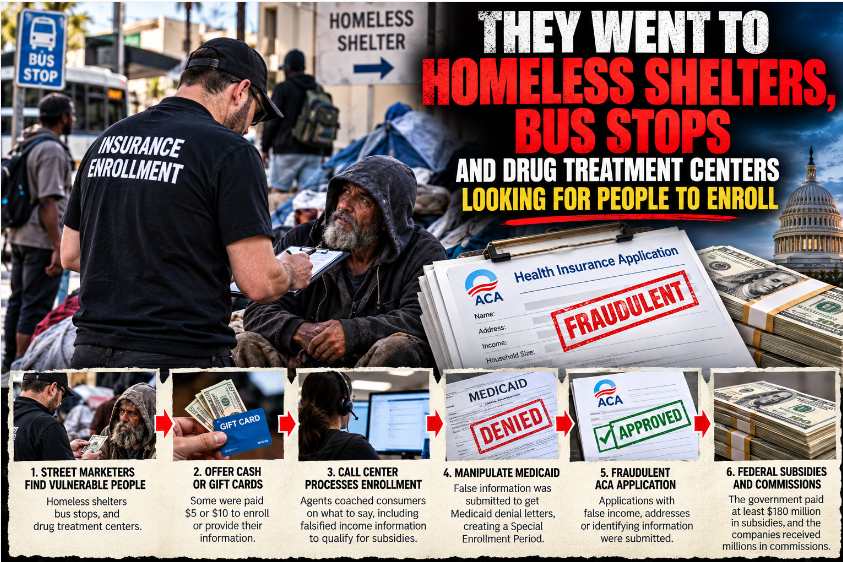
 A homeless person could receive $5 or $10.
The federal government could pay thousands of dollars toward that person's health-insurance premiums.
And somewhere farther up the financial chain, the enrollment could generate commissions, bonuses and other payments for the insurance businesses responsible for putting the policy in place.
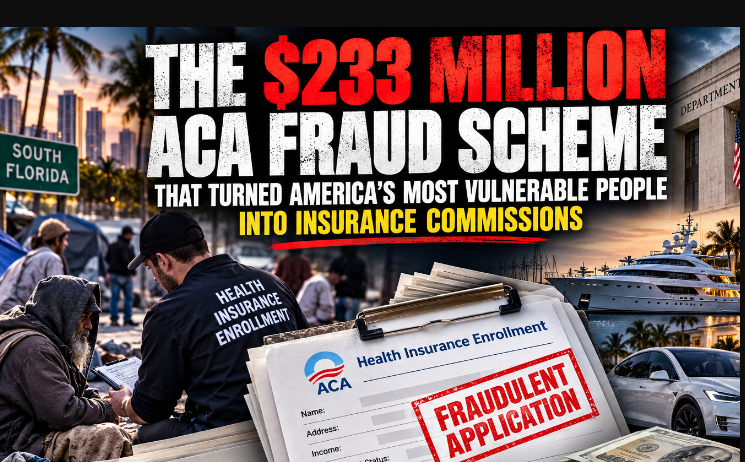
That financial structure is essential to understanding the $233 million Affordable Care Act fraud scheme examined in this series.
The people recruited at homeless shelters, bus stops and drug-treatment centers were not valuable because they had money.
Many had almost none.
They became valuable because the federal government did.
When a consumer qualified for an Advanced Premium Tax Credit, the government could send the subsidy directly to an insurance company each month toward the consumer's premium.
The consumer might pay nothing.
But the insurance policy was still producing money.
And the brokerage responsible for enrolling that consumer could get paid.
Federal prosecutors established at trial that Cory Lloyd and Steven Strong exploited that system to seek more than $233 million in fraudulent ACA subsidies, of which the government paid at least $180 million. Their companies received millions of dollars in commissions. Both men were convicted in November 2025 and sentenced in February 2026 to 20 years in federal prison. Their appeals remain pending.
But a later federal case revealed that the money trail did not stop with those two men.
The Brokerage Was Fiorella Insurance Agency
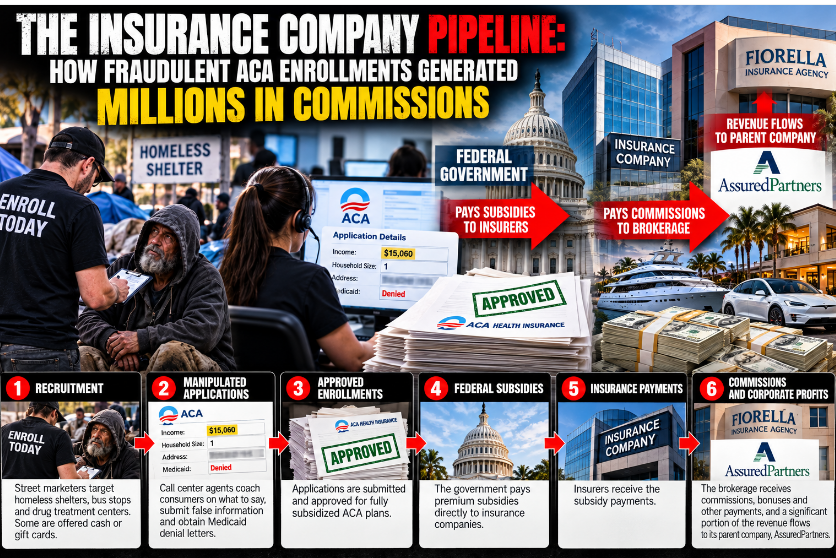
For years, the insurance operation at the center of the case was known as Fiorella Insurance Agency.
Federal court records say Fiorella Insurance Agency Inc. operated as an insurance brokerage from 1988 until February 2021.
Cory Lloyd was one of its owners.
Then the corporate structure changed.
AP of South Florida LLC, or APSF, was formed in Florida in January 2021. The following month, APSF purchased certain assets of Fiorella.
APSF thereafter continued doing business under the Fiorella Insurance Agency name, and many of Fiorella's managers and employees went to work for the new company.
Lloyd became president of APSF.
So from the consumer's perspective, the name Fiorella could remain familiar.
Behind it, however, ownership had changed.
That change would become extremely important years later.

Lloyd Continued the Scheme After the Acquisition
The Justice Department says Lloyd began the fraudulent enrollment scheme while working at the legacy Fiorella entity.
The government says it did not stop when APSF purchased Fiorella's assets in February 2021.
Lloyd became president of APSF and, according to the Justice Department, continued orchestrating the scheme on APSF's behalf.
The underlying business model remained remarkably straightforward.
Find consumers.
Enroll them in ACA insurance.
Generate commissions.
The fraud arose because many of those consumers did not actually qualify for the fully subsidized policies being obtained in their names.
Federal authorities say APSF employees falsely represented that consumers expected to earn income just above the federal poverty threshold, allowing them to qualify for the maximum subsidies.
Employees also submitted false information to Florida Medicaid to obtain denial letters that could be used to trigger Special Enrollment Periods.
When the Centers for Medicare & Medicaid Services questioned information in applications, APSF employees submitted additional false information, according to the company's federal settlement documents.
Each successful enrollment could produce revenue.
APSF Received Commissions, Bonuses and Other Payments
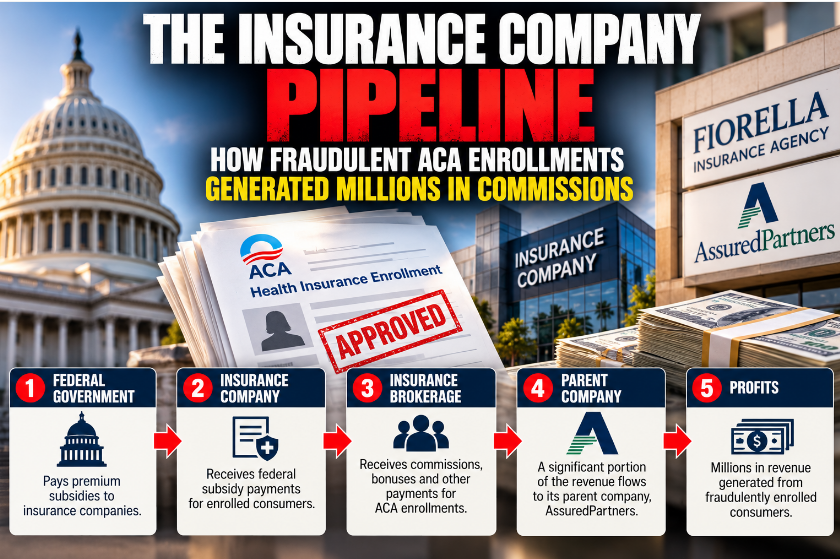
The federal government's 2026 civil settlement states explicitly what APSF received.
For consumers enrolled in ACA plans, the brokerage received:
commissions, bonuses and other payments from the insurer.
The government's settlement documents go one step further.
They say a significant portion of APSF's revenues from the fraudulently obtained payments flowed up to its parent corporation, AssuredPartners.
That transformed the case.
This was no longer simply a story about street marketers, a South Florida insurance executive and a marketing-company owner.
Money generated by the enrollments had entered the revenue stream of a much larger national insurance organization.
AssuredPartners Had Become the Parent Company
AssuredPartners was the corporate parent of APSF during part of the period addressed by the government's 2026 resolution.
The Justice Department describes AssuredPartners as a national partnership of insurance brokers.
In April 2026, the federal government announced parallel criminal and civil resolutions concerning the enrollment operation.
The distinction between the two companies is important.
APSF agreed to plead guilty to a federal criminal charge.
AssuredPartners was not criminally charged.
Instead, AssuredPartners agreed to pay $107 million to resolve civil False Claims Act allegations concerning fraudulent ACA applications.
The Justice Department expressly states that the civil claims were allegations only and that there had been no determination of liability through the civil settlement.
That distinction should not be blurred.
The government's criminal case against APSF and its civil resolution with AssuredPartners are legally different proceedings.
APSF Agreed to Plead Guilty
On April 6, 2026, federal prosecutors filed a criminal information against AP of South Florida LLC, doing business as Fiorella Insurance Agency.
The company was charged with major fraud against the United States.
APSF entered into a written plea agreement with the Justice Department and agreed to plead guilty.
As of the Justice Department's current case update, however, that agreement still must be accepted by the federal district court.
The government says APSF's conduct resulted in approximately:
$141.5 million in unwarranted federal ACA subsidies.
That number provides some sense of how much of the larger scheme passed through the brokerage operation.
$141.5 Million in Subsidies Wasn't $141.5 Million in Commissions
There is an important accounting distinction.
The $141.5 million was not simply deposited into APSF's bank account.
Those were federal subsidies associated with improperly enrolled consumers.
ACA premium subsidies generally flow from the federal government to insurance carriers to help pay consumers' monthly premiums.
The brokerage's financial benefit came through the commissions, bonuses and other payments generated by the enrollments.
That helps explain why volume mattered so much.
One enrollment might generate a limited commission.
Thousands of enrollments could generate millions.
And a customer who remained insured could continue generating revenue.
The incentive was therefore not merely to enroll people.
It was to enroll a very large number of people.
Strong Supplied Consumers. Lloyd Received Insurance Payments.
The Lloyd and Strong trial exposed another layer of that financial chain.
According to evidence accepted by the jury, Lloyd received commissions and other payments from an insurance company for enrolling consumers.
Lloyd, in turn, paid Strong commissions for consumer referrals.
Strong's marketing operation supplied potential customers.
Street marketers found people.
Insurance agents processed them.
The government paid subsidies to insurers.
Insurance-related payments traveled back toward the businesses generating the enrollments.
The structure created a powerful financial incentive to keep the pipeline full.
A person encountered at a bus stop could begin a sequence of transactions extending far beyond the few dollars that might have persuaded that person to participate.
The Government Says Tens of Thousands Were Targeted
By sentencing, federal authorities described the victim population as numbering in the tens of thousands.
They included people struggling with homelessness, addiction and mental-health problems.
That scale helps explain how commission revenue could become enormous.
The scheme did not depend upon extracting money from the consumers themselves.
In many cases, the consumers were selected precisely because they had little money.
The federal subsidy effectively supplied the purchasing power.
That is what made the model unusual.
Ordinarily, a business seeking customers wants people capable of paying for its product.
Here, a consumer's inability to pay did not necessarily make that person commercially unattractive.
If the application could be structured to qualify for a fully subsidized ACA plan, the government could pay the premium.
A Medical Provider Warned Lloyd
There is evidence that concerns reached the brokerage while the operation was underway.
The Justice Department says Lloyd, while serving as APSF's president, received complaints from a medical provider about homeless consumers who had been given cash to enroll.
According to the provider's complaint, the individuals had opioid addictions and were desperate for money.
The provider said they did not even know they had insurance until attempts were made to obtain medications through a county program for uninsured patients.
The result, according to the complaint, was that they could face more than $500 per month for medications.
The provider warned that the patients were worse off with the newly obtained insurance than they had been without it.
The enrollments nevertheless generated financial benefits elsewhere in the chain.
That contrast is central to understanding the case.
The Corporate Parent Received Revenue From the Operation
The federal settlement says a significant portion of APSF's revenue from fraudulently obtained payments flowed to AssuredPartners.
The Justice Department ultimately resolved its civil allegations against AssuredPartners for $107 million.
Again, the legal distinction matters: AssuredPartners was not charged in the criminal information, and the False Claims Act allegations resolved through the civil settlement were not adjudicated findings of liability.
APSF's position was different.
It entered a plea agreement concerning the criminal charge, subject to the district court accepting that agreement.
The two resolutions nevertheless expose how far money associated with the enrollments traveled through the corporate structure.
The Government's Recovery Exceeded $135 Million
The April 2026 resolutions were substantial.
AssuredPartners agreed to pay $107 million in the civil settlement.
APSF's resolution included additional financial obligations, bringing the announced combined resolutions to more than $135 million.
Those payments came after Lloyd and Strong had already been ordered to pay $180.6 million in restitution following their criminal convictions.
The numbers overlap different legal proceedings and should not simply be added together as though they represent separate measurements of the government's total loss.
But they demonstrate the scale of the enforcement response.
This was no longer an investigation confined to a few fraudulent applications.
It had become a major criminal and civil case involving individual executives, an insurance brokerage, a corporate parent, hundreds of millions of dollars in federal subsidies and tens of thousands of consumers.
The Insurance Carrier Is Another Part of the Story
There is still another institution in the middle of the financial chain.
The insurance company.
Federal records establish that Lloyd received commissions and other payments from an insurer in exchange for ACA enrollments.
The federal government, meanwhile, paid the ACA subsidies directly toward insurance premiums.
That means the complete money trail cannot be understood merely by examining Lloyd, Strong or the brokerage.
The subsidies went somewhere before commission payments came back.
That raises a separate set of questions:
Which insurer or insurers received the federal premium payments associated with these consumers?
How much was paid?
What information did the carriers receive about the enrollment population?
Were unusually large numbers of fully subsidized consumers visible?
Did enrollment patterns create warning signs?
And at what point did anyone outside the brokerage recognize that homeless people and people with addiction or mental-health problems were being enrolled at extraordinary scale?
Those questions deserve their own examination.
The Person on the Street Was the Beginning of a Much Larger Financial Transaction
The previous article in this series followed the consumer.
A street marketer approaches someone at a homeless shelter, bus stop or treatment facility.
Perhaps the person receives $5 or $10.
Perhaps a gift card.
The person's information enters an enrollment system.
Income can be manipulated.
Medicaid can be engineered toward a denial.
An ACA application can be approved.
But the transaction does not end there.
The federal government begins paying a subsidy.
The insurer receives premium payments.
The brokerage can receive commissions and bonuses.
Referral commissions can be paid.
And according to the government's civil settlement, a significant portion of APSF's revenue from fraudulently obtained payments ultimately flowed to its corporate parent.
The person at the beginning of that chain might have been homeless and virtually penniless.
But once that person's identity entered the insurance pipeline, money could flow all the way up.