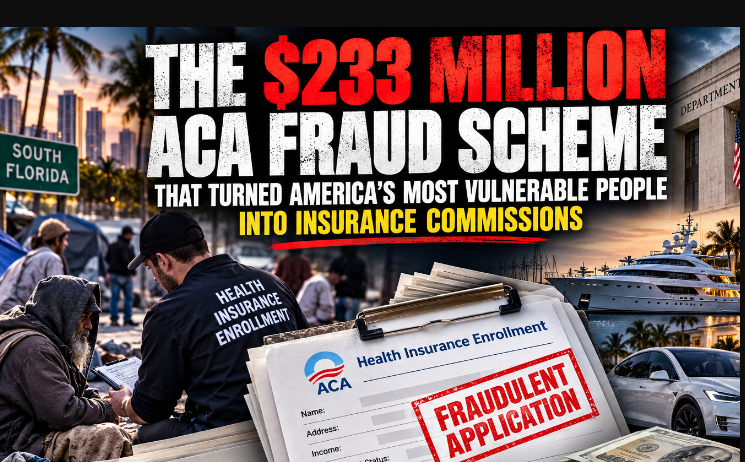
 The $233 million Affordable Care Act fraud scheme did not begin inside an insurance office.
It began on the street.
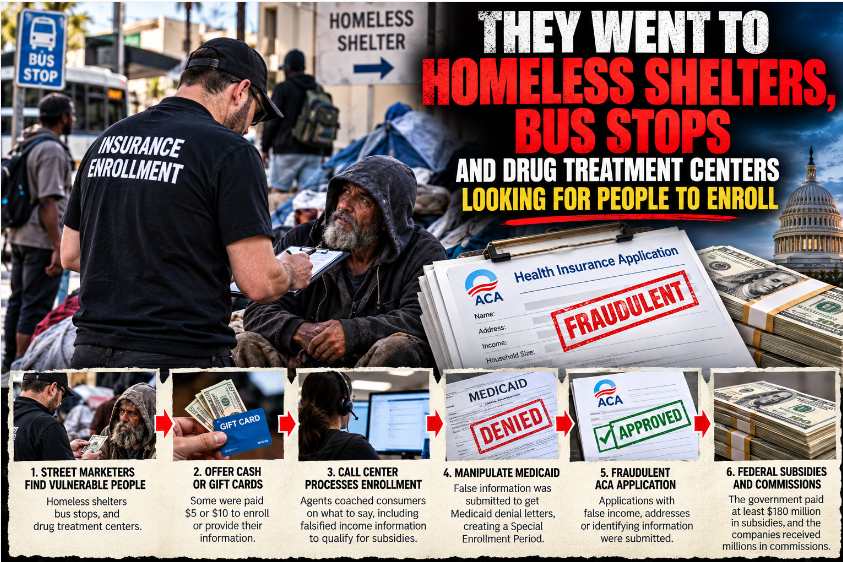
Federal records show marketers were dispatched to places where some of the country's most vulnerable people could be found: homeless shelters, bus stops, drug-treatment facilities and other locations frequented by low-income people.
Sometimes the pitch included money.
Sometimes it was a gift card.
The objective was to obtain enough information to turn the person standing in front of the marketer into something financially valuable:
a new health-insurance enrollment.
Federal prosecutors established at the 2025 trial of insurance executive Cory Lloyd and marketing executive Steven Strong that "street marketers" working on their behalf targeted people experiencing homelessness, unemployment, mental-health disorders and substance-use disorders. Some prospective enrollees were offered bribes to participate.
But what happened after someone agreed is what makes the operation remarkable.
The person recruited on the street could be passed into a system designed to transform someone with little or no income into an applicant who appeared eligible for federally subsidized private health insurance.
The Marketers Supplied the People
The fraud required a constant supply of potential insurance customers.
Strong's marketing operation helped provide them.
The government's sentencing memorandum describes the division of labor bluntly: Strong supplied thousands of consumers through street-marketing campaigns, while Lloyd supplied insurance brokers trained to obtain the income representation needed to secure federal subsidies and resulting commissions.
The marketers did not simply wait for consumers to search for health insurance.
They went looking for them.
In the subsequent criminal case against AP of South Florida LLC, or APSF, the Justice Department said the brokerage contracted with street marketers who targeted:
homeless shelters,
bus stops,
drug-treatment clinics,
and similar locations.
Marketers offered some people cash or gift cards either to enroll in subsidized ACA insurance or simply to provide the personal information needed for an application.
That distinction is significant.
According to the federal case, the valuable commodity wasn't necessarily a person actively shopping for insurance.
It could be the person's identity and eligibility information.
Sometimes $5 or $10 Was Enough
The amounts paid to individual consumers could be remarkably small.
A federal sentencing memorandum filed in the related prosecution of Dafud Iza says street marketers sometimes persuaded vulnerable people to sign up by paying them $5 or $10.
At the other end of the transaction was considerably more money.
An eligible ACA applicant can receive a federal premium tax credit. Instead of handing that subsidy to the consumer, the government generally pays it directly to the insurer toward the person's monthly premium.
Insurance brokers can then receive commissions associated with policies they enroll.
Multiply that arrangement across thousands of people and the economics change dramatically.
A few dollars handed to someone on the street could help produce an insurance policy generating recurring commissions while the federal government paid the premium subsidy.
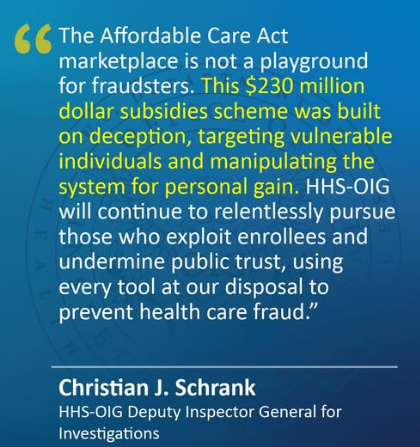
Lloyd and Strong ultimately sought more than $233 million in fraudulent ACA subsidies, according to evidence established at their trial.
The government paid at least $180 million.
Then the Consumer Reached the Call Center
Recruiting someone was only the beginning.
There was an obvious problem with many of the people the marketers found.
Their actual incomes did not qualify them for the subsidies being sought.
Federal prosecutors described what happened next.
The street marketer would connect the prospective enrollee with the insurance operation's call center.
According to the government's sentencing evidence, agents were trained to use leading questions designed to get consumers to agree that they would attempt to earn the minimum income required for the federal subsidy.
The government characterized the necessary income figure as the "magic number."
Agents were not determining what the consumer actually earned or genuinely expected to earn, prosecutors said.
The objective was to obtain agreement to the number and continue processing the enrollment.
That number could transform the application.
Someone with essentially no expected income could now appear on paper to have income just above the federal poverty threshold necessary for the desired ACA subsidy.
The Application Could Say Something Very Different From Reality
Income was not the only information manipulated.
Evidence at trial established that fraudulent applications included inaccurate or fictitious information, including addresses and, in some instances, Social Security numbers that did not match the purported applicant.
The later APSF case provides still more detail.
The Justice Department says APSF employees falsely represented that consumers would earn a minimum income just above the federal poverty line.
Why?
Because that could cause the government to pay the highest subsidy amount.
So a person found at a bus stop or treatment center could become an applicant whose federal records presented a materially different financial picture.
The consumer hadn't suddenly obtained a job.
The paperwork had changed.
Medicaid Created Another Obstacle
For some consumers, there was another problem.
They might qualify for Medicaid.
That was not necessarily useful to the insurance-enrollment operation.
Private ACA enrollment could generate commissions.
The federal record shows that the operation developed a way around the Medicaid problem.
According to the Justice Department, APSF employees knowingly submitted false information to Florida's Medicaid program to produce Medicaid denial letters.
Those denial letters could then be used as qualifying events allowing the person to enter a Special Enrollment Period and enroll in an ACA plan outside normal enrollment periods.
The government's sentencing memorandum in the Iza case describes step-by-step instructions designed to ensure consumers would be denied Medicaid—even when they otherwise might have qualified for it.
That maneuver did more than produce another insurance application.
It could change the consumer's healthcare.
A Medical Provider Sounded the Alarm
One of the most revealing records in the entire case came from a healthcare provider.
According to the federal government, while Lloyd was president of APSF, he received complaints from a provider about multiple homeless patients who had been given cash to sign up for ACA insurance.
The provider said all of them suffered from opioid addiction and had been desperate for money.
More troublingly, the provider reported that the individuals did not even realize they had the insurance until the provider attempted to obtain medications for them through a county program for uninsured patients.
The unexpected private insurance changed their situation.
The provider warned that the patients were now being asked to pay more than $500 per month for medications and said they were worse off than they had been without the private insurance.
That complaint goes to the heart of the scheme's human consequences.
A person could receive a few dollars for signing something.
The enrollment could generate commissions for others.
And the resulting insurance policy could interfere with the healthcare programs upon which that person had previously depended.
The Disruptions Involved Serious Medical Conditions
This was not simply a matter of receiving a different insurance card.
Federal prosecutors established that some consumers experienced serious disruptions in their existing medical care or prior coverage under Medicaid and other programs.
The government specifically identified risks involving treatment for:
opioid-use disorders,
mental-health disorders,
and serious infectious diseases.
Some consumers were placed at risk of losing access to what prosecutors described as life-saving treatment.
That makes the choice of recruiting locations particularly consequential.
Drug-treatment centers weren't merely places where marketers could find people.
They contained people who might already be receiving continuing medical treatment.
Changing their insurance could change how that treatment was paid for—or whether it remained accessible at all.
They Even Discussed Hurricane Shelters
The operation's search for potential enrollees extended beyond homeless populations and treatment facilities.
At trial, prosecutors introduced text messages between Strong and Lloyd discussing another place containing large numbers of vulnerable people:
Florida hurricane shelters.
Strong suggested sending street marketers into the shelters.
Lloyd enthusiastically agreed.
The remainder of the exchange contained crude language about exploiting the people there.
The significance of that conversation is difficult to dismiss.
A hurricane shelter contains people who may have just been displaced from their homes, lost property, evacuated communities or become temporarily dependent upon emergency assistance.
To the defendants, according to the evidence the jury heard, that concentration of vulnerable people represented another potential source of insurance enrollments.
The jury convicted both men in November 2025.
The Street Marketers Were Only the First Layer
The operation depended upon different people performing different jobs.
Street marketers located consumers.
Call-center personnel handled enrollments.
Insurance agents processed applications.
Other employees dealt with Medicaid and federal verification procedures.
And federal subsidies flowed to insurers after applications were approved.
APSF then received commissions, bonuses and other payments connected to consumers enrolled through the operation, according to the Justice Department.
That structure helps explain how the scheme reached such extraordinary scale.
It was not one person falsifying one application.
It was a pipeline.
And Federal Verification Didn't Stop It
Even after the applications entered government systems, there were supposed to be safeguards.
Federal authorities could ask for documentation to verify questionable information.
But prosecutors say the operation addressed that obstacle too.
According to the APSF criminal resolution, employees responded to inquiries from the Centers for Medicare & Medicaid Services by supplying additional false information, including false income information, to support the applications.
The initial misrepresentation therefore did not necessarily collapse when the government questioned it.
More information could be submitted to reinforce it.
That raises the next major question in this series.
How could a system administering billions of dollars in health-insurance subsidies accept applications for people whose reported financial circumstances did not reflect reality?
From a Bus Stop to a Federal Subsidy
Strip away the insurance terminology and the process becomes surprisingly simple.
A marketer could approach a vulnerable person.
A small incentive could persuade that person to participate or provide identifying information.
The person could be transferred to a call center.
An agent could obtain agreement to an income figure necessary for subsidy eligibility.
A Medicaid application could be manipulated to generate a denial.
An ACA application could then be submitted.
Federal verification inquiries could be answered with additional false information.
The insurer could receive the government subsidy.
And the insurance operation could receive commissions.
One person's difficult circumstances had been transformed into a revenue-producing transaction.
Lloyd and Strong are now serving 20-year federal sentences, subject to their pending appeals. APSF subsequently agreed to plead guilty for its own role in the scheme, with the agreement subject to court acceptance.
But the street marketers reveal something important about how a fraud of this size became possible.
The operation did not need to find thousands of people eager to commit a sophisticated federal insurance fraud.
It needed to find thousands of vulnerable people—and then build the sophisticated fraud around them.