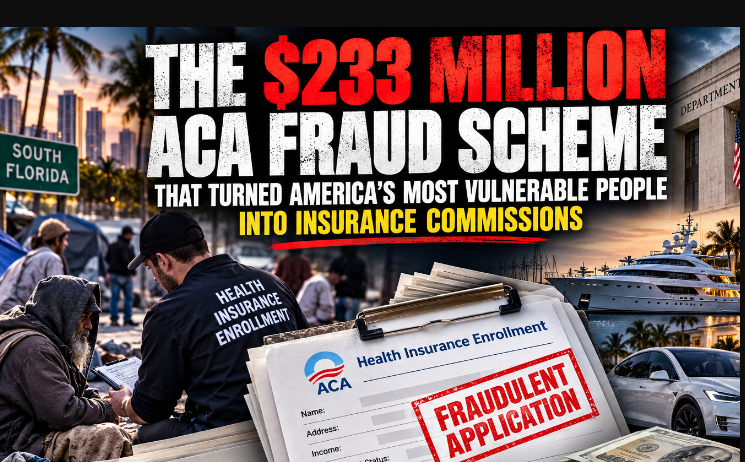

At first glance, it sounds like an unusual kind of victim.
Someone receives private health insurance without having to pay the monthly premium.
The federal government covers the cost.
How could that possibly hurt the person receiving it?
The answer is buried inside the federal prosecution of Cory Lloyd and Steven Strong and the subsequent case involving AP of South Florida LLC, which operated as Fiorella Insurance Agency.
For some of the vulnerable people swept into the $233 million Affordable Care Act enrollment fraud scheme, obtaining private insurance was not necessarily an improvement.
It could interfere with healthcare they already had.
Federal prosecutors proved at trial that some consumers experienced serious disruptions in medical care and often lost previous coverage under Medicaid or other programs after being improperly enrolled in subsidized ACA plans. Some were put at risk of losing access to treatment for opioid-use disorders, mental-health disorders and serious infectious diseases.
One medical provider described the consequences even more starkly.
Homeless patients with opioid addiction had allegedly been paid to enroll.
According to the provider, some did not even realize they had private insurance.
When the provider later tried to obtain their medications through a county program for uninsured patients, the newly discovered insurance became a problem.
The provider's conclusion was extraordinary:
The patients were now being asked to pay more than $500 per month for their medications and were worse off than when they had no private insurance.
The Scheme Needed People Who Qualified for Federal Money
The financial incentive behind the operation helps explain how this happened.
Affordable Care Act premium tax credits allow qualifying consumers to purchase private health insurance with the federal government paying some or potentially nearly all of the monthly premium.
For a legitimate enrollee, that subsidy can provide affordable access to private health insurance.
For the businesses involved in the fraud, prosecutors proved, those subsidized policies generated commissions.
Lloyd and Strong therefore needed consumers whose applications could be made to qualify for subsidies.
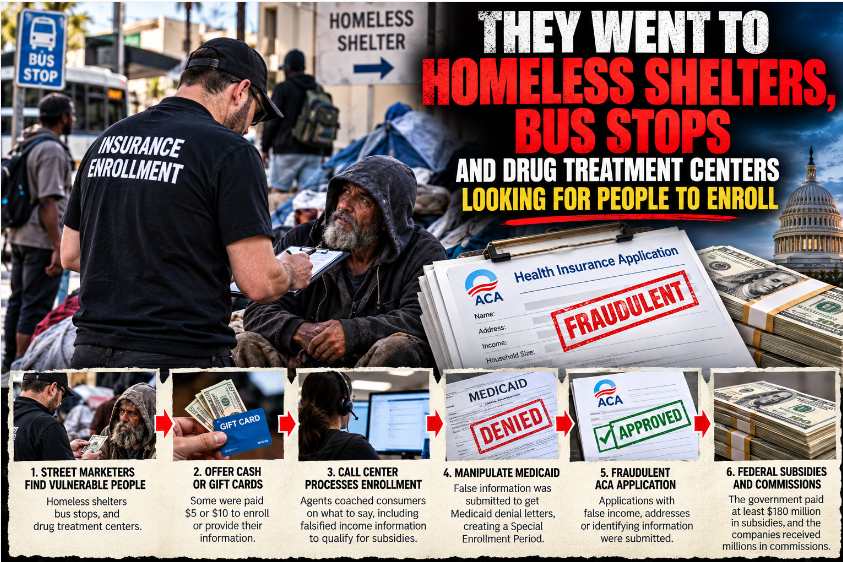
Street marketers targeted people experiencing homelessness, unemployment, mental-health problems and substance-use disorders. Some were offered money to participate.
But many of those people presented a problem.
They had little or no income.
And some already had access to Medicaid or other public assistance.
Those facts could prevent the particular ACA enrollment the operation wanted.
So, according to evidence established at trial, the system was manipulated.
They Engineered Medicaid Denials
This may be one of the most consequential parts of the entire scheme.
Federal prosecutors proved that Lloyd and Strong deliberately submitted thousands of Medicaid applications in a manner designed to guarantee their denial.
The denial served another purpose.
It could create a Special Enrollment Period that allowed the consumer to be enrolled in a fully subsidized ACA plan outside the normal annual enrollment window.
That meant the operation could continue generating enrollments—and commissions—throughout the year.
The later federal resolution involving APSF provides additional detail.
According to the government's civil settlement, APSF employees knowingly submitted Florida Medicaid applications containing false or unverified income information for the purpose of obtaining a Medicaid denial letter.
That denial letter could then be used to trigger a Special Enrollment Period for private ACA coverage.
This wasn't simply manipulating numbers on an insurance application.
For some people, it altered their healthcare coverage.
Some People Actually Lost Medicaid
The government's APSF settlement makes the consequence explicit.
As a result of the Medicaid-denial practice, federal authorities said certain individuals lost Medicaid coverage and received ACA insurance that did not provide coverage for their medical needs.
That sentence changes the way this fraud should be understood.
The federal government certainly lost money.
Insurance applications contained false information.
Businesses generated commissions.
But the people whose names appeared on those applications were not necessarily beneficiaries of the fraud.
Some lost something they already had.
Medicaid is not interchangeable with every private insurance policy.
A patient's doctors, medications, treatment program and cost-sharing obligations can depend upon the particular coverage involved.
Changing insurance can therefore change the practical availability of healthcare.
For someone undergoing continuous treatment, that disruption can be particularly serious.
One Provider Encountered the Problem Firsthand
The government says Lloyd received a warning while serving as president of APSF.
A medical provider contacted him about multiple patients who had been enrolled in ACA coverage.
The patients were homeless.
They had opioid addictions.
And according to the provider, they had been given cash to sign up.
The provider said the patients had been desperate for money.
Then came an even more troubling detail.
The provider said the patients were unaware they had insurance until an attempt was made to obtain their medications through a county hospital program for uninsured people.
The existence of private insurance was discovered during that process.
According to the provider, the patients were subsequently being asked to pay more than $500 per month for medications.
The provider wrote that the patients were worse off than they had been without insurance.
The government later relied upon that evidence in describing the scheme.
These Weren't People Shopping for Better Insurance
That context matters.
The operation did not merely persuade middle-class consumers to switch from one private insurance company to another.
Federal prosecutors established that the targeted population included people experiencing:
homelessness,
unemployment,
mental-health disorders,
and substance-use disorders.
Street marketers sometimes offered inducements to get people enrolled.
These could be people whose healthcare circumstances were already fragile.
A person receiving treatment for opioid addiction, for example, may depend upon continued access to medication and a particular treatment provider.
A person receiving psychiatric care may depend upon medication management and regular appointments.
Someone being treated for a serious infectious disease may require uninterrupted medication.
A disruption isn't necessarily an inconvenience.
It can interrupt an ongoing course of medical care.
Federal Prosecutors Specifically Identified Life-Saving Treatments
By the time Lloyd and Strong were sentenced in February 2026, the government had gone considerably further than saying some consumers experienced generic insurance problems.
The Justice Department said the fraudulent enrollments caused serious disruptions in medical care and previous Medicaid or other coverage.
The affected individuals were placed at risk of losing access to life-saving treatments for opioid-use disorders, mental-health disorders and serious infectious diseases.
That finding came after a jury trial.
Lloyd and Strong were convicted in November 2025, and each was subsequently sentenced to 20 years in federal prison and ordered to pay $180.6 million in restitution. They have appealed their convictions and sentences.
The patient consequences therefore are not simply allegations from the original indictment.
The government presented evidence of the scheme to a jury and obtained convictions.
The Government's Verification System Was Also Manipulated
There were supposed to be safeguards.
When information submitted for an ACA enrollment did not match government records, the Centers for Medicare & Medicaid Services could request additional verification.
But the APSF settlement says employees responded to those discrepancies by knowingly submitting additional false statements to CMS.
Those statements extended deadlines for resolving the inconsistencies and caused the federal government to continue paying subsidies.
So the government could identify a problem.
The operation could answer the problem with more information.
And according to the settlement, some of that additional information was itself false.
Meanwhile, the insurance remained active.
The Policy Was Valuable Even When It Wasn't Valuable to the Patient
This is perhaps the most revealing contradiction in the entire case.
A particular insurance policy could be financially valuable to nearly everyone involved in creating it while providing little or even negative value to the person whose name appeared on it.
The insurer could receive federally funded premium payments.
The brokerage could receive commissions, bonuses or other payments.
Referral sources could receive commissions.
The enrollment could generate revenue farther up the corporate structure.
But the consumer might lose Medicaid.
The consumer might discover that a medication was no longer affordable.
The consumer might not even know private insurance had been obtained.
The government's settlement says APSF received commissions, bonuses and other payments for ACA enrollments and that a significant portion of revenues from fraudulently obtained payments flowed to its parent corporation.
That means the financial success of an enrollment did not necessarily depend upon whether the insurance actually improved the consumer's healthcare.
It depended upon whether the enrollment produced a policy that generated payments.
$5 on One End, Hundreds of Millions on the Other
The contrast throughout this case is extraordinary.
Federal records describe vulnerable people being recruited on the street, sometimes for very small incentives.
Their identities then entered a system capable of generating enormous amounts of federal money.
By the conclusion of the Lloyd and Strong trial, prosecutors proved that the scheme sought more than $233 million in fraudulent ACA subsidies and caused the federal government to pay at least $180 million.
Their companies received millions in commissions.
Yet some of the people whose enrollments helped generate that money faced disruptions in their own medical treatment.
That makes the word "victim" unusually complicated in this case.
The taxpayers were victims.
The federal healthcare system was a victim.
But some of the people whose names appeared on the fraudulent applications were victims too.
They Were Supposed to Be the People Health Insurance Helped
The Affordable Care Act subsidy system exists because healthcare is expensive.
Medicaid exists because people with limited financial resources still need medical care.
Those systems serve different populations under different eligibility rules, but both are supposed to improve access to healthcare.
The scheme inverted that purpose.
According to the federal record, vulnerable people became tools for generating subsidized insurance enrollments.
Medicaid applications were manipulated to produce denials.
ACA applications were manipulated to obtain subsidies.
Government verification efforts were circumvented.
And commissions were generated.
Some consumers emerged from that process with insurance they did not qualify for.
Some experienced disruptions in the coverage they previously had.
Some faced risks to treatment for serious medical conditions.
The irony is difficult to miss.
The government spent enormous amounts of money supposedly purchasing healthcare coverage for these consumers.
Yet for some of the people whose identities generated those payments, the result wasn't better access to healthcare at all.
It was losing access to the care they already had.