You drive through an intersection.
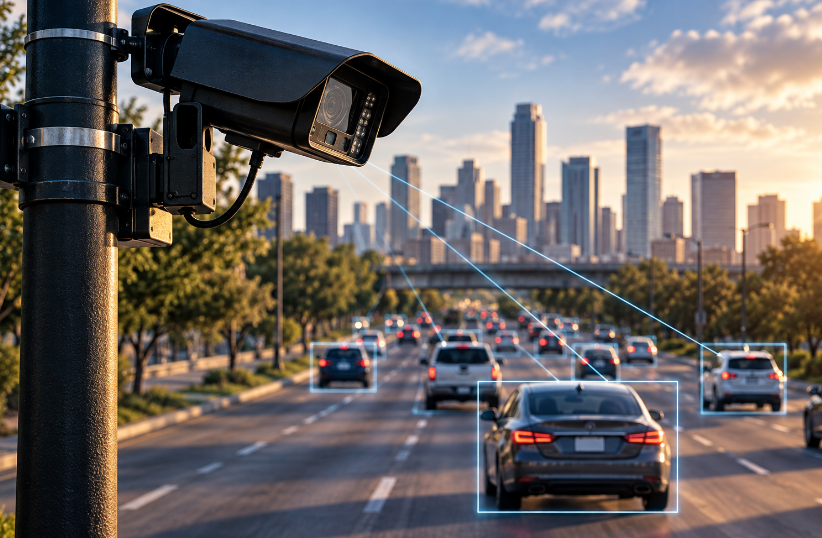
A camera mounted beside the road photographs your vehicle.
Then you keep driving.
For the driver, the encounter may be over almost immediately. There may be no flash, traffic stop or notification that anything happened.
For the data, however, the journey has just begun.
Automated license plate readers operated through systems such as Flock Safety don't simply produce photographs. They turn observations of vehicles into searchable records containing information that can potentially be retrieved later by an authorized user.
According to Flock's current policy, an LPR record can include a license-plate image, an image of the vehicle, vehicle characteristics such as color and make, the plate number and state, and the date, time and location of the camera.
That means the more interesting privacy question may begin after the car has disappeared from the camera's view.
Where does the information go?
Who can search it?
What can they search for?
Can another police department see it?
And when does it actually disappear?
The Photograph Becomes Data
A conventional photograph is something a person looks at.
An automated license plate reader is designed to make the photograph useful to a computer.
Flock describes an LPR as a combination of high-speed cameras and data processing that converts images of vehicles and plates into computer-readable information.
That distinction matters.
Imagine that investigators are looking for a white pickup truck seen near a burglary.
With traditional surveillance footage, an officer might have to locate cameras, obtain the recordings and manually watch hours of video.
A searchable LPR system can work differently.
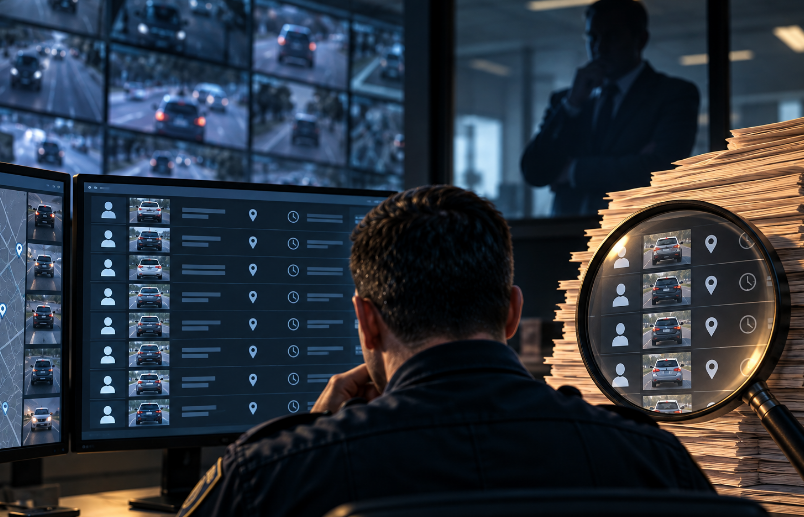
Flock says its users can search using a full or partial license plate and filter observations according to characteristics such as vehicle type, make and color. Its newer vehicle-search tools can also use vehicle characteristics when investigators don't have a visible plate.
The camera therefore isn't merely creating a photograph.
It is creating an entry in a database.
The Record Goes to the Cloud
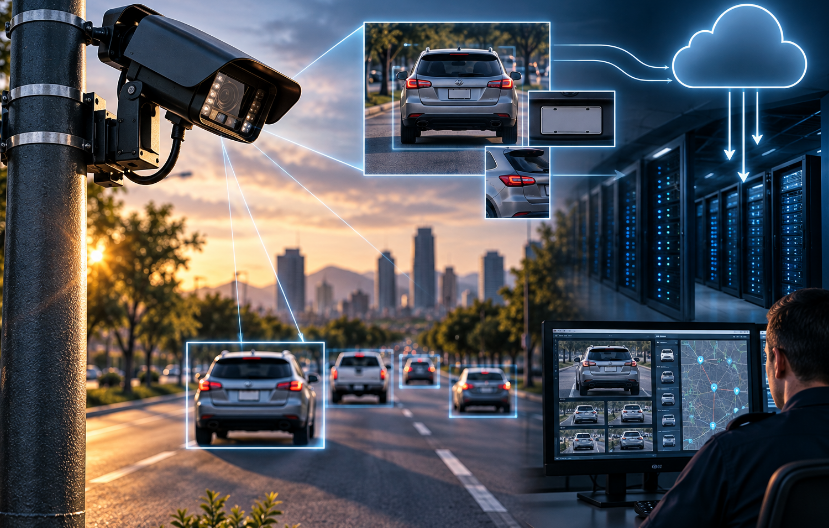
Flock's current LPR policy says information is stored briefly on the camera and then transferred to AWS Government Cloud infrastructure.
Once there, the observation can become part of an investigative search.
Suppose a camera records a vehicle at 8:42 p.m.
Nothing about the vehicle generates an alert at the time.
Three days later, detectives obtain information connecting that vehicle with a crime.
They may then be able to search historical observations and discover where the vehicle was previously recorded.
This reverses the sequence people traditionally associate with surveillance.
Police don't necessarily begin by deciding to watch a particular vehicle.
The observation can happen first.
The reason to search for it can come later.
That capability is one reason automated license plate readers have become valuable investigative tools—and one reason their use has generated privacy concerns.
The Database Doesn't Necessarily Require a Complete License Plate
A license plate is an obvious way to search vehicle records, but it isn't the only one.
Flock says its system can filter searches using characteristics including body type, make and color. Its Vehicle Signature technology is intended to help investigators identify vehicles even when a plate isn't visible.
Consider what that means operationally.
A witness might report:
A dark-colored SUV.
A particular body style.
A roof rack.
A partial license plate.
A particular area and approximate time.
Instead of manually reviewing every photograph captured around that time, investigators may be able to narrow the database to vehicles matching those characteristics.
That can make an enormous collection of photographs practically searchable.
And searchability is one of the characteristics that distinguishes modern surveillance databases from ordinary observation.
But Who Is Allowed to Search?
According to Flock, access isn't supposed to function like a public search engine.
The company says law-enforcement customers designate administrators and authorized users who can access their systems. Its current policies state that access is associated with individual user accounts and searches must have an investigative purpose.
More importantly, the searches themselves create records.
Flock says its audit information includes the username, date, time, purpose of the query and the plate or other information used for the search.
So an officer searching for a vehicle doesn't merely retrieve information.
The officer can also create another piece of information:
a record showing that the search occurred.
Flock says supervisors can review those logs to determine who searched the system and why.
That creates an important distinction between technological capability and authorized use.
A database may technically contain millions of observations.
Agency policy determines who is supposed to search them and for what purposes.
Sharing Can Make a Local Camera Much Less Local
A camera may belong to one police department, but that doesn't necessarily mean its information must remain inside that department.
Flock operates a connected network through which participating organizations can share vehicle information. The company says customers control whether and how their information is shared with other agencies.
According to Flock, sharing isn't automatic: an agency chooses its sharing settings and participating agencies may then receive access consistent with those settings.
That has significant consequences for understanding what a roadside camera represents.
A resident might see a camera belonging to a local police department and reasonably think of it as a local surveillance system.
Technically, however, the more important question may be:
What network can that camera participate in?
A collection of isolated cameras is one thing.
A collection of cameras whose observations can be searched across jurisdictions can be something substantially more powerful.
Flock describes its product as a connected LPR network operating across 49 states, while emphasizing that agencies control their own sharing arrangements.
Then the Clock Starts Running
Vehicle observations aren't necessarily retained indefinitely.
Flock made a significant change to its standard retention approach in 2026.
Its current LPR policy says the default retention period is seven days, after which data is hard-deleted on a rolling basis. The company says that period can be different when required by a customer's law or policy.
Flock's evidence policy similarly identifies seven days as its standard period but says customers may operate under different retention requirements. The company says longer retention of up to a year can be offered in certain circumstances after approval from an elected official or governing body.
Existing systems may therefore operate under retention periods different from the current default.
That is important because retention changes the power of the database.
Seven days of observations can answer one set of questions.
Thirty days can answer more.
A year could reveal considerably more.
The camera hasn't changed.
The difference is how far backward the database can look.
Deletion Doesn't Necessarily Mean Evidence From a Case Vanishes
There is another distinction that can easily get lost when discussing retention periods.
Routine LPR data and evidence preserved for an investigation aren't necessarily the same thing.
Flock says ordinary LPR information is permanently deleted after the applicable retention period. But it also offers mechanisms for preserving specific information associated with an active investigation.
That makes practical sense.
Imagine police identify a vehicle observation as important evidence in a homicide investigation on day five.
A seven-day general retention policy would be of little investigative value if the evidence necessarily disappeared two days later regardless of the case.
Instead, relevant information can be preserved as evidence while routine observations continue through their normal deletion cycle.
So saying that a system has a seven-day retention policy does not necessarily mean every copy of every observation disappears seven days after the camera captured it.
The treatment of information that has already been identified and preserved as evidence is a separate issue.
What About Someone Who Has Done Nothing Wrong?
This is where the privacy debate becomes more difficult.
Most vehicles photographed by a busy roadside camera will presumably have nothing to do with whatever crime police investigate next.
They belong to people driving to work.
Taking children to school.
Going to restaurants.
Visiting friends.
Driving home.
The system doesn't need to determine whether those drivers are suspicious before making the initial observation.
Their records can enter the same database because their vehicles passed the camera.
Flock emphasizes that its LPR system captures vehicle information rather than facial-recognition or biometric information and says it prohibits using the technology for tracking individuals or mass surveillance.
Privacy concerns nevertheless arise from what vehicle movements can reveal when enough observations are assembled.
A car isn't a person.
But people routinely use cars to travel between the places that make up their lives.
That is why the constitutional debate surrounding automated license plate readers focuses increasingly on aggregation rather than simply the existence of an individual photograph.
A Real Case Shows What the Database Can Look Like
The litigation surrounding Norfolk, Virginia's Flock system provides a useful example.
According to the Virginia Court of Appeals' 2026 decision in Robinson v. Commonwealth, Norfolk had installed 172 Flock cameras at public-road intersections.
The system captured still images of vehicles and stored information including the license plate number, vehicle color, manufacturer, model and identifying characteristics such as roof racks or bumper stickers.
At the time relevant to that case, Norfolk's system retained the information for 30 days.
Detectives could then search the database for particular vehicles at particular locations.
The court ultimately rejected Robinson's argument that police use of the Flock information in his case violated the Fourth Amendment.
But the factual description is useful even apart from the constitutional ruling.
It shows what happens between the camera and the courtroom.
A vehicle passes a camera.
An observation is created.
The observation enters a database.
Investigators later search that database.
A matching observation becomes an investigative lead.
And eventually that digital record can become evidence in a criminal prosecution.
Accuracy Matters Too
There is another reason to understand what happens after the photograph is taken.
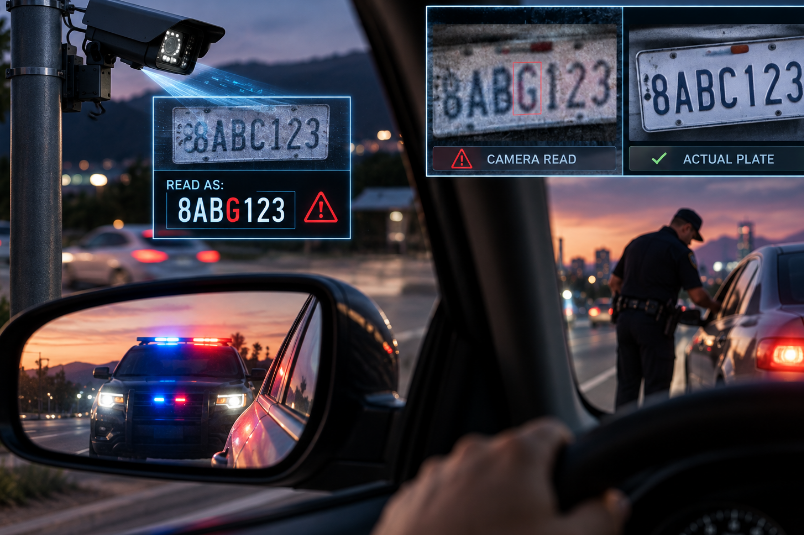
Computers can make mistakes.
Flock's own policy acknowledges that license-plate translation can occasionally be incomplete or inaccurate and instructs users to confirm the computer-generated translation before taking action based on an alert or search.
That safeguard matters because the consequences of a database match can extend far beyond the database.
An alert could contribute to an officer deciding to locate a vehicle.
A search result could become part of an investigation.
An observation could eventually appear in an affidavit, suppression hearing or criminal trial.
The original camera record therefore needs to be understood for what it is:
an investigative data point—not necessarily proof of who was driving the vehicle or what that person was doing.
The Most Important Part of the Camera May Be Invisible
People naturally focus on the hardware.
They notice the pole.
The camera.
The solar panel.
The lens pointing toward traffic.
But the physical camera may be the least complicated part of the system.
The more consequential infrastructure exists somewhere else:
The database.
The retention rules.
The search engine.
The user accounts.
The audit logs.
The sharing agreements.
The evidence-preservation system.
Those determine what can happen after a vehicle disappears down the road.
And they explain why the modern debate over automated license plate readers isn't really a debate about photography.
It is a debate about what computers can do with millions of photographs after they have been taken.
A camera sees a vehicle for a moment.
A database can remember it.
A search can find it again.
And as these networks continue to expand, the legal questions will increasingly concern not merely what cameras are permitted to see—but what government may do with what they remember.