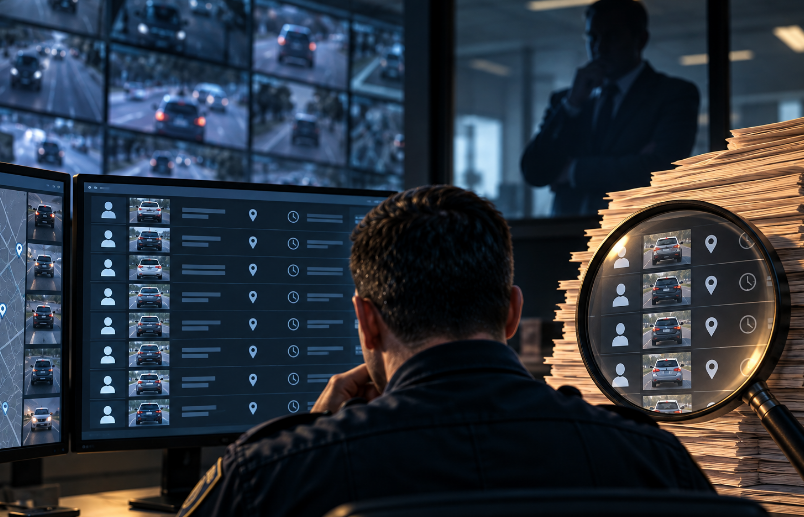
A police officer opens a computer and searches for a license plate.
The database may reveal where cameras have recently photographed the vehicle.
But the search creates another record at the same time.
The system records the officer.
Flock Safety says searches of its automated license plate reader system are tied to individual users and automatically logged. Its current materials say supervisors can review those records to determine who searched the system, when the search occurred and whether its use complied with agency policy.
It is an important safeguard.
But it raises a second question that has become increasingly significant as license-plate-reader networks have expanded across the country:
Who checks the people doing the searching?
An audit log can document activity.
It cannot review itself.
And events in several communities have demonstrated the difference between having an audit trail and actually auditing it.
The Database Can Watch Its Users
Modern surveillance systems present an unusual opportunity for oversight.
Unlike an officer simply observing a car on the street, a database search can leave a detailed electronic trail.
Flock says every search is associated with a specific user account. Searches must have an investigative purpose, and supervisors can review search histories. The company says agencies control their own access and sharing settings.
Flock has also said its audit reports permanently preserve searches and their stated reasons, including in the audit records of agencies whose cameras were included in a network search.
That means an agency can potentially reconstruct how its surveillance system has been used.
Who searched?
What did they search for?
When?
Why did they say they were searching?
Which cameras or agencies were involved?
Those records can become a powerful accountability mechanism.
But only if someone looks at them.
An Investigation Found Departments That Weren't Regularly Looking
In August 2026, The Washington Post reported the results of an investigation into misuse of automated license-plate-reader systems.
The newspaper identified at least 69 police officials who had been accused, charged or convicted of misusing Flock or other license-plate-reader systems.
In at least 15 of those cases, according to the Post, the suspected misuse was initially identified by someone outside the officer's department—including journalists, activists and alleged victims.
The newspaper then examined publicly available information and identified three police employees whose search histories showed indications of potential misuse.
According to the Post, all three departments acknowledged that they had not been regularly auditing employee use of the system.
The newspaper's inquiries prompted investigations involving all three employees and disciplinary measures against two.
That revealed a weakness that has little to do with the camera itself.
The audit records existed.
The problem was whether anyone was routinely examining them.
A Search Reason Isn't Necessarily an Investigation
Requiring users to explain why they're searching sounds straightforward.
An officer searches a plate.
The system asks for the reason.
The officer provides it.
The search proceeds.
But an accountability system is only as useful as the information entered into it and the review that follows.
Flock says its platform has evolved to require standardized offense categories and uses other search safeguards designed to enforce legal and agency restrictions.
The company has also emphasized that every query is associated with an individual account rather than a shared login.
Those controls can make inappropriate activity easier to identify.
They do not make inappropriate activity impossible.
A user with legitimate access to a powerful database can still attempt to use that access improperly.
That isn't a problem unique to Flock.
It is a recurring issue with databases containing sensitive information.
The central security question often isn't simply:
Can an unauthorized person break into the system?
It is:
What prevents an authorized person from using legitimate access for an unauthorized purpose?
Costa Mesa Confronted That Question
That issue became concrete in Southern California in 2026.
The Costa Mesa City Council called for an in-depth audit of the police department's automated license-plate-reader program after a misuse case involving a police officer.
At the time, more than 40 Flock cameras were operating in the city.
The episode prompted city officials and residents to examine not merely whether the technology could help solve crimes, but whether existing oversight was sufficient to detect improper searches.
That distinction matters.
A police department can have a rule prohibiting personal searches.
A technology company can record every search.
But neither fact establishes that violations will be discovered promptly.
Detection requires another step.
Someone has to examine the records.
California Discovered Another Problem: Who Else Was Searching?
Audit records have also revealed problems involving data sharing, rather than individual officer misuse.
In June 2026, San Francisco police disclosed the results of an audit of the city's automated license-plate-reader system.
The department reported that outside and federal agencies had improperly queried San Francisco's ALPR data nearly 300 times over roughly a year.
Police said those queries represented approximately 0.005 percent of all searches during the period. The department also reported that its review found no searches involving immigration enforcement or reproductive-rights investigations.
The percentage was tiny.
The discovery was nevertheless important.
California places statutory restrictions on sharing ALPR information with out-of-state and federal agencies, and San Francisco's audit showed that access had occurred contrary to those restrictions.
Once again, the audit trail did something important.
It made it possible to look backward and determine what had happened.
Flock Acknowledged Problems With California Sharing
Flock itself has acknowledged that some California agencies experienced unintended sharing.
In March 2026, the company said its review of agency audit logs showed that some California law-enforcement camera networks—including Ventura County's—had been inadvertently accessible to out-of-state law-enforcement agencies during a period in 2025.
Flock said earlier limitations in technical logging meant that in some instances it was impossible to determine exactly how the sharing occurred. The company announced additional California-specific safeguards intended to prevent unauthorized out-of-state access.
That episode demonstrates another important characteristic of surveillance oversight.
Logging improves accountability, but the quality of the logging matters too.
A record that says exactly who accessed data, under which authorization, through which agency and for what reason can make an incident reconstructable.
Missing or incomplete records can leave questions that cannot be answered later.
The Federal Question Became Complicated Too
Flock has repeatedly stated that it does not have a contract with U.S. Immigration and Customs Enforcement and that ICE does not have direct access to Flock cameras or customer data.
The company says federal access is disabled by default and that local agencies control whether they establish permitted sharing relationships.
But the broader history of federal involvement has been more complicated.
Flock disclosed that it previously conducted pilot programs involving several federal agencies, including the FBI, ATF, Naval Criminal Investigative Service, Homeland Security Investigations and Customs and Border Protection. According to the company's published timeline, those pilot programs have ended, and Flock announced in 2025 that it would no longer conduct federal-agency pilots.
Flock has also acknowledged that some of its earlier public statements concerning federal relationships contained inaccurate information. In August 2025, the company said it had conducted limited CBP and HSI pilots related to human trafficking and fentanyl investigations.
None of that establishes that ICE itself has unrestricted access to local Flock data.
Flock says it does not.
Instead, it illustrates why the details of who can access which agency's data, under which sharing arrangement, have become central to the public debate.
Local Control Can Be Powerful—and Complicated
Flock's position is that its customers own and control their data.
The company says it doesn't sell customer data and doesn't independently decide to share an agency's information with another agency.
That places substantial responsibility on local government.
A police department may decide:
Who receives accounts.
What searches are permitted.
Whether other agencies receive access.
What restrictions apply.
How often audit logs are reviewed.
What happens when an employee violates the rules.
This decentralization means two cities using essentially the same cameras can operate them under substantially different policies.
One city might perform frequent supervisory audits.
Another might examine logs only after receiving a complaint.
One might permit broad interagency sharing.
Another might restrict access to its own investigators.
The hardware can be identical.
The oversight can be completely different.
There Are Really Two Kinds of Surveillance Here
The obvious surveillance occurs on the road.
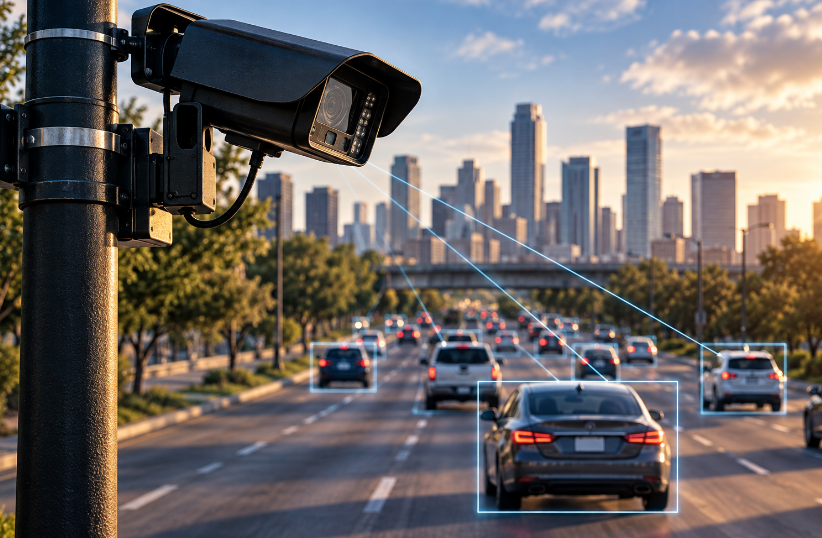
The camera watches vehicles.
But another kind occurs inside the system.
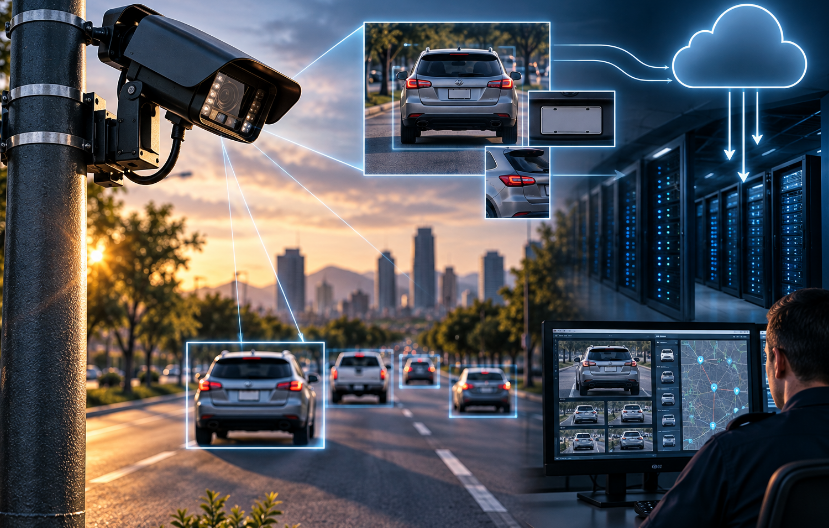
The database watches its users.
That second form of surveillance may become increasingly important.
Imagine an agency conducting an automated review every month.
Software could potentially identify officers who repeatedly search the same vehicle without corresponding case activity.
It could flag unusual search patterns.
It could identify queries made outside normal assignments.
It could reveal repeated searches involving acquaintances or coworkers.
It could identify agencies accessing information they weren't authorized to receive.
The same computing power that makes a massive vehicle database searchable can also make its audit trail searchable.
The question becomes whether agencies use that capability.
The Difference Between Logging and Auditing
These two concepts sound similar but they are fundamentally different.
Logging means creating a record.
Auditing means examining the record.
A security camera can record a hallway for years.
If nobody reviews the recording after something happens, the existence of the camera didn't necessarily prevent the event.
Database logs work similarly.
A system might preserve every query perfectly.
But unless searches are reviewed systematically—or automatically analyzed for unusual activity—misuse can remain invisible.
The 2026 Washington Post investigation highlighted precisely that concern: some departments were not routinely reviewing employee activity even though the system produced records capable of supporting that review.
Transparency Creates Another Difficult Question
If the public wants to know whether a surveillance system is being used appropriately, audit logs may contain some of the best evidence.
But releasing them can create competing concerns.
Logs can contain license plates.
They may reveal active investigations.
They can identify officers.
They can expose investigative techniques.
They may contain information concerning victims or suspects who were never charged with crimes.
That means public disclosure isn't necessarily as simple as posting every search online.
Huntsville, Alabama, confronted that conflict in September 2026 as residents sought access to Flock audit records and police resisted broad disclosure. The controversy centered on whether the public could meaningfully evaluate the system's use without access to records showing why searches were conducted.
The problem presents two legitimate interests that can pull in opposite directions:
Oversight requires information.
Investigations sometimes require confidentiality.
How governments balance those interests is increasingly becoming part of the surveillance debate.
Technology Can't Decide Whether Its Own Use Is Appropriate
Flock has continued adding technical safeguards.
The company says its system now includes search filters designed to prevent queries associated with uses prohibited by applicable laws or agency policies.
It requires individual authentication.
It logs searches.
It provides audit capabilities.
It has added jurisdiction-specific controls.
Those measures can make abuse more difficult and detection easier.
But ultimately, a computer cannot answer every oversight question.
An officer may have authority to investigate a crime but still conduct an unnecessarily broad search.
A technically permitted data-sharing arrangement might conflict with community expectations.
An unusual search might have an entirely legitimate explanation.
A seemingly routine search might conceal an improper purpose.
Human judgment remains part of the system.
And so does institutional oversight.
The Cameras Watch the Road. Someone Still Has to Watch the Cameras.
The debate over automated license-plate readers often begins with the people whose vehicles are photographed.
That is understandable.
Millions of ordinary drivers can pass these cameras without being suspected of any crime.
But once a surveillance database exists, another group deserves attention:
the people who can search it.
A well-designed audit system can make those searches unusually visible.
It can identify the user.
Record the time.
Preserve the reason.
Document the query.
And potentially show which agencies accessed the information.
That is a substantial accountability tool.
But an audit trail isn't accountability by itself.
It is evidence from which accountability can occur.
The distinction may become increasingly important as automated surveillance expands.
The first generation of the debate asked:
Who is being watched?
The next may increasingly ask:
Who is watching the watchers?